Chemistry • Year 12 • Module 8 • Lesson 13
Optical Isomerism & Chirality in Medicines
Lock in the core vocabulary: chiral centres, enantiomers, racemic mixtures, optical activity and their roles in pharmacology.
1. Label the chirality concept diagram
The diagram below shows two mirror-image molecules and a polarimeter setup. Write the missing labels into boxes A–H. Each label comes from the Key Terms in Lesson 13. 8 marks
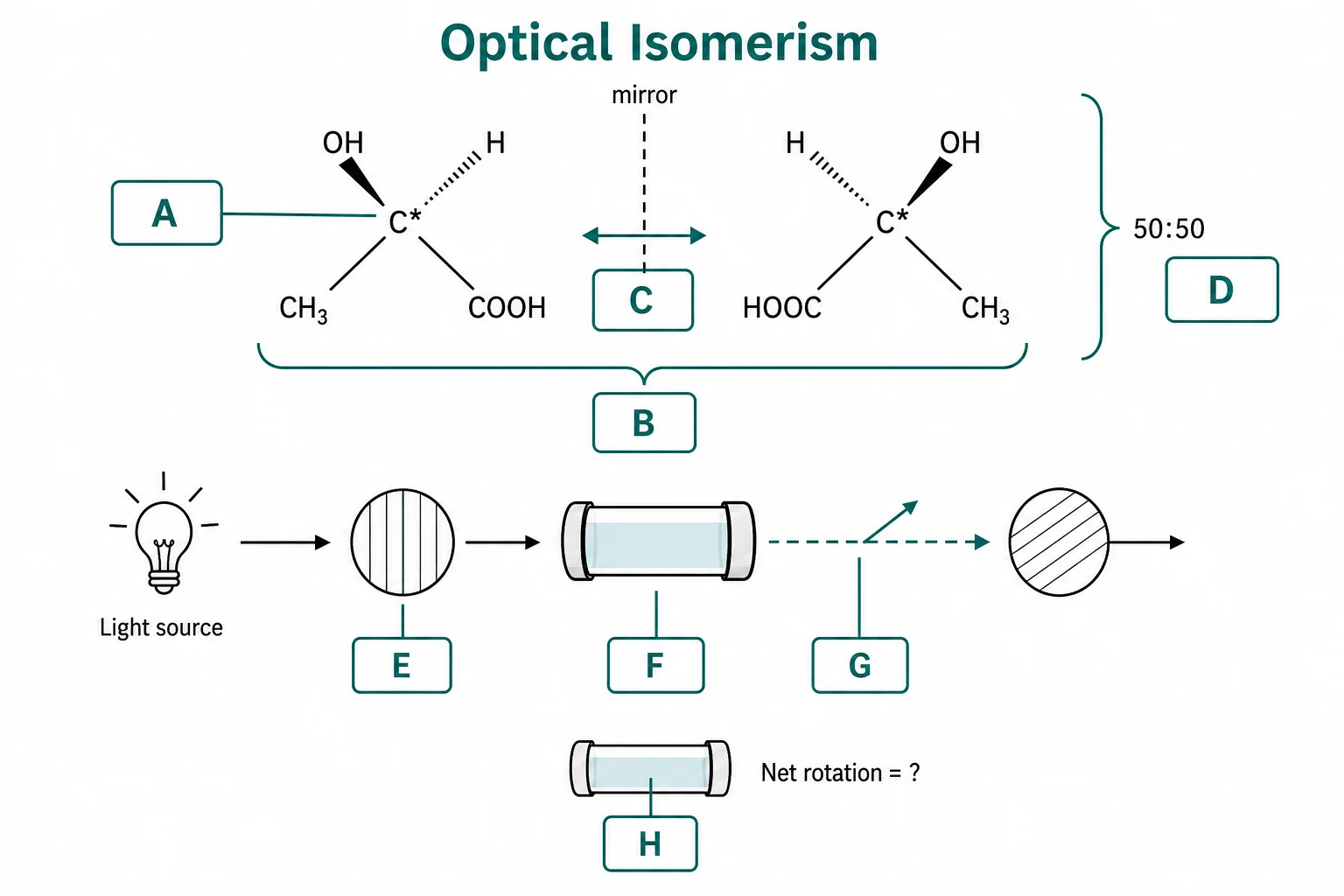
- A — the central carbon labelled C* (what type of carbon is this?) ___________________________
- B — the relationship between the two molecules on each side of the mirror ___________________________
- C — a word describing that the two mirror images cannot be placed on top of each other ___________________________
- D — a 50:50 mixture of both structures would be called a ___________________________ mixture
- E — the instrument shown below the molecules (measures rotation of light) ___________________________
- F — the property of a pure enantiomer that makes it rotate plane-polarised light ___________________________
- G — what the analyser measures (the angle of ___________________________)
- H — if the sample were a 50:50 racemic mixture, the net rotation would be ___________________________ (value)
| Box | Your label |
|---|---|
| A | |
| B | |
| C | |
| D | |
| E | |
| F | |
| G | |
| H |
2. Term–definition match
Ten definitions are listed in shuffled order below. In the right-hand column, write the matching term from this list: chiral centre, enantiomers, optical activity, racemic mixture, non-superimposable, plane-polarised light, polarimetry, biological specificity, R-enantiomer, S-enantiomer. 10 marks
| # | Definition (shuffled) | Matching term |
|---|---|---|
| 2.1 | A carbon atom bonded to four different substituents; creates two possible three-dimensional arrangements. | |
| 2.2 | A pair of stereoisomers that are mirror images of each other but cannot be superimposed on one another. | |
| 2.3 | The ability of a chiral molecule to rotate the plane of polarised light; detected using a polarimeter. | |
| 2.4 | A 50:50 mixture of both enantiomers of a chiral compound; shows no net rotation of plane-polarised light. | |
| 2.5 | Describing two mirror images that cannot be overlaid exactly, no matter how they are rotated. | |
| 2.6 | Light vibrating in one plane only, used in optical rotation measurements. | |
| 2.7 | An instrument that measures the rotation of plane-polarised light by a chiral sample. | |
| 2.8 | The property of enzymes and receptors that allows them to distinguish between mirror-image molecules; only one enantiomer is typically active or safe. | |
| 2.9 | The designation applied to the thalidomide enantiomer associated with sedative effects in the original drug. | |
| 2.10 | The designation applied to the thalidomide enantiomer associated with teratogenic effects. |
3. True or false — with correction
Circle T or F. If the statement is false, write the corrected version on the line provided. 8 marks (1 for T/F, 1 for correction where needed)
3.1 A chiral centre is any carbon atom in an organic molecule. T / F
3.2 Enantiomers are non-superimposable mirror images of each other. T / F
3.3 A racemic mixture rotates plane-polarised light significantly because it contains a chiral compound. T / F
3.4 Enantiomers always have identical biological activity because they contain the same atoms and bonds. T / F
4. Function recall
Answer each question in 1–2 sentences using precise lesson terms. 10 marks (2 each)
4.1 What structural feature must a carbon have to be described as a chiral centre?
4.2 What is the function of a polarimeter in investigating a chiral drug sample?
4.3 Why do biological receptors and enzymes care about molecular chirality?
4.4 What is a racemic mixture, and what is its optical rotation?
4.5 Why did the use of thalidomide as a racemic mixture lead to birth defects?
5. Fill the blanks — chirality in medicines
Complete the passage using the words in the box below. Each word is used once. 8 marks
Word bank: chiral centre • enantiomers • racemic • teratogenic • sedative • optically active • biological specificity • enantiopure
Thalidomide contains a _______________________ — a carbon bonded to four different groups. This gives rise to a pair of _______________________ that are non-superimposable mirror images. The original drug was sold as a _______________________ mixture containing equal amounts of both enantiomers. The R-enantiomer acted as a _______________________, whereas the S-enantiomer was _______________________, causing birth defects. This is possible because of _______________________— enzymes and receptors recognise the three-dimensional arrangement of molecules and respond differently to each enantiomer. A pure solution of one enantiomer is _______________________ because it rotates plane-polarised light. Modern drug development therefore prefers _______________________ drugs where the pharmacologically active form can be isolated.
Q1 — Labelled diagram
A: chiral centre (stereogenic centre / C*). B: enantiomers. C: non-superimposable. D: racemic. E: polarimeter. F: optical activity. G: rotation. H: zero (0°).
Q2 — Term–definition matches
2.1 chiral centre • 2.2 enantiomers • 2.3 optical activity • 2.4 racemic mixture • 2.5 non-superimposable • 2.6 plane-polarised light • 2.7 polarimetry • 2.8 biological specificity • 2.9 R-enantiomer • 2.10 S-enantiomer.
Q3 — True / False
3.1 False. A chiral centre is a carbon bonded to four different substituents — not any carbon atom.
3.2 True.
3.3 False. A racemic mixture shows zero net rotation because the equal amounts of the two enantiomers rotate light in opposite directions and cancel out.
3.4 False. Biological environments are chiral; enzymes and receptors can distinguish enantiomers, so they can have very different biological activities even if their physical properties in non-chiral settings are similar.
Q4.1 — Chiral centre structure
A carbon atom must be bonded to four different groups (substituents) to be a chiral centre. This creates two possible non-superimposable three-dimensional arrangements.
Q4.2 — Polarimeter function
A polarimeter passes plane-polarised light through the drug sample and measures the angle by which it is rotated. This tells the analyst whether the sample is optically active (a pure enantiomer or an unequal mixture) or optically inactive (a racemic mixture).
Q4.3 — Why receptors care about chirality
Biological receptors and enzymes are themselves chiral macromolecules. Their three-dimensional binding sites fit one enantiomer but not its mirror image, just as a left glove fits a left hand but not a right hand. So one enantiomer of a drug may bind well while the other does not.
Q4.4 — Racemic mixture and optical rotation
A racemic mixture is a 50:50 mixture of both enantiomers of a chiral compound. Its net optical rotation is zero because the clockwise rotation of one enantiomer exactly cancels the anticlockwise rotation of the other.
Q4.5 — Thalidomide racemic mixture
In the lesson framing, the S-enantiomer of thalidomide is teratogenic (causes birth defects), while the R-enantiomer is sedative. Selling the drug as a racemic mixture meant patients received both enantiomers, including the teratogenic S-form, causing birth defects in babies of pregnant women who took the drug.
Q5 — Cloze answers (in order)
chiral centre • enantiomers • racemic • sedative • teratogenic • biological specificity • optically active • enantiopure.