Chemistry • Year 12 • Module 8 • Lesson 11
Drug Classification & Functional Groups
Lock in the vocabulary, the major drug categories, and the key functional groups found in aspirin, paracetamol, ibuprofen and penicillin.
1. Label the functional group overview diagram
The diagram below shows the six key functional groups that appear most often in drug molecules studied in this course, with blank label boxes A–F. Write the correct functional group name and notation (e.g. −COOH) for each box. 6 marks
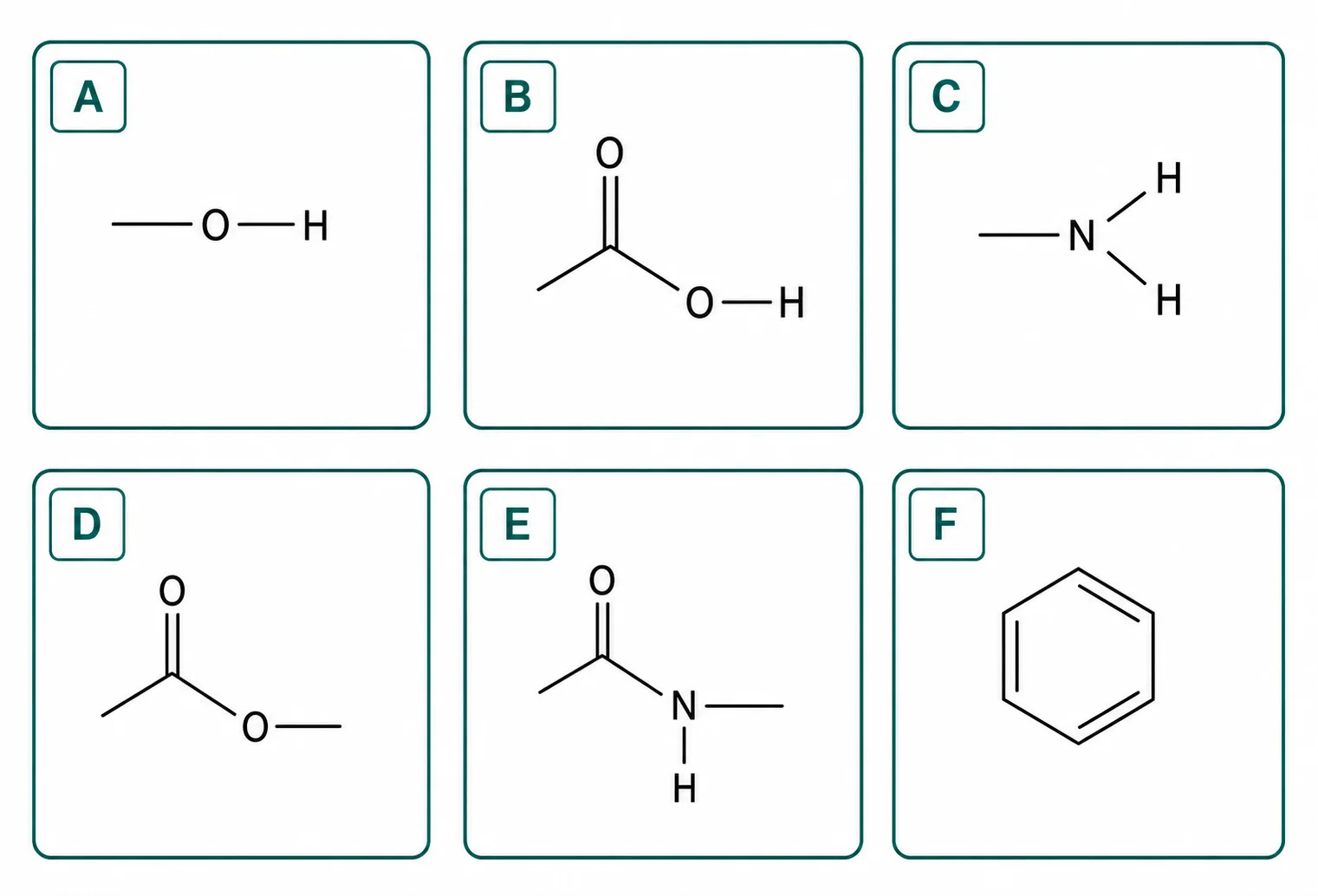
- A — functional group name + notation: _______________________
- B — functional group name + notation: _______________________
- C — functional group name + notation: _______________________
- D — functional group name + notation: _______________________
- E — functional group name + notation: _______________________
- F — functional group name + notation: _______________________
2. Term–definition match
The twelve definitions below are shuffled. In the right-hand column write the matching term from this list: analgesic, antibiotic, anti-inflammatory, antacid, local anaesthetic, pharmacophore, functional group, structure–activity relationship (SAR), carboxylic acid, amide, ester, phenol. 12 marks
| # | Definition (shuffled) | Matching term |
|---|---|---|
| 2.1 | A pain-relieving medicine; examples include aspirin, paracetamol and morphine. | |
| 2.2 | A medicine that kills or inhibits the growth of bacteria; examples include penicillin and amoxicillin. | |
| 2.3 | A medicine that reduces the body’s inflammatory response; examples include ibuprofen and cortisol. | |
| 2.4 | A basic substance taken orally to neutralise excess hydrochloric acid in the stomach. | |
| 2.5 | A medicine that reduces the body’s inflammatory response by suppressing the immune system’s reaction; examples include ibuprofen. | |
| 2.6 | The specific part of a drug molecule responsible for its biological activity through interaction with a receptor. | |
| 2.7 | A specific arrangement of atoms with characteristic chemical properties that recurs in a range of molecules. | |
| 2.8 | The relationship between the chemical structure of a drug and its biological effect; guides medicinal design. | |
| 2.9 | The functional group −COOH; present in aspirin and ibuprofen; responsible for acidic behaviour. | |
| 2.10 | The functional group −CONH− (or −CO−NH−); present in paracetamol and penicillin; strongly polar. | |
| 2.11 | The functional group −COO−; present in aspirin; can undergo hydrolysis; formed from carboxylic acid + alcohol. | |
| 2.12 | An aromatic hydroxyl group −OH attached directly to a benzene ring; present in paracetamol; weakly acidic. |
3. True or false — with correction
For each statement, circle T or F. If the statement is false, write the corrected version on the line below. 10 marks (1 for T/F, 1 for correction where needed)
3.1 Aspirin contains both an ester and a carboxylic acid functional group. T / F
3.2 Paracetamol is classified as an antibiotic because it kills bacteria by inhibiting cell-wall synthesis. T / F
3.3 The carboxylic acid group (−COOH) is responsible for the acidic behaviour of ibuprofen in aqueous solution. T / F
3.4 Two medicines that share the same functional group must have identical pharmacological effects. T / F
3.5 A pharmacophore is defined as the entire drug molecule, including all functional groups and the hydrocarbon backbone together. T / F
4. Function recall
Answer each question in 1–2 sentences using precise terms from the lesson. 8 marks (2 each)
4.1 What is the functional role of the carboxylic acid group (−COOH) in determining the chemical behaviour of aspirin?
4.2 Why does paracetamol have different polarity and hydrogen-bonding characteristics compared with ibuprofen?
4.3 What is the functional role of a pharmacophore in a drug molecule?
4.4 Why are antacids chemically different from organic drug molecules such as aspirin, paracetamol and ibuprofen?
5. Cloze — fill the blank paragraph
Use the word bank to complete the paragraph. Each term is used once only. 8 marks
Aspirin is classified as an because it relieves pain. Its molecular structure contains two functional groups: a group, which is responsible for the molecule’s acidic behaviour, and an linkage. Paracetamol, by contrast, contains an group that contributes to its strong and hydrogen-bonding capacity. The key structural feature that produces a drug’s biological activity is called the . A drug must bind to a biological for shape, polarity and functional group features to all be complementary. The study of how molecular structure determines biological effect is called the .
Q1 — Labelled diagram
A: hydroxyl (−OH). B: carboxylic acid (−COOH). C: amine (−NH2). D: ester (−COO−). E: amide (−CONH− or −CO−NH−). F: aromatic ring (benzene ring / phenyl group).
Q2 — Term–definition matches
2.1 analgesic • 2.2 antibiotic • 2.3 anti-inflammatory • 2.4 antacid • 2.5 local anaesthetic • 2.6 pharmacophore • 2.7 functional group • 2.8 structure–activity relationship (SAR) • 2.9 carboxylic acid • 2.10 amide • 2.11 ester • 2.12 phenol.
Q3 — True / false with correction
3.1 True. Aspirin contains both an ester group and a carboxylic acid group.
3.2 False. Correction: paracetamol is classified as an analgesic (pain reliever), not an antibiotic. Penicillin is an antibiotic that inhibits bacterial cell-wall synthesis.
3.3 True. The −COOH group donates a proton to water, making ibuprofen a weak acid in aqueous solution.
3.4 False. Correction: pharmacological activity depends on the specific 3D shape of the pharmacophore and receptor binding site, not just functional group identity. Molecules sharing the same functional group can have very different biological effects.
3.5 False. Correction: a pharmacophore is the specific part of a drug molecule responsible for its key biological activity — usually a particular arrangement of functional groups and shape features that interact with the receptor. It is not the whole molecule.
Q4.1 — Role of −COOH in aspirin
The carboxylic acid group (−COOH) in aspirin makes the molecule weakly acidic because the −COOH can donate a proton (H+) to water. This group also increases polarity and contributes to hydrogen-bonding capacity, affecting solubility and biological interactions.
Q4.2 — Polarity difference: paracetamol vs ibuprofen
Paracetamol contains a phenolic −OH and an amide group (−CONH−), both of which are strongly polar and capable of hydrogen bonding. Ibuprofen contains a carboxylic acid but a much larger hydrocarbon (non-polar) region, giving it more mixed character — less polar overall than paracetamol relative to molecular size.
Q4.3 — Role of the pharmacophore
The pharmacophore is the specific arrangement of features in a drug molecule responsible for the key interactions that produce biological activity. It is the part of the molecule that binds to the receptor site, meaning shape, polarity and functional group identity all matter at this critical region.
Q4.4 — Antacids vs organic drugs
Most antacids (e.g. magnesium hydroxide, sodium bicarbonate, calcium carbonate) are inorganic bases. Their mode of action is a simple acid–base neutralisation reaction with hydrochloric acid, not receptor binding through an organic pharmacophore. This distinguishes them chemically from aspirin, paracetamol and ibuprofen, which act via organic functional groups interacting with specific biological targets.
Q5 — Cloze answers (in order)
analgesic • carboxylic acid • ester • amide • polarity • pharmacophore • receptor • structure–activity relationship.