Chemistry • Year 12 • Module 8 • Lesson 10
Water Treatment Processes
Lock in the vocabulary, the stage sequence, and the key chemical reactions in drinking water treatment, disinfection chemistry and desalination.
1. Label the drinking-water treatment train
The diagram below shows the seven main stages a NSW drinking-water treatment plant uses to convert raw dam water into safe drinking water. Write the correct stage name into each box A–G. Use the word bank below. 7 marks
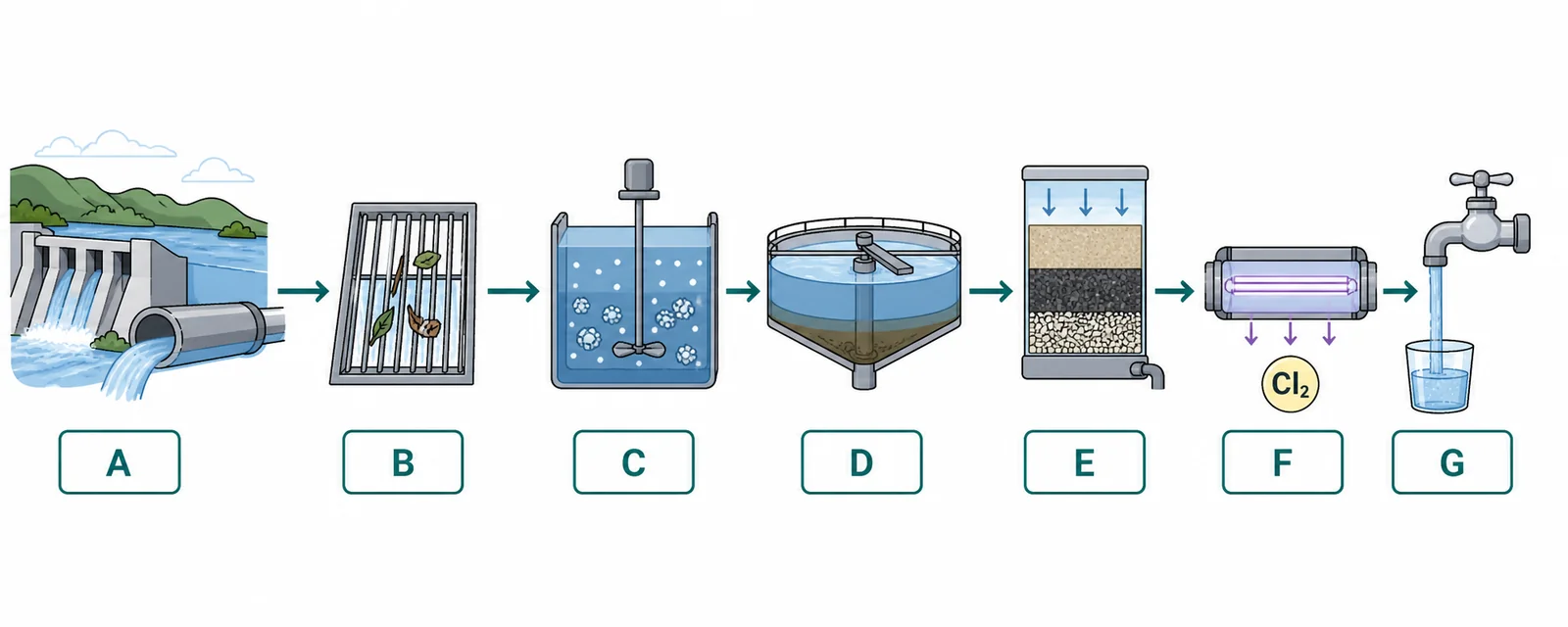
Word bank: coagulation/flocculation • disinfection • distribution • filtration • raw water intake • screening • sedimentation
- A — ___________________________________________
- B — ___________________________________________
- C — ___________________________________________
- D — ___________________________________________
- E — ___________________________________________
- F — ___________________________________________
- G — ___________________________________________
2. Term–definition match
Write the matching term from the list into the right-hand column. Terms: activated carbon, alum, chloramines, coagulation, desalination, disinfection by-products (DBPs), flocculation, hypochlorous acid (HOCl), fluoridation, reverse osmosis (RO), sedimentation, trihalomethanes (THMs). 12 marks
| # | Definition | Your answer |
|---|---|---|
| 2.1 | Addition of Al₂(SO₄)₃ to water to neutralise particle charges and begin clump formation. | |
| 2.2 | Gentle mixing after coagulant addition that encourages small destabilised particles to collide and grow into larger clumps called flocs. | |
| 2.3 | The gravity-driven settling of heavy flocs out of the water column in a large quiescent tank. | |
| 2.4 | The more active disinfecting species produced when Cl₂ dissolves in water; dominant at lower pH. | |
| 2.5 | A high-surface-area filter medium that adsorbs dissolved organic compounds affecting taste, odour and disinfection. | |
| 2.6 | Unwanted compounds formed when chlorine reacts with natural organic matter in water; include THMs. | |
| 2.7 | A class of halogenated DBPs (e.g. chloroform, CHCl₃) associated with chlorination of organic matter. | |
| 2.8 | Disinfectants formed by reacting chlorine with ammonia; produce fewer DBPs than free chlorine but disinfect more slowly. | |
| 2.9 | Membrane process that forces water through a semi-permeable barrier under high pressure, removing dissolved salts; energy-intensive. | |
| 2.10 | The removal of dissolved salts from seawater or brackish water to produce fresh drinking water. | |
| 2.11 | Common name for aluminium sulfate Al₂(SO₄)₃, the most widely used coagulant in NSW water treatment. | |
| 2.12 | Addition of fluoride (NaF or Na₂SiF₆) at ~0.6–1.1 mg L⁻¹ to drinking water to reduce dental caries; practised across all major NSW reticulated supplies. |
3. True or false — with correction
Circle T or F. If false, write the corrected statement on the line below. 8 marks (1 T/F, 1 correction where needed)
3.1 Coagulation with alum is primarily a disinfection step that kills pathogens. T / F
3.2 HOCl is the more active chlorinating species compared with OCl⁻. T / F
3.3 As pH rises above 7.5, a higher proportion of dissolved chlorine exists as HOCl, increasing disinfection effectiveness. T / F
3.4 Reverse osmosis removes dissolved salts from water but has a significant energy cost and produces a concentrated brine waste stream. T / F
4. Function recall
Answer each in 1–2 sentences using precise chemical terms. 8 marks (2 each)
4.1 What is the chemical function of Al²⁺ ions produced by dissolving alum in water?
4.2 Why is removing dissolved organic matter before chlorination chemically important?
4.3 What advantage do chloramines have over free chlorine for a large water distribution network?
4.4 What is the purpose of fluoridation in drinking water treatment, and at what concentration is fluoride typically added in NSW?
5. Cloze — complete the passage
Fill in each blank using the word bank. Use each word once. 10 marks
Word bank: Al(OH)₃ • activated carbon • brine • coagulation • disinfection • flocs • HOCl • OCl⁻ • pH • trihalomethanes
At the Prospect Water Treatment Plant, raw water from Warragamba Dam first undergoes _____________, in which alum is added. The Al²⁺ ions hydrolyse to form a gelatinous colloid of _____________ that adsorbs suspended particles. Gentle mixing then promotes collision of particles into larger _____________, which settle during sedimentation. Water then passes through sand and _____________ filters. _____________ is the final treatment step; adding Cl₂ produces _____________ and HCl. This is the more effective disinfectant; as water becomes more alkaline, more of the chlorine shifts to _____________. The ratio of the two species is controlled by _____________. If organic matter was not removed before this step, chlorine can react with it to produce _____________, which are potential carcinogens. Perth’s desalination plant removes salt by reverse osmosis, but this process generates a concentrated _____________ waste that must be carefully managed.
Q1 — Treatment train labels
A: raw water intake. B: screening. C: coagulation/flocculation. D: sedimentation. E: filtration. F: disinfection. G: distribution.
Q2 — Term–definition matches
2.1 coagulation • 2.2 flocculation • 2.3 sedimentation • 2.4 hypochlorous acid (HOCl) • 2.5 activated carbon • 2.6 disinfection by-products (DBPs) • 2.7 trihalomethanes (THMs) • 2.8 chloramines • 2.9 reverse osmosis (RO) • 2.10 desalination • 2.11 alum • 2.12 fluoridation.
Q3 — True / false
3.1 False. Coagulation is primarily a particle-removal step. It destabilises fine suspended particles so they can be removed by flocculation and sedimentation; it does not primarily kill pathogens.
3.2 True.
3.3 False. As pH rises above about 7.5, a greater proportion of dissolved chlorine shifts to OCl⁻ (not HOCl), which is the less effective disinfectant; disinfection therefore becomes less effective.
3.4 True.
Q4.1 — Function of Al²⁺
Al²⁺ ions from dissolved alum hydrolyse in water to form a gelatinous Al(OH)₃ colloid. This colloid adsorbs fine suspended particles and destabilises their surface charges, allowing them to aggregate into larger flocs that can then be removed by sedimentation.
Q4.2 — Why remove organic matter before chlorination
Natural organic matter in water can react with chlorine during disinfection to produce unwanted disinfection by-products (DBPs) such as trihalomethanes (THMs), which are potential carcinogens. Removing organic matter by activated carbon filtration before chlorination reduces the amount of precursor material available, lowering DBP formation.
Q4.3 — Advantage of chloramines in distribution networks
Chloramines provide a longer-lasting residual disinfectant in the distribution system than free chlorine at comparable doses. They also generally form fewer trihalomethane-type DBPs. Their main limitation is that they disinfect more slowly than free chlorine.
Q4.4 — Purpose and concentration of fluoridation
Fluoridation adds fluoride (as NaF or Na₂SiF₆) to drinking water at approximately 0.6–1.1 mg L⁻¹ to reduce dental caries (tooth decay) in the community. All major NSW reticulated water supplies are fluoridated. The process is evidence-based but has been subject to community debate.
Q5 — Cloze answers (in order)
coagulation → Al(OH)₃ → flocs → activated carbon → disinfection → HOCl → OCl⁻ → pH → trihalomethanes → brine.