Chemistry • Year 12 • Module 8 • Lesson 9
Nutrient Pollution & Eutrophication
Lock in the core vocabulary of eutrophication, the nitrate/phosphate testing methods, and the step-by-step sequence from nutrient loading to fish kill.
1. Label the eutrophication sequence diagram
The diagram below shows the steps from nutrient loading to fish kill. Write the missing labels into boxes A–H. Each label comes from the lesson’s Key Terms or Card 4. 8 marks
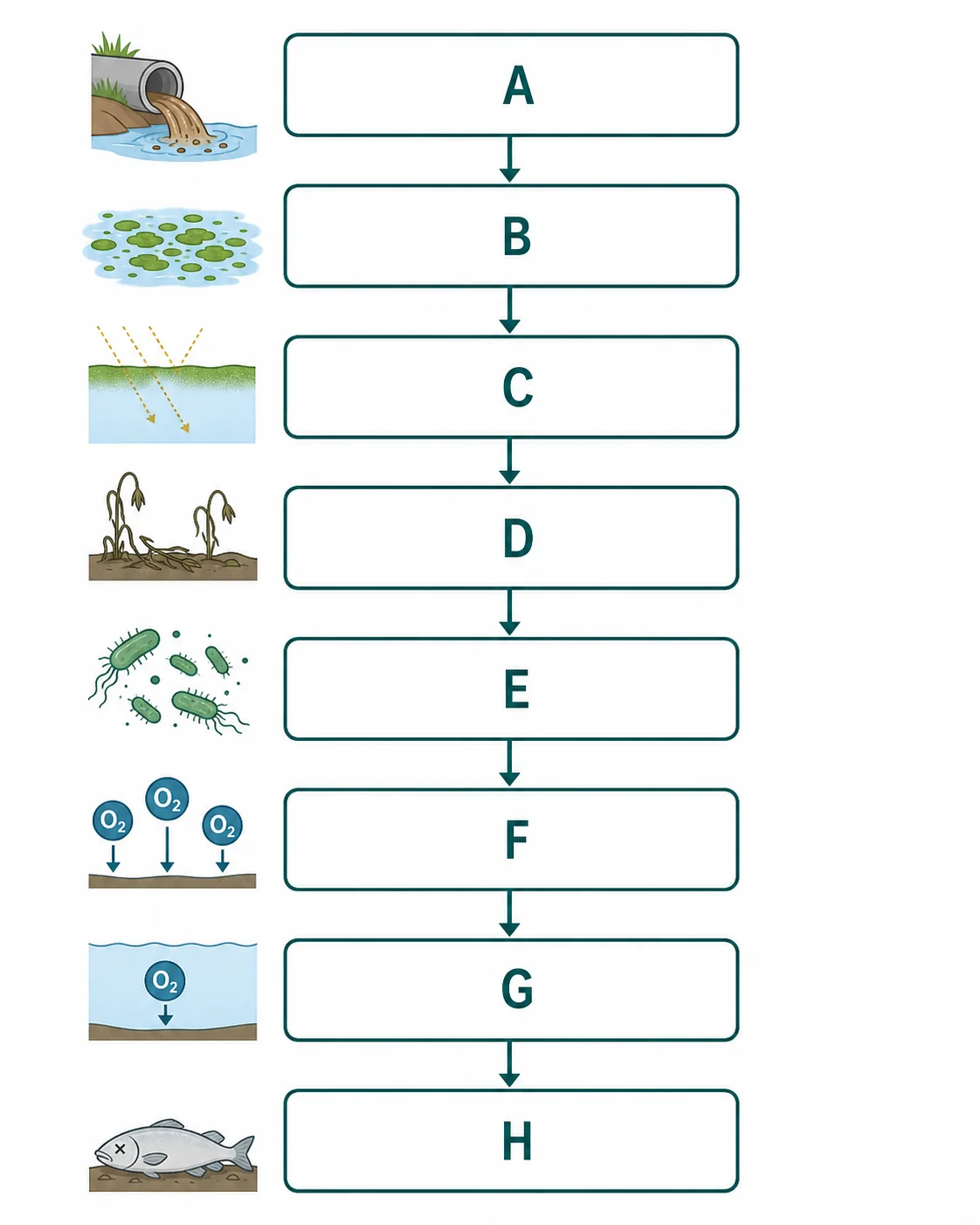
- A — The first step: excess _______ and _______ enter the water.
- B — Rapid excessive growth of algae at the water surface (____ ____)
- C — Dense algal mat prevents _______ reaching submerged plants.
- D — Submerged vegetation dies due to light deprivation.
- E — Dead biomass is broken down by _______ (decomposition).
- F — _______ oxygen demand (BOD) increases.
- G — _______ oxygen falls to dangerous levels (hypoxia).
- H — Oxygen-dependent organisms die — the _______ _______ event.
| Box | Your label / missing word(s) |
|---|---|
| A | |
| B | |
| C | |
| D | |
| E | |
| F | |
| G | |
| H |
2. Term–definition match
The definitions below are shuffled. In the right-hand column write the matching term from this list: eutrophication, nutrient pollution, algal bloom, nitrate, phosphate, dead zone, BOD, molybdenum blue method, ion chromatography, limiting nutrient. 10 marks
| # | Definition (shuffled) | Matching term |
|---|---|---|
| 2.1 | The enrichment of a water body with nutrients, causing excessive algal growth and depletion of dissolved oxygen. | |
| 2.2 | Rapid, excessive growth of algae at the water surface; blocks sunlight and depletes oxygen when it decomposes. | |
| 2.3 | The primary nitrogen-containing ion associated with agricultural fertiliser runoff and eutrophication. | |
| 2.4 | The primary phosphorus-containing ion; the limiting nutrient in most Australian freshwater systems. | |
| 2.5 | Excess NO3− and PO43− entering waterways from fertiliser runoff, sewage or animal waste. | |
| 2.6 | A hypoxic region in a water body where dissolved oxygen is so low that most aquatic life cannot survive. | |
| 2.7 | The nutrient whose concentration most restricts biological productivity in a given ecosystem. | |
| 2.8 | Biochemical oxygen demand — a measure of how much dissolved oxygen microbial decomposition will consume. | |
| 2.9 | A colorimetric method in which phosphate reacts with ammonium molybdate to form a blue complex measurable by UV-Vis spectroscopy. | |
| 2.10 | An instrumental analytical method that separates dissolved anions such as NO3− and PO43− before measuring their signals. |
3. True or false — with correction
For each statement, circle T or F. If the statement is false, write the corrected version on the line provided. 8 marks (1 for T/F, 1 for each needed correction)
3.1 Eutrophication is caused by too much dissolved oxygen entering the water. T / F
3.2 Phosphorus is the limiting nutrient in most Australian freshwater lakes, while nitrogen tends to limit productivity in coastal marine systems. T / F
3.3 In the eutrophication sequence, fish die primarily because algae directly release a lethal toxin into the water. T / F
3.4 The molybdenum blue colorimetric method is used to detect phosphate concentrations in water samples. T / F
4. Function recall
Answer each in 1–2 sentences using precise terms from the lesson. 10 marks (2 each)
4.1 What is the role of bacterial decomposition in the eutrophication sequence?
4.2 Why is it important to distinguish whether nitrogen or phosphorus is the limiting nutrient when designing a management strategy?
4.3 What is the function of riparian buffer zones as a nutrient-pollution management strategy?
4.4 What does the term dead zone mean, and at what stage of the eutrophication sequence does it form?
4.5 Identify two management strategies for nutrient pollution mentioned in the lesson and explain how each reduces nutrient input into waterways.
5. Cloze — complete the eutrophication paragraph
Fill in each blank using one word or phrase from the word bank below. Each term is used once only. 9 marks
When excess _______________ and _______________ enter a water body from agricultural runoff, they stimulate the rapid growth of algae, forming an _______________. As algae cover the surface, they block _______________ from reaching submerged plants, which then die. Bacteria break down this dead biomass through _______________, a process that dramatically increases _______________ (BOD). The resulting consumption of dissolved oxygen leads to _______________ — critically low oxygen levels. If severe enough, this produces a _______________ where fish and other aquatic organisms cannot survive. Effective _______________ strategies focus on reducing nutrient input before the sequence reaches this point.
Q1 — Eutrophication sequence labels
A: Nutrient loading — excess nitrate (NO3−) and phosphate (PO43−) enter the water.
B: Algal bloom — rapid excessive growth of algae at the water surface.
C: Light blockage — dense algal growth prevents light reaching submerged plants.
D: Submerged plant death — underwater vegetation dies due to low light.
E: Bacterial decomposition — dead biomass broken down by microorganisms.
F: BOD increase — biochemical oxygen demand rises as microbial respiration consumes dissolved oxygen.
G: Hypoxia — dissolved oxygen falls to dangerously low levels.
H: Fish kill — oxygen-dependent organisms die or are forced out of the water body.
Q2 — Term–definition matches
2.1 eutrophication • 2.2 algal bloom • 2.3 nitrate • 2.4 phosphate • 2.5 nutrient pollution • 2.6 dead zone • 2.7 limiting nutrient • 2.8 BOD • 2.9 molybdenum blue method • 2.10 ion chromatography
Q3 — True/False with correction
3.1 False. Correction: eutrophication is caused by excess nutrient input (nitrogen and phosphorus), which drives algal blooms; it is the subsequent decomposition of algal biomass that depletes dissolved oxygen.
3.2 True.
3.3 False. Correction: the primary mechanism of fish death in eutrophication is oxygen depletion (hypoxia) caused by microbial decomposition and rising BOD, not direct toxin release from algae (though cyanobacteria can also release toxins, the core HSC mechanism is DO depletion).
3.4 True.
Q4.1 — Role of bacterial decomposition
When algae die after a bloom, bacteria decompose the dead biomass. This process consumes dissolved oxygen as the bacteria respire aerobically, dramatically increasing the biochemical oxygen demand (BOD) and ultimately driving the water into hypoxia.
Q4.2 — Nitrogen vs phosphorus as limiting nutrient
Targeting the limiting nutrient produces the greatest reduction in algal productivity per unit of effort. In freshwater lakes, phosphorus typically limits growth, so reducing phosphate input (e.g. tertiary wastewater treatment, phosphate-free detergents) is most effective. In marine/coastal systems, nitrogen often limits growth, so reducing nitrate input (e.g. riparian buffers, precision agriculture) is prioritised. Treating the wrong nutrient wastes resources.
Q4.3 — Function of riparian buffer zones
Riparian buffer zones are strips of vegetation planted alongside waterways. They intercept nutrient-rich runoff from farmland, absorbing nitrate and phosphate before it enters the waterway, reducing the nutrient load that can drive algal blooms.
Q4.4 — Dead zone definition and stage
A dead zone is a hypoxic region in a water body where dissolved oxygen is so low that most aquatic life cannot survive. It forms at the end of the eutrophication sequence, after bacterial decomposition of dead algal biomass has consumed so much dissolved oxygen that the water body becomes anoxic or hypoxic.
Q4.5 — Two management strategies for nutrient pollution
Two management strategies from the lesson are: (1) Buffer zones (riparian buffers) — strips of vegetation alongside waterways that intercept nutrient-rich agricultural runoff, absorbing nitrate and phosphate before they enter the water. (2) Reducing fertiliser application / precision agriculture — applying only the amount of fertiliser actually needed reduces the total nutrient load lost to runoff. Both strategies target reducing nutrient input before eutrophication can begin.
Q5 — Cloze answers (in order)
nitrate • phosphate • algal bloom • light • decomposition • biochemical oxygen demand • hypoxia • dead zone • management