Chemistry • Year 12 • Module 8 • Lesson 5
Chromatography: TLC, Column & HPLC
Lock in the core vocabulary, the Rf formula, the three-method comparison, and the key principle that separation depends on differential affinity for stationary and mobile phases.
1. Label the TLC plate diagram
The diagram below shows a TLC plate before and after development. Write the missing labels into boxes A–H. Each label is drawn from the lesson Key Terms or Content Cards 1–2. 8 marks
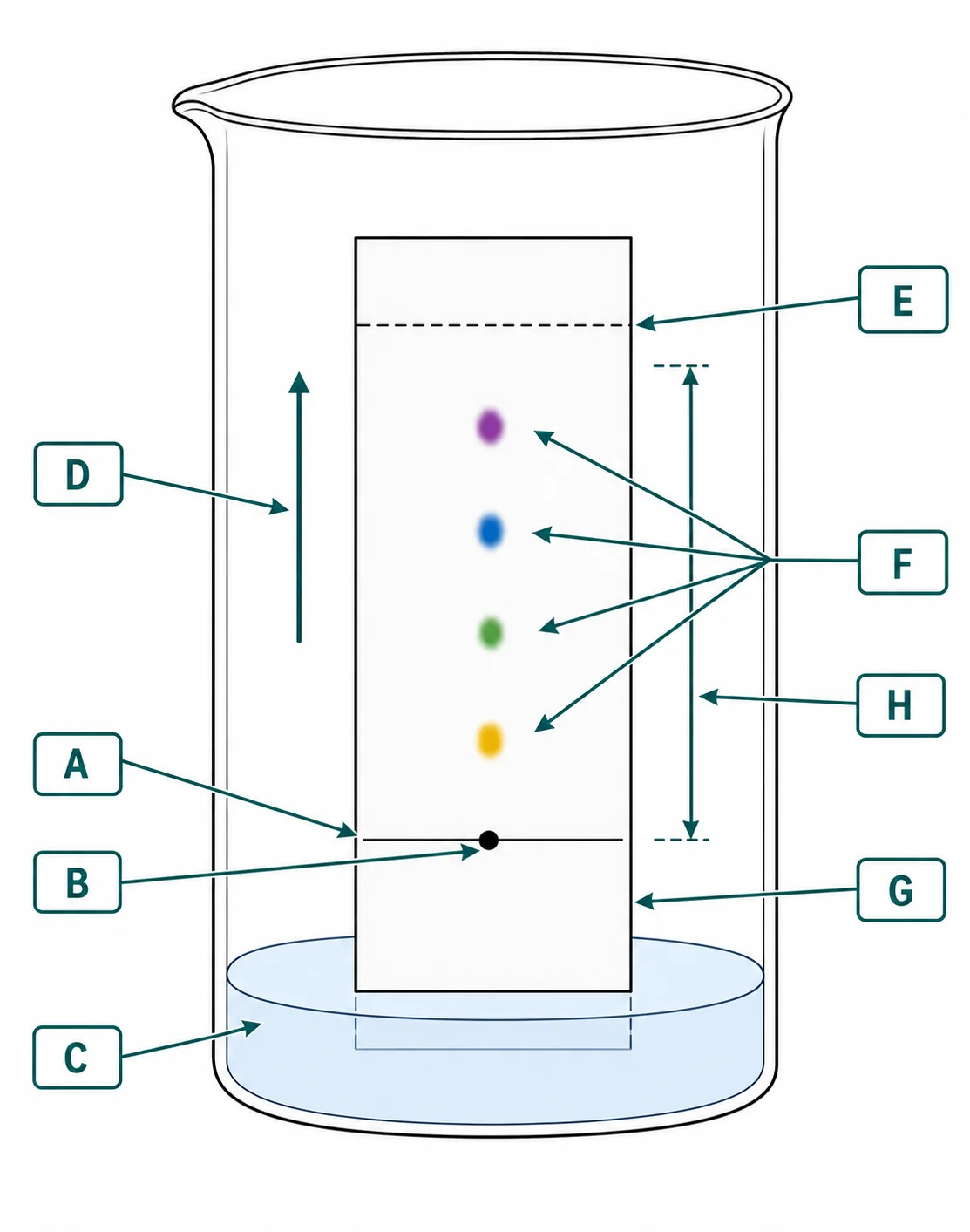
- A — the line drawn near the bottom of the plate before development _______________________
- B — where the sample mixture is spotted on the plate _______________________
- C — the liquid in the developing chamber that carries components up the plate _______________________
- D — the direction in which the mobile phase travels _______________________
- E — the line marking how far the solvent has moved _______________________
- F — the spots produced when a mixture contains more than one component _______________________
- G — the silica layer coating the plate _______________________
- H — the distance used as the denominator in the Rf formula _______________________
| Box | Your label |
|---|---|
| A | |
| B | |
| C | |
| D | |
| E | |
| F | |
| G | |
| H |
2. Term–definition match
Match each definition in the right column to the correct term from this list: chromatography, stationary phase, mobile phase, Rf value, retention time, HPLC, column chromatography, differential affinity, silica, peak area. 10 marks
| # | Definition | Matching term |
|---|---|---|
| 2.1 | A separation technique that exploits differences in affinity of mixture components between a fixed medium and a moving solvent or gas. | |
| 2.2 | The fixed medium through which the mobile phase passes; components with stronger attraction to it move more slowly. | |
| 2.3 | The solvent or gas that carries sample components through the system; its polarity determines separation efficiency. | |
| 2.4 | The ratio of the distance a compound travels to the distance the solvent front travels in TLC; has no units and must lie between 0 and 1. | |
| 2.5 | The time taken for a specific component to travel from injection to the detector in an HPLC system; used for identification. | |
| 2.6 | High-performance liquid chromatography; uses high pressure to push mobile phase through a fine-particle column; highly sensitive and quantitative. | |
| 2.7 | A preparative technique in which the mobile phase flows by gravity through a column packed with stationary phase, collecting separated fractions. | |
| 2.8 | The phenomenon that drives separation: different compounds interact with differing strengths with the stationary and mobile phases. | |
| 2.9 | The most common stationary phase material in TLC and column chromatography; a polar adsorbent that holds more polar compounds more strongly. | |
| 2.10 | In HPLC, the area under a compound's peak in the chromatogram; proportional to the concentration of that component in the sample. |
3. True or false — with correction
Circle T or F. If the statement is false, write the corrected version on the line. 8 marks (1 for T/F, 1 for each correction where needed)
3.1 In TLC, the Rf value is calculated by dividing the distance the solvent front travels by the distance the compound travels. T / F
3.2 A compound with a high Rf value is more strongly attracted to the stationary phase than a compound with a low Rf value. T / F
3.3 Observing two spots in a TLC lane labelled “pure compound” is evidence that the sample is a mixture rather than a single pure substance. T / F
3.4 HPLC uses high pressure to push the mobile phase through the column, making it faster and more sensitive than gravity-fed column chromatography. T / F
4. Function recall
Answer each in 1–2 sentences using precise terms from the lesson. 10 marks (2 each)
4.1 What does the stationary phase do in any chromatographic system?
4.2 What does the mobile phase do, and how does its polarity affect which compounds move faster?
4.3 What is the purpose of comparing an unknown compound’s Rf value with a standard’s Rf on the same TLC plate?
4.4 What role does retention time play in HPLC analysis?
4.5 Why is column chromatography preferred over TLC when a chemist needs to physically collect separated components?
5. Cloze — fill in the blanks
Complete the paragraph using words from the word bank below. Each word is used once. 9 marks (1 per blank)
Word bank: stationary • mobile • differential affinity • polarity • Rf • solvent front • baseline • retention time • peak area
In every chromatographic system there is a phase and a phase. Components of a mixture separate because they have different attraction—called —for those two phases. In TLC, the sample is spotted near the of the plate and the solvent rises by capillary action. The compound’s value equals the distance the compound travels divided by the distance the travels. The degree of separation depends on the of the solvent relative to the compound. In HPLC, each component is identified by its , and its concentration can be estimated from its .
Q1 — Labelled TLC plate
A: baseline. B: sample spot / origin. C: mobile phase (solvent / developing solvent). D: upward (capillary action direction). E: solvent front. F: separated compound spots. G: stationary phase (silica). H: solvent front distance (denominator in Rf).
Q2 — Term–definition matches
2.1 chromatography • 2.2 stationary phase • 2.3 mobile phase • 2.4 Rf value • 2.5 retention time • 2.6 HPLC • 2.7 column chromatography • 2.8 differential affinity • 2.9 silica • 2.10 peak area.
Q3 — True / false with correction
3.1 False. Correction: Rf = distance the compound travels divided by the distance the solvent front travels. The compound distance is always the numerator so the value stays between 0 and 1.
3.2 False. Correction: a high Rf value means the compound has less affinity for the stationary phase and more affinity for the mobile phase, so it travels further. A low Rf indicates stronger attraction to the stationary phase.
3.3 True.
3.4 True.
Q4.1 — Function of the stationary phase
The stationary phase acts as the fixed medium that interacts with (adsorbs or partitions) mixture components as the mobile phase passes through. Components with greater affinity for it move more slowly, which is what produces separation.
Q4.2 — Function of the mobile phase and effect of polarity
The mobile phase carries the sample components through the system. A more polar mobile phase preferentially carries more polar compounds further and faster because “like dissolves like”—polar compounds have greater affinity for a polar solvent, reducing their time on the polar stationary phase.
Q4.3 — Purpose of Rf comparison with a standard
If an unknown compound and a known standard produce spots with the same Rf value under identical TLC conditions (same plate, same solvent), this supports the identification of the unknown as the same compound as the standard. It is supporting evidence, not absolute proof.
Q4.4 — Role of retention time in HPLC
Under identical instrument conditions (same column, solvent, flow rate), each compound has a characteristic retention time. By comparing the retention time of a peak in an unknown sample with that of a known standard run under the same conditions, the identity of the component can be supported.
Q4.5 — Why column chromatography for collection
TLC is an analytical technique—the separated spots are on a thin plate and cannot be easily recovered. Column chromatography allows eluted fractions to be collected as liquids from the column exit, so chemists can physically isolate and use the separated components.
Q5 — Cloze answers (in order)
stationary • mobile • differential affinity • baseline • Rf • solvent front • polarity • retention time • peak area.