Chemistry • Year 12 • Module 8 • Lesson 2
Gravimetric Analysis
Build core vocabulary and recall the five-step method, common precipitating systems, and the direction of common errors — the foundation for all calculation work.
1. Label the gravimetric analysis process diagram
The diagram below shows the five key stages of a gravimetric analysis. Each stage is represented by a station; some labels have been removed. Write the missing labels for boxes A–H using words from the word bank. 8 marks
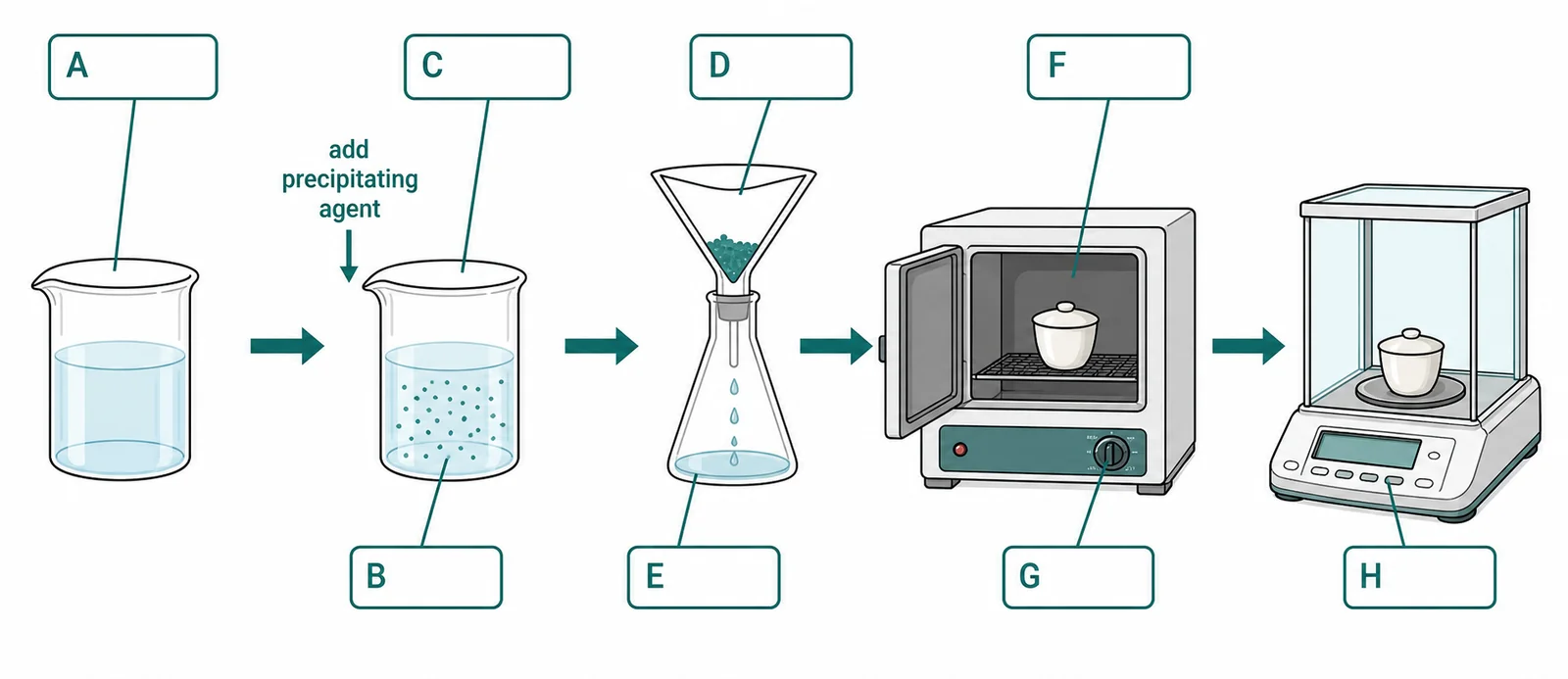
Word bank: filtration • ashless filter paper • precipitate • ignition/drying • dissolve • mass • n = m/M • complete precipitation
| Box | Your answer |
|---|---|
| A | |
| B | |
| C | |
| D | |
| E | |
| F | |
| G | |
| H |
2. Term–definition match
Match each definition to the correct term. Write the term in the right-hand column. Terms: gravimetric analysis • precipitating agent • co-precipitation • analyte • percentage composition • filtration • ignition • incomplete precipitation • stoichiometry • quantitative filtration. 10 marks
| # | Definition | Matching term |
|---|---|---|
| 2.1 | A quantitative analytical technique that determines the amount of an analyte by converting it to a pure, insoluble precipitate, collecting it, and measuring its mass. | |
| 2.2 | The ion or compound whose quantity is being determined in the sample. | |
| 2.3 | A reagent added in excess to ensure complete conversion of the target ion into an insoluble solid. | |
| 2.4 | The process of separating an insoluble solid from a liquid mixture, usually through a paper or porous barrier. | |
| 2.5 | An error in which not all of the target ion converts to precipitate, leaving some analyte dissolved; results in a mass that is too low. | |
| 2.6 | A contamination error where foreign ions or impurities become physically trapped within the forming precipitate, increasing its mass. | |
| 2.7 | Heating a dried precipitate in a crucible to convert it to a stable oxide or compound of known formula suitable for accurate weighing. | |
| 2.8 | The use of mole ratios from a balanced equation to convert between moles of precipitate and moles of analyte. | |
| 2.9 | A filtration technique, using ashless filter paper, that minimises mass error in gravimetric work. | |
| 2.10 | The mass of the target analyte expressed as a fraction of the original sample mass, multiplied by 100. |
3. True or false — with correction
Circle T or F. If false, write a corrected version on the line provided. 10 marks (1 for T/F, 1 for correct correction)
3.1 In gravimetric analysis, the analyte is determined by measuring the volume of precipitate formed. T / F
3.2 Adding excess precipitating reagent ensures that precipitation is as complete as possible. T / F
3.3 BaCl2(aq) is the appropriate precipitating agent for chloride ion (Cl-) analysis. T / F
3.4 Incomplete drying of the precipitate makes the measured mass too high, causing the analyte amount to be overestimated. T / F
3.5 If some precipitate passes through a torn filter, the final calculated analyte content will be overestimated. T / F
4. Common gravimetric precipitation systems
Complete the table. For each analyte ion, fill in the reagent, the precipitate formed, and its formula. 10 marks (1 each cell)
| Analyte ion | Precipitating reagent | Precipitate formed | Formula | Colour |
|---|---|---|---|---|
| SO42− | Barium sulfate | White | ||
| Cl− | AgNO3(aq) | AgCl(s) | ||
| Ag+ | Silver chloride | White | ||
| Ba2+ | Na2SO4(aq) | White | ||
| Ca2+ | (NH4)2C2O4(aq) | Calcium oxalate | White |
5. Cloze paragraph
Fill each blank with a word from the box below. Use each word once. 8 marks
Word box: insoluble • stoichiometry • excess • analyte • precipitate • dried • molar mass • percentage
In gravimetric analysis, the target is converted into an precipitate of known formula. The precipitating reagent is added in to ensure complete reaction. After filtering, the is thoroughly before weighing so that only the solid contributes to its mass. The moles of precipitate are found using n = m/M, where M is the of the precipitate. The of the balanced equation then links precipitate moles to analyte moles. Finally, the composition of the analyte in the original sample is calculated.
Q1 — Labelled diagram
A: dissolve. B: complete precipitation. C: precipitate. D: filtration. E: ashless filter paper. F: ignition/drying. G: mass. H: n = m/M.
Q2 — Term–definition matches
2.1 gravimetric analysis • 2.2 analyte • 2.3 precipitating agent • 2.4 filtration • 2.5 incomplete precipitation • 2.6 co-precipitation • 2.7 ignition • 2.8 stoichiometry • 2.9 quantitative filtration • 2.10 percentage composition.
Q3 — True/False with corrections
3.1 False. Correction: gravimetric analysis determines the analyte by measuring the mass of precipitate, not its volume.
3.2 True.
3.3 False. Correction: AgNO3(aq) is used for chloride ion analysis — it forms insoluble AgCl(s). BaCl2(aq) is used for sulfate analysis.
3.4 True.
3.5 False. Correction: loss of precipitate through the filter lowers the measured mass, so the analyte amount is underestimated, not overestimated.
Q4 — Precipitation systems table
| Analyte | Reagent | Precipitate | Formula | Colour |
|---|---|---|---|---|
| SO42− | BaCl2(aq) or Ba(NO3)2(aq) | Barium sulfate | BaSO4(s) | White |
| Cl− | AgNO3(aq) | Silver chloride | AgCl(s) | White/cream |
| Ag+ | NaCl(aq) or HCl(aq) | Silver chloride | AgCl(s) | White |
| Ba2+ | Na2SO4(aq) | Barium sulfate | BaSO4(s) | White |
| Ca2+ | (NH4)2C2O4(aq) | Calcium oxalate | CaC2O4(s) | White |
Q5 — Cloze paragraph
In order: analyte → insoluble → excess → precipitate → dried → molar mass → stoichiometry → percentage.