Chemistry • Year 12 • Module 8 • Lesson 1
Acid-Base Titrations & Indicators
Lock in the core vocabulary of titration as an analytical technique: primary standards, concordant results, titre calculations, and indicator selection.
1. Term–definition match
The twelve definitions below are shuffled. Write the matching term from this list in the right-hand column: standard solution, primary standard, indicator selection, titre, concordant titres, equivalence point, endpoint, back titration, indicator, aliquot, analyte, rough titre. 12 marks
| # | Definition | Matching term |
|---|---|---|
| 1.1 | A solution whose concentration has been accurately determined, used to titrate an unknown solution. | |
| 1.2 | A highly pure, stable solid used to prepare or verify the concentration of a standard solution (e.g. anhydrous Na2CO3). | |
| 1.3 | Choosing an indicator whose pH transition range overlaps the steep portion of the titration curve near the equivalence point. | |
| 1.4 | The volume of standard solution delivered from the burette to reach the endpoint. | |
| 1.5 | Successive titres that agree closely with each other; in NSW Chemistry practice, within ±0.10 mL of each other. | |
| 1.6 | The point in a titration at which stoichiometrically equivalent amounts of acid and base have reacted. | |
| 1.7 | The experimental point at which the indicator permanently changes colour, used to estimate the equivalence point. | |
| 1.8 | A titration method where an excess of one reagent is added to the sample, then the leftover excess is titrated with a second standard solution. | |
| 1.9 | A substance added in small amounts to a titration that changes colour near the equivalence point, signalling the endpoint. | |
| 1.10 | The measured fixed volume of analyte placed in the conical flask, typically delivered by a volumetric pipette. | |
| 1.11 | The solution of unknown concentration being analysed in a titration. | |
| 1.12 | The first (imprecise) run used only to locate the approximate endpoint region; excluded from the calculated average. |
2. True or false — with correction
For each statement, circle T or F. If false, write the correct version on the line provided. 10 marks (1 T/F + 1 correction where needed)
2.1 The endpoint and the equivalence point in a titration are always exactly the same thing. T / F
2.2 A rough titre should be included in the average because it reduces random error. T / F
2.3 In a back titration, the excess reagent left over after reacting with the sample is measured in a second titration. T / F
2.4 Phenolphthalein is the best indicator for a strong acid–weak base titration because it changes colour above pH 8. T / F
2.5 A primary standard must be a highly pure, stable substance so that its weighed mass accurately represents a known number of moles. T / F
3. Function recall
Answer each prompt in 1–2 sentences using precise terms from the lesson. 12 marks (2 each)
3.1 What is the function of the burette in a titration, and why is it used rather than a measuring cylinder?
3.2 Why is it essential to rinse the burette with the titrant solution before filling it?
3.3 What is the purpose of using a white tile under the conical flask during a titration?
3.4 Explain why concordant titres are used for the final average rather than all recorded titres.
3.5 State the general rule for choosing a suitable indicator for an acid–base titration.
3.6 Explain why back titration is used instead of direct titration when analysing a commercial antacid tablet.
4. Cloze — titration procedure paragraph
Complete the passage using the word bank below. Each word is used once. 8 marks
Word bank: stoichiometry • concordant • equivalence • moles • titre • standard • endpoint • indicator
In an acid–base titration, a solution of accurately known concentration, called a __________________ solution, is added from a burette to a measured aliquot of unknown concentration. A few drops of an __________________ are added to signal when the titration is near completion. The volume of standard solution delivered when the __________________ changes colour permanently is called the __________________. This corresponds as closely as possible to the __________________ point, where acids and bases have reacted in exact __________________ proportions. To improve reliability, the experiment is repeated and only __________________ titres are used to calculate the average. The number of __________________ of the standard solution at equivalence is then used, along with the balanced equation, to calculate the unknown concentration.
5. Label the titration set-up
The diagram below shows the key pieces of equipment in a standard acid–base titration. Write the name of each labelled component (A–F) in the table. For component E, also state its specific function. 7 marks (1 per label; 2 for E)
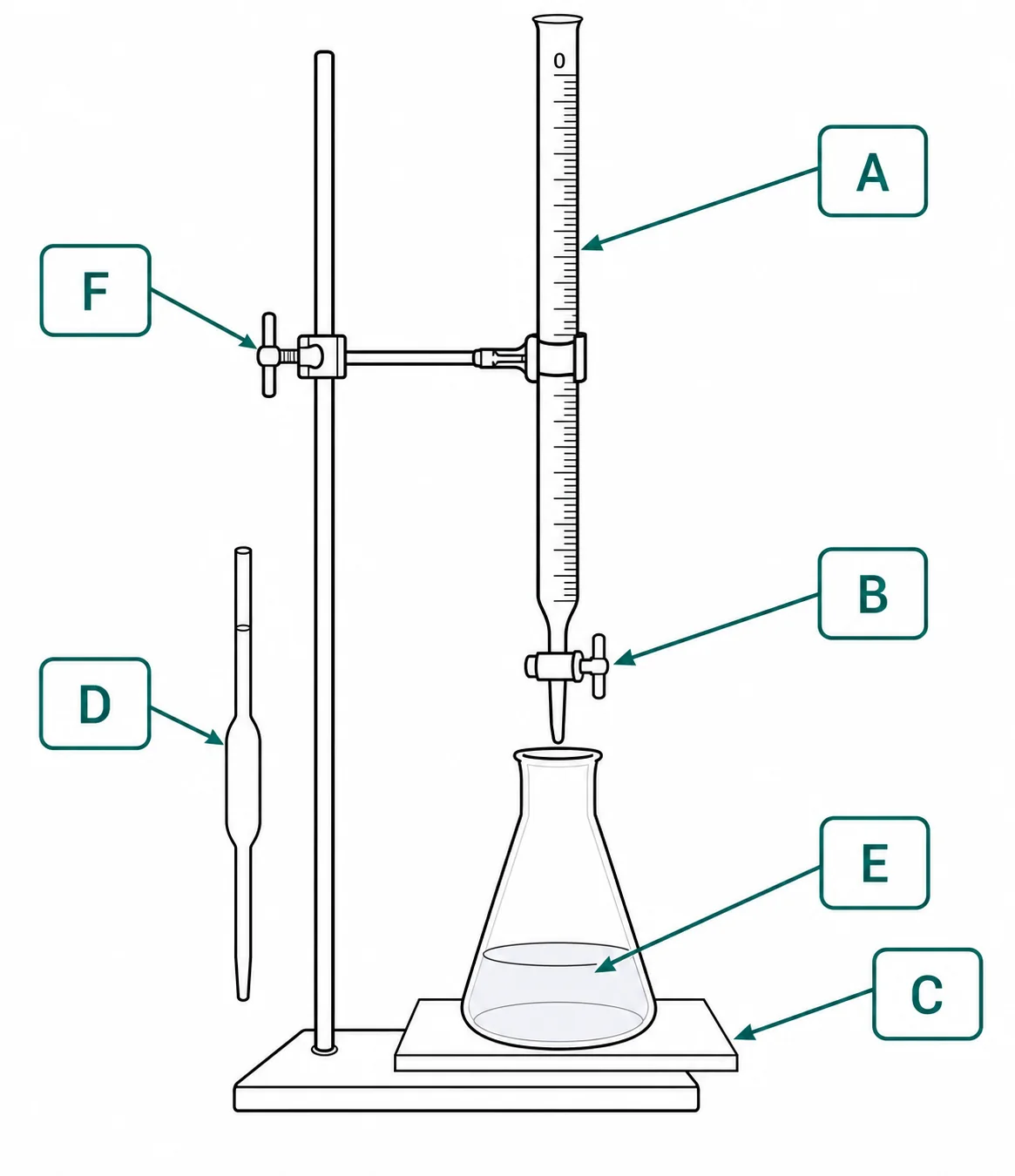
| Label | Component name | Function (E only) |
|---|---|---|
| A | ||
| B | ||
| C | ||
| D | ||
| E | ||
| F |
Q1 — Term–definition matches
1.1 standard solution • 1.2 primary standard • 1.3 indicator selection • 1.4 titre • 1.5 concordant titres • 1.6 equivalence point • 1.7 endpoint • 1.8 back titration • 1.9 indicator • 1.10 aliquot • 1.11 analyte • 1.12 rough titre.
Q2 — True / false with correction
2.1 False. The equivalence point is where the reaction is stoichiometrically complete; the endpoint is where the indicator changes colour. They should be close but are not identical concepts.
2.2 False. The rough titre is excluded from the average because it was used only to locate the endpoint region and is typically less precise than subsequent titrations.
2.3 True.
2.4 False. For a strong acid–weak base titration the equivalence point is below pH 7, so methyl orange (pH 3.1–4.4) is more appropriate. Phenolphthalein changes colour above pH 8, which is past the steep pH drop and would give an incorrect endpoint.
2.5 True.
Q3 — Function recall
3.1 The burette delivers small, precise volumes of standard solution from the stopcock; a measuring cylinder does not have the precision required (burettes read to 0.05 mL).
3.2 Rinsing the burette with the titrant removes any residual water that would dilute the solution and lower its effective concentration, causing an error in the titre.
3.3 The white tile provides a plain background that makes it easier to observe the first permanent colour change of the indicator, reducing the chance of overshooting the endpoint.
3.4 Concordant titres are used because they represent the most reliable, reproducible results. Including outliers or the rough titre distorts the mean and reduces accuracy.
3.5 Choose an indicator whose pH transition range overlaps the steep portion of the titration curve near the equivalence point, so the endpoint occurs as close as possible to the true equivalence point.
3.6 Back titration is used because the tablet is a solid that may dissolve slowly or be difficult to titrate directly. Adding a known excess of acid ensures the reaction is complete before the second titration measures the leftover acid.
Q4 — Cloze answers (in order)
standard — indicator — endpoint — titre — equivalence — stoichiometry — concordant — moles.
Q5 — Labelled diagram
A: Burette. B: Stopcock (burette tap). C: Conical flask (on white tile). D: Volumetric pipette. E: Indicator (function: changes colour at the endpoint to signal when the titration is near the equivalence point). F: Retort stand / boss and clamp assembly.