Chemistry • Year 12 • Module 7 • Lesson 21
Addition Polymers
Build Band 5–6 extended-response technique: evaluate polymer selection using structural evidence, critique scientific claims, and reach evidence-based judgements.
1. Data + scenario — polymer selection for medical implants (Band 5–6)
8 marks Band 5–6
Scenario. A biomedical engineering team in Australia is selecting an addition polymer for a permanent joint-replacement implant that must satisfy three criteria: (i) chemical inertness in body fluids (saline, lipids, enzymes at pH 5–8); (ii) low surface friction to reduce wear against adjacent tissue; (iii) mechanical rigidity to support body weight (~700 N for a 70 kg patient) without significant deformation over 20 years. The team is considering three candidates: PTFE, HDPE, and polypropylene (PP).
Data.
| Property | PTFE | HDPE | PP |
|---|---|---|---|
| Density (g cm−3) | 2.14–2.20 | 0.94–0.97 | 0.90–0.91 |
| Melting point (°C) | ~327 | ~130 | ~165 |
| Tensile modulus (GPa) | 0.5–0.6 | 0.8–1.5 | 1.5–2.0 |
| Coefficient of friction (dry, on steel) | 0.04–0.10 | 0.20–0.30 | 0.25–0.35 |
| Chemical resistance to body fluids | Excellent (C–F sheath) | Good (C–C backbone, no hydrolysable bonds) | Good (similar to HDPE) |
Data: Polymer Properties Database; ASM International. Values are representative ranges.
Q1. Evaluate which of the three polymers is most suitable for the joint-replacement implant. In your response you must:
- Define addition polymerisation and explain why all three candidates are addition polymers.
- Compare all three polymers on all three criteria (chemical inertness, surface friction, mechanical rigidity) using data from the table and structural chemistry reasoning.
- Explain the structural basis for PTFE’s low friction coefficient using intermolecular force reasoning.
- Identify and explain one limitation of your chosen polymer for this application, using data from the table.
- Reach an evidence-based judgement that names the most suitable polymer and acknowledges the trade-offs.
2. Source critique — evaluate a textbook claim about polymer properties (Band 5–6)
7 marks Band 5–6
Source — fictional student study guide, Year 12 Chemistry Revision Toolkit, 3rd edition, p. 184:
“The key difference between LDPE and HDPE is that they are made from different monomers. LDPE is made from ethene, while HDPE is made from ethylene. Because these are different molecules, HDPE has stronger covalent bonds in its backbone than LDPE, which is why HDPE has a higher melting point. Both LDPE and HDPE are thermoplastics, meaning that they can be recycled by reacting them with strong acids to break the polymer chains back into their monomers.”
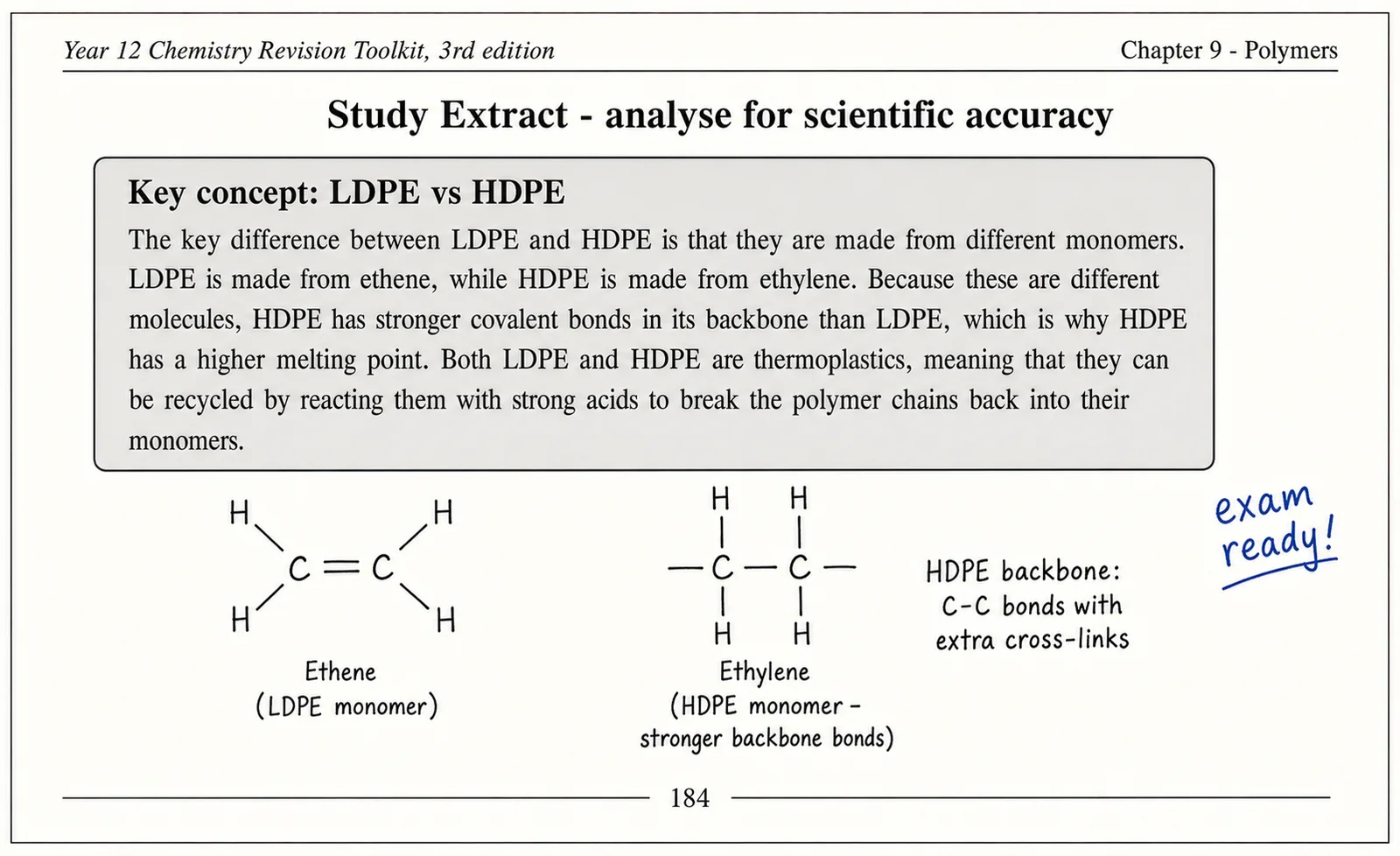
Q2. The source contains three distinct scientific errors. For each error:
- Identify the specific claim that is wrong.
- Explain the correct chemistry, including a reference to bond type, chain architecture, or molecular structure where relevant.
- For Error 3 (the recycling claim): explain how you would design a simple experiment to demonstrate the correct recycling mechanism for thermoplastics, and state what result would confirm your correction.
Error 1: State the incorrect claim.
Correction:
Error 2: State the incorrect claim.
Correction:
Error 3: State the incorrect claim.
Correction + experimental test:
Q1 — Marking criteria (8 marks)
1 mark — Definition of addition polymerisation + why all three are addition polymers. Addition polymerisation is a chain reaction where alkene monomers (containing a C=C double bond) link together by opening their pi bond, forming new C–C single bonds with no atoms lost and no by-product produced. PTFE, HDPE, and PP are all addition polymers because each is formed from an alkene monomer (CF2=CF2, CH2=CH2, CH2=CHCH3 respectively) and their repeat units contain only single bonds with no other functional group and no missing atoms.
2 marks — Criterion-by-criterion comparison using data. (i) Chemical inertness: PTFE is superior — C–F bond energy ~485 kJ mol−1 provides a fluorine sheath that blocks all aqueous biological reagents; HDPE and PP are “good” but not excellent, as their C–C backbones have no polar bonds but do not have the same steric protection. (ii) Surface friction: PTFE is clearly superior: coefficient of friction 0.04–0.10 vs 0.20–0.35 for HDPE/PP. (iii) Mechanical rigidity: PP is superior (tensile modulus 1.5–2.0 GPa), followed by HDPE (0.8–1.5 GPa), with PTFE clearly the weakest (0.5–0.6 GPa). [Award 2 marks for comparing all three criteria with data. 1 mark if comparison is incomplete.]
1 mark — Structural basis for PTFE’s low friction using IMF reasoning. The PTFE surface consists entirely of fluorine atoms. Fluorine has no H-bond donor capacity, no polar —OH or —NH groups, and no ionic charges. The only intermolecular forces operating between PTFE and any contacting surface are very weak London (dispersion) forces. This produces extremely weak adhesion between PTFE and the adjacent tissue or bone — hence an exceptionally low coefficient of friction (0.04–0.10).
1 mark — One limitation of chosen polymer with data reference. If choosing PTFE: low tensile modulus (0.5–0.6 GPa) means PTFE will deform under sustained loading — 700 N body weight over 20 years may cause creep and dimensional changes in the implant, compromising fit. Reference to the data table required. If choosing HDPE: lower chemical resistance than PTFE; if choosing PP: higher friction than PTFE.
1 mark — Evidence-based judgement acknowledging trade-offs. PTFE is likely the most suitable overall because it best satisfies criteria (i) and (ii), which are more critical for biological compatibility and long-term function, and its mechanical weakness can be partially mitigated by using a thicker PTFE component or a composite design. Accept HDPE with valid justification based on tensile modulus advantage and adequate chemical resistance. Reject answers that give a winner without any trade-off acknowledgement.
2 marks — Overall quality of response. Award up to 2 additional marks for coherent structure: response moves logically from definition → comparison → IMF reasoning → limitation → judgement, uses chemical terminology correctly throughout, and maintains scientific precision (e.g. “dispersion forces” not just “intermolecular forces”).
Q2 — Source critique marking criteria (7 marks)
Error 1 — “LDPE is made from ethene, while HDPE is made from ethylene” (2 marks)
Identifying the error [1]: The source implies LDPE and HDPE are made from different monomers (“ethene” and “ethylene” are actually the same molecule — this is a naming confusion — but the intended claim is that the monomers are chemically different, which is false).
Correction [1]: Both LDPE and HDPE are made from exactly the same monomer: ethene (CH2=CH2, also called ethylene). The difference between LDPE and HDPE is chain architecture, not monomer identity. LDPE is produced at high pressure using free-radical initiators, producing branched chains. HDPE is produced at lower pressure with a Ziegler–Natta catalyst, producing linear chains. Same repeat unit: (-CH2-CH2-)n in both cases.
Error 2 — “HDPE has stronger covalent bonds in its backbone than LDPE, which is why HDPE has a higher melting point” (2 marks)
Identifying the error [1]: The source claims HDPE has stronger covalent backbone bonds than LDPE. This is incorrect: both polymers have identical C–C single bonds in their backbone (same bond type, same bond energy ~347 kJ mol−1), so covalent bond strength cannot explain the melting point difference.
Correction [1]: HDPE has a higher melting point because its linear chains pack together more closely, maximising the surface contact between adjacent chains and strengthening intermolecular London (dispersion) forces. More energy is needed to separate the closely packed HDPE chains than the loosely packed branched LDPE chains. Melting point is determined by intermolecular forces between chains, not covalent bond strength within chains.
Error 3 — “thermoplastics can be recycled by reacting them with strong acids to break polymer chains back into monomers” (3 marks)
Identifying the error [1]: The source claims thermoplastics are recycled by acid-catalysed depolymerisation back to monomers. This is incorrect for addition polymers like LDPE and HDPE: their C–C backbone contains no acid-labile (hydrolysable) bonds, so strong acids have virtually no effect on the polymer chain.
Correction [1]: Thermoplastics are recycled by melting and remoulding, not by chemical depolymerisation. Because the chains are held together by intermolecular forces (not covalent cross-links), heating to above the melting point (e.g. ~130°C for HDPE) breaks the dispersion forces, allowing chains to flow. The melt is reshaped and cooled, re-establishing the intermolecular forces in the new shape. The covalent backbone is unchanged throughout — no chemical reaction occurs.
Experimental test [1]: Take a small piece of HDPE (e.g. a milk crate offcut). Heat to ~140°C in a mould; observe it softens and takes the shape of the mould; cool it and observe it hardens. Repeat the heating–cooling cycle 3–5 times. If recycling is a physical (not chemical) process, the material should re-soften and re-harden reproducibly each cycle without any acid required and without any observable change in chemical composition (IR spectrum would remain unchanged). As a control, place a piece of the same HDPE in concentrated H2SO4 at room temperature and 70°C for 24 h: if the source were correct, the acid should dissolve or depolymerise the sample. If the mass remains unchanged, the source is refuted.