Chemistry • Year 12 • Module 7 • Lesson 21
Addition Polymers
Recall the core vocabulary, identify monomers and repeat units, and fix common misconceptions about addition polymerisation.
1. Term–definition match
The ten definitions below are shuffled. Write the matching term from this list in the right-hand column: addition polymerisation, monomer, repeat unit, degree of polymerisation, thermoplastic, LDPE, HDPE, free radical, PTFE, PVC. 10 marks
| # | Definition (shuffled) | Matching term |
|---|---|---|
| 1.1 | A chain reaction in which alkene monomers join together by opening their C=C double bond, with no atoms lost and no by-product produced. | |
| 1.2 | A small molecule containing a C=C double bond that undergoes repeated addition to build a polymer chain. | |
| 1.3 | The basic structural unit that repeats along a polymer chain; written inside square brackets with a subscript n. | |
| 1.4 | The number of repeat units n in a polymer chain; equal to the polymer mass divided by the repeat-unit mass. | |
| 1.5 | A polymer that softens reversibly when heated and re-hardens on cooling because its chains are held only by intermolecular forces. | |
| 1.6 | Low-density polyethylene; made from ethene under high temperature and pressure using radical initiators; branched chains, flexible, MP ~110°C. | |
| 1.7 | High-density polyethylene; made from ethene using Ziegler–Natta catalysts; linear chains, rigid, MP ~130°C. | |
| 1.8 | A highly reactive species with an unpaired electron; initiates addition polymerisation by attacking the C=C of the first monomer. | |
| 1.9 | Addition polymer of tetrafluoroethene; chemically inert due to strong C–F bonds (~485 kJ mol−1); used in non-stick cookware. | |
| 1.10 | Addition polymer of chloroethene; rigid when unplasticised; used in Australian plumbing pipes endorsed by the Vinyl Council of Australia. |
2. True or false — with correction
Circle T or F for each statement. If the statement is false, write the corrected version on the line provided. 10 marks (1 T/F + 1 correction each)
2.1 In addition polymerisation, a small molecule such as water is released as a by-product when each monomer joins the chain. T / F
2.2 The repeat unit of polyethylene is [-CH2-CH2-]n and it contains no C=C double bond. T / F
2.3 LDPE and HDPE are made from different monomers, which is why they have different melting points. T / F
2.4 Polystyrene is an addition polymer whose repeat unit contains a phenyl (C6H5) group on every second backbone carbon. T / F
2.5 PTFE can be attacked by most common acids and oxidising agents because its C–F bond is relatively weak. T / F
3. Cloze passage — complete the paragraph
Fill in each blank with the correct word or phrase. Use the word bank below. Each term is used once. 8 marks
Word bank: pi bond • sigma bond • no by-product • radical • propagation • termination • degree of polymerisation • repeat unit
In addition polymerisation, the _____________________ of each monomer's C=C double bond is consumed when monomers link together. The _____________________ framework of the original C=C remains as the new C–C single bond between adjacent monomers. Because every atom in every monomer ends up in the chain, _____________________ is produced — unlike condensation polymerisation. The mechanism begins with initiation, when a free _____________________ opens the first C=C. During _____________________, the chain radical attacks successive monomers, extending the chain one unit at a time. The reaction ends at _____________________, when two chain radicals combine. The number of _____________________ units in the final chain is called the _____________________ and equals the polymer mass divided by the mass of one repeat unit.
4. Label the addition polymerisation diagram
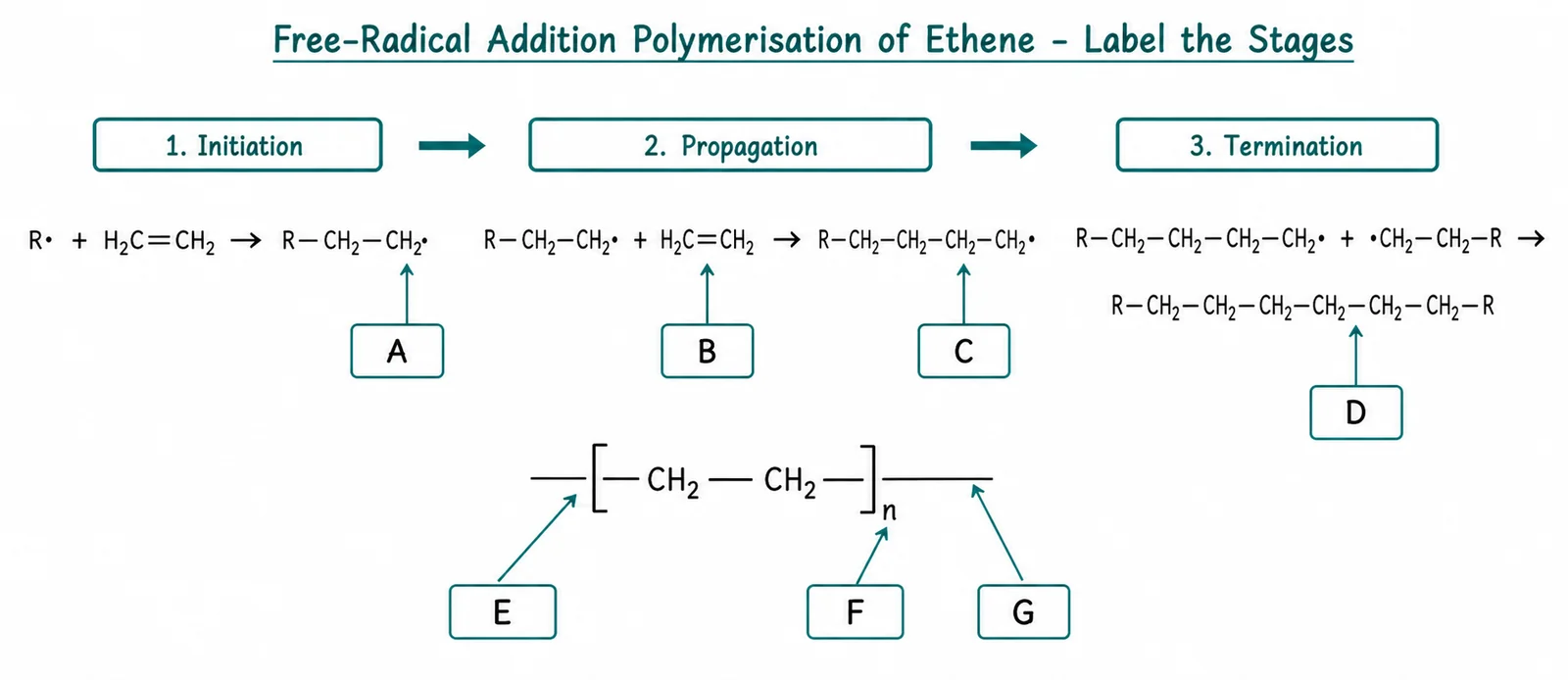
The diagram below shows the free-radical addition polymerisation of ethene. Write the missing labels A–G into the boxes on the right. Each label is drawn from lesson Key Terms or Card 1. 7 marks
| Label | Your answer |
|---|---|
| A | |
| B | |
| C | |
| D | |
| E | |
| F | |
| G |
5. Function recall
Answer each question in 1–2 sentences using precise lesson terms. 8 marks (2 each)
5.1 What is the function of square brackets and subscript n in polymer notation?
5.2 What is the function of an initiator in free-radical addition polymerisation?
5.3 What structural feature of PTFE gives it exceptional chemical resistance?
5.4 What is the function of chain branching in LDPE (compared with the linear chains of HDPE)?
Q1 — Term–definition matches
1.1 addition polymerisation • 1.2 monomer • 1.3 repeat unit • 1.4 degree of polymerisation • 1.5 thermoplastic • 1.6 LDPE • 1.7 HDPE • 1.8 free radical • 1.9 PTFE • 1.10 PVC.
Q2 — True / false with correction
2.1 False. Correction: addition polymerisation produces no by-product — every atom in every monomer is incorporated into the polymer chain. It is condensation polymerisation that releases a small molecule (e.g. water).
2.2 True. The C=C pi bond is consumed during polymerisation; the repeat unit contains only C–C single bonds.
2.3 False. Correction: both LDPE and HDPE are made from the same monomer, ethene (CH2=CH2). The difference is chain architecture — LDPE chains are branched (formed under high temperature/pressure using radical initiators) while HDPE chains are linear (Ziegler–Natta catalyst). Different process conditions, not different monomers, produce different properties.
2.4 True.
2.5 False. Correction: PTFE is extremely resistant to chemical attack because the C–F bond energy is ~485 kJ mol−1 — one of the strongest bonds to carbon. The fluorine atoms form a tight sheath around the carbon backbone, shielding it from attack by acids, bases, and oxidisers.
Q3 — Cloze passage
In order: pi bond / sigma bond / no by-product / radical / propagation / termination / repeat unit / degree of polymerisation.
Q4 — Labelled diagram
A: carbon radical (chain-end radical). B: pi bond (being consumed / opened). C: new C–C sigma bond (linking chains). D: square brackets (enclosing the repeat unit). E: subscript n (showing repetition). F: open bond (showing chain continuation). G: no by-product produced (OR: all atoms incorporated into polymer).
Q5.1 — Function of square brackets and subscript n
Square brackets define the boundary of the smallest repeating structural unit in the polymer. Subscript n outside the closing bracket indicates that this unit is repeated n times along the chain. Without both features, the drawing is indistinguishable from a small molecule — HSC marking guidelines require both.
Q5.2 — Function of an initiator
The initiator (e.g. an organic peroxide) decomposes to generate free radicals, each with an unpaired electron. These radicals attack the C=C double bond of the first monomer, opening the pi bond and creating a new carbon radical at the chain end. Without an initiator, the monomers cannot start linking because they have no radical to open the first C=C.
Q5.3 — Structural feature giving PTFE chemical resistance
Every hydrogen atom on the polyethylene backbone is replaced by fluorine. The C–F bond (~485 kJ mol−1) is exceptionally strong, and the small, densely-packed fluorine atoms form a continuous “fluorine sheath” around the carbon backbone, physically and electrostatically blocking attacking reagents. No common acid, base, or oxidiser can break C–F bonds under normal conditions.
Q5.4 — Function of branching in LDPE
Branches prevent adjacent LDPE chains from aligning and packing closely together. This reduces chain–chain contact area, weakening London (dispersion) forces between chains. The result is a lower density, a lower melting point (~110°C vs ~130°C for HDPE), and a more flexible, softer material. Branching is the structural cause of all these property differences.