Chemistry • Year 12 • Module 7 • Lesson 17
Soaps, Detergents & Saponification
Lock in the core vocabulary, saponification equation, soap structure, and the key differences between soaps and synthetic detergents.
1. Label the soap molecule and micelle diagram
The diagram below shows a single soap molecule and a cross-section of a soap micelle in water. Write the missing labels into boxes A–H using terms from the lesson's Key Terms panel and Cards 1–3. 8 marks
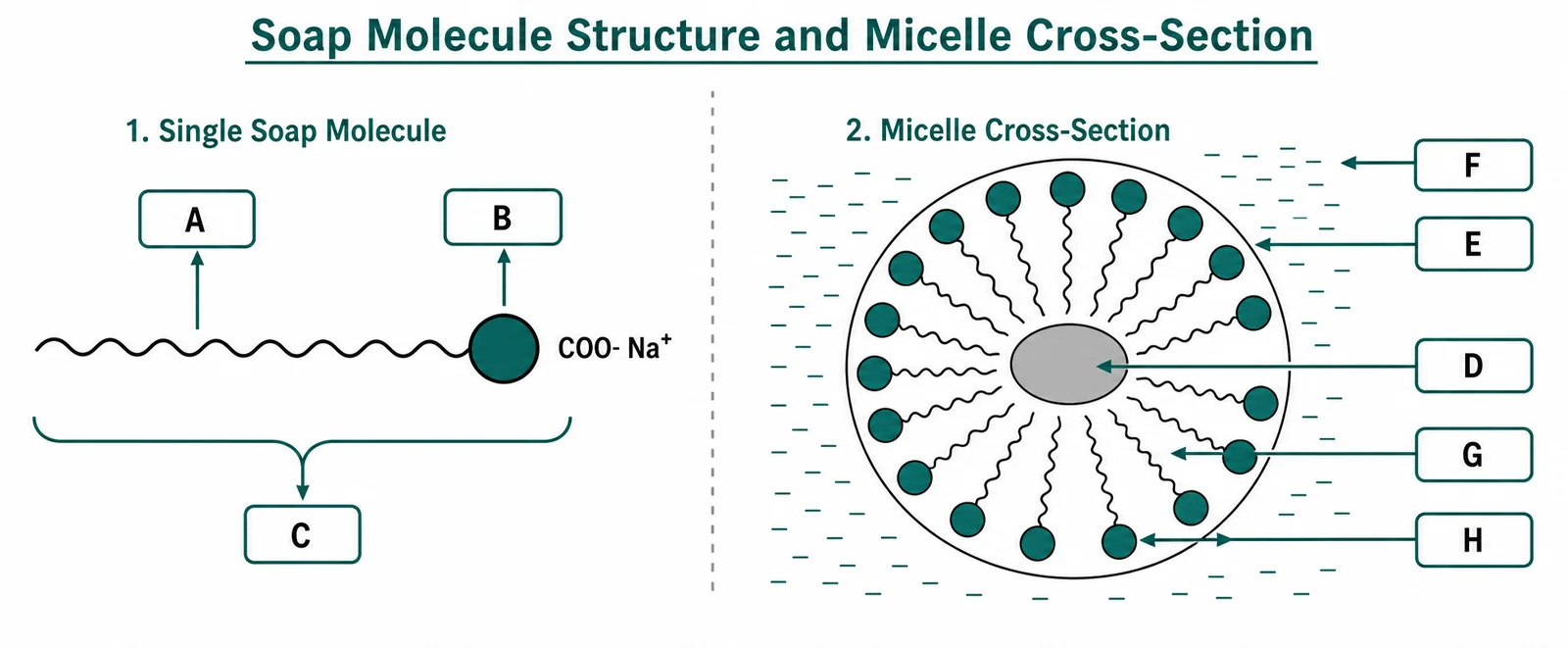
| Box | Your label |
|---|---|
| A | |
| B | |
| C | |
| D | |
| E | |
| F | |
| G | |
| H |
2. Term–definition match
The ten definitions below are shuffled. In the right-hand column write the matching term from this list: saponification, amphipathic, micelle, hydrophobic tail, hydrophilic head, surfactant, hard water, soap scum, detergent, glycerol. 10 marks
| # | Definition (shuffled) | Matching term |
|---|---|---|
| 2.1 | The base hydrolysis of a triglyceride with NaOH or KOH to produce glycerol and a sodium or potassium carboxylate (soap). | |
| 2.2 | A molecule that has both a polar (water-loving) region and a non-polar (water-fearing) region in the same structure. | |
| 2.3 | A spherical aggregate of soap or detergent molecules in water; tails point inward, heads point outward, and grease is trapped in the non-polar interior. | |
| 2.4 | The long, non-polar hydrocarbon chain of a soap molecule (C14–C18) that is attracted to oils and fats via London dispersion forces. | |
| 2.5 | The ionic carboxylate group (–COO⁻Na⁺) of a soap molecule that is strongly solvated by water via ion–dipole interactions. | |
| 2.6 | A surface-active agent that reduces the surface tension of water and allows oil and water to mix by forming micelles. | |
| 2.7 | Water containing dissolved Ca²⁺ and Mg²⁺ ions (e.g. from dissolved CaCO3 in limestone regions such as parts of the Murray–Darling basin). | |
| 2.8 | The insoluble white precipitate formed when soap reacts with Ca²⁺ or Mg²⁺ ions in hard water; the formula is (RCOO)2Ca(s). | |
| 2.9 | A synthetic surfactant with a similar amphipathic structure to soap but with a sulfonate (–SO3⁻) or other head group whose Ca²⁺ salts remain soluble. | |
| 2.10 | The three-carbon trihydroxy alcohol (propane-1,2,3-triol) produced as a co-product of saponification; used in pharmaceuticals and cosmetics. |
3. True or false — with correction
For each statement, circle T or F. If the statement is false, write the corrected version on the line below. 8 marks (1 for T/F, 1 for correction where needed)
3.1 In the saponification reaction, NaOH acts as a catalyst and is not consumed. T / F
3.2 Saponification is an irreversible reaction because the product is a carboxylate salt that cannot re-esterify under basic conditions. T / F
3.3 When soap is used in hard water, the Ca²⁺ ions form an insoluble precipitate with the carboxylate head groups of the soap molecules. T / F
3.4 Soap removes grease by dissolving it completely into water at the molecular level. T / F
4. Function recall
Answer each in 1–2 sentences using precise terms from the lesson. 10 marks (2 each)
4.1 What is the function of the hydrophobic tail of a soap molecule during the cleaning of a greasy surface?
4.2 What is the function of the hydrophilic head (–COO⁻Na⁺) of a soap molecule during micelle formation?
4.3 What is the function of concentrated NaOH in the saponification of a triglyceride? (State whether it is a reagent or catalyst and why.)
4.4 What is the function of the sulfonate head group in a synthetic detergent that makes it more effective than soap in hard water?
4.5 What is the function of the negative charge on the outer surface of a soap micelle after a greasy stain has been emulsified?
5. Fill-in-the-blank paragraph
Complete the paragraph by filling each blank with the correct term from the word bank below. Each term is used once. 8 marks
Soap is made by a process called ________________ (1), which is the base hydrolysis of a triglyceride with NaOH. The reaction is ________________ (2) because the product is a ________________ (3) salt that cannot re-esterify under basic conditions. Every soap molecule is ________________ (4), meaning it contains both a non-polar hydrophobic tail and a polar hydrophilic head. When soap is added to greasy water, molecules aggregate into a sphere called a ________________ (5), trapping the grease inside. The grease is ________________ (6) rather than dissolved. When used in hard water, soap reacts with Ca²⁺ to form an insoluble precipitate called ________________ (7). Synthetic detergents avoid this problem by using a different head group, often a ________________ (8) group, whose calcium salts remain soluble.
Q1 — Labelled diagram (8 marks)
A: Hydrophobic tail (long non-polar hydrocarbon chain, C14–C18). B: Hydrophilic head (–COO⁻Na⁺, ionic carboxylate). C: Amphipathic (compatible with both polar and non-polar environments). D: Non-polar core (oil/grease environment). E: Hydrophilic heads (–COO⁻Na⁺, pointing outward into water). F: Water (polar environment surrounding the micelle). G: Tails point inward (away from water, toward non-polar core). H: Electrostatic repulsion (negatively charged –COO⁻ heads repel each other, stabilising the micelle).
Q2 — Term–definition matches (10 marks)
2.1 saponification • 2.2 amphipathic • 2.3 micelle • 2.4 hydrophobic tail • 2.5 hydrophilic head • 2.6 surfactant • 2.7 hard water • 2.8 soap scum • 2.9 detergent • 2.10 glycerol
Q3 — True / false with correction (8 marks)
3.1 False. Correction: NaOH is a REAGENT in saponification — it is consumed in the reaction (coefficient 3 per triglyceride) and Na⁺ becomes part of the soap product. It is not a catalyst. (1 T/F + 1 correction)
3.2 True. The carboxylate salt (RCOO⁻Na⁺) cannot re-esterify under basic conditions — esterification requires acidic conditions to regenerate RCOOH. The reaction goes to completion (~100% yield). (1 mark for T)
3.3 True. Ionic equation: 2RCOO⁻(aq) + Ca²⁺(aq) → (RCOO)2Ca(s)↓ — calcium carboxylate is insoluble and precipitates as soap scum. (1 mark for T)
3.4 False. Correction: Soap removes grease by emulsification — grease is surrounded by soap molecules (tails into grease, heads into water) forming dispersed micelle droplets in which the grease remains as a separate non-polar phase inside the micelle. Grease is emulsified, not dissolved. (1 T/F + 1 correction)
Q4.1 — Function of hydrophobic tail (2 marks)
The hydrophobic tail (long non-polar hydrocarbon chain, C14–C18) is attracted to the non-polar grease chains via London dispersion forces ("like dissolves like"). It inserts into the grease deposit, allowing the soap molecule to attach to the grease and begin the emulsification process. [1 mark for function; 1 mark for named force]
Q4.2 — Function of hydrophilic head (2 marks)
The ionic carboxylate head (–COO⁻Na⁺) remains pointing outward into the water phase during micelle formation, strongly solvated via ion–dipole interactions with water molecules. This keeps the micelle dispersed in water and prevents the emulsified grease droplet from sinking or re-depositing. [1 mark for function; 1 mark for ion–dipole / faces outward into water]
Q4.3 — Function of concentrated NaOH (2 marks)
NaOH is a REAGENT (not a catalyst) — it is consumed in the reaction with stoichiometry 3 mol NaOH per mol triglyceride. The hydroxide ion (OH⁻) hydrolyses each ester bond, and Na⁺ becomes part of the soap product (sodium carboxylate, RCOONa). [1 mark for identifying it as a reagent, consumed; 1 mark for explaining how — OH⁻ hydrolyses ester, Na⁺ in product]
Q4.4 — Function of sulfonate head in detergent (2 marks)
The sulfonate head group (–SO3⁻) forms calcium and magnesium salts that are soluble in water. When the detergent is used in hard water, Ca²⁺ does not precipitate the sulfonate anion — the detergent remains dissolved and continues to form micelles and clean effectively. No soap scum is formed. [1 mark for Ca²⁺/Mg²⁺ salts are soluble; 1 mark for therefore no scum / continues to clean]
Q4.5 — Function of negative charge on micelle surface (2 marks)
The negatively charged –COO⁻ heads on the micelle surface create electrostatic repulsion between micelles (like charges repel). This prevents the emulsified grease droplets from re-coalescing into large deposits or re-adsorbing onto the cleaned surface. The droplets remain stably dispersed in water and are carried away during rinsing. [1 mark for electrostatic repulsion between micelles; 1 mark for prevents re-coalescence / re-deposition]
Q5 — Cloze paragraph (8 marks, 1 per blank)
(1) saponification • (2) irreversible • (3) carboxylate • (4) amphipathic • (5) micelle • (6) emulsified • (7) scum • (8) sulfonate