Chemistry • Year 12 • Module 7 • Lesson 16
Amines & Amides: Structure, Properties & Reactions
Lock in the core vocabulary, structural classification of amines, boiling-point ranking, and the distinction between amine basicity and amide neutrality.
1. Label the amine classification diagram
The diagram below shows the three classes of amine and key structural features. Write the missing labels into boxes A–H. Each label is drawn from the lesson's Key Terms and Cards 1–2. 8 marks
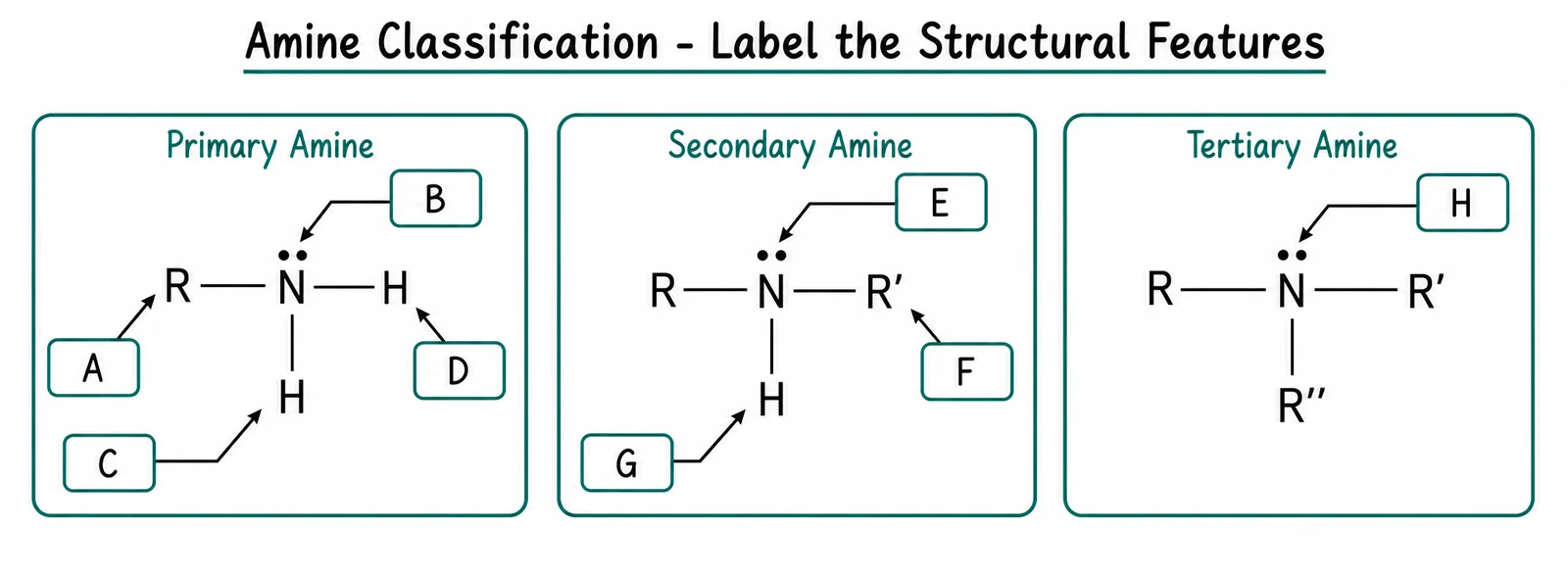
- A — classification name of R–NH₂ _______________________
- B — number of alkyl groups on N in R–NH–R' _______________________
- C — number of H atoms on N in R–N(R')R'' _______________________
- D — does R–NH₂ donate H-bonds between its own molecules? _______________________
- E — hybridisation of N in all three amines _______________________
- F — approximate bond angle at N _______________________
- G — example molecule for R–NH–R' (dimethyl variant) _______________________
- H — the reactive feature of N that makes all amines weak bases _______________________
| Box | Your label |
|---|---|
| A | |
| B | |
| C | |
| D | |
| E | |
| F | |
| G | |
| H |
2. Term–definition match
Match each definition to the correct term. Write the term in the right-hand column. Terms: primary amine, secondary amine, tertiary amine, amide, ammonium salt, condensation reaction, peptide bond, lone pair, delocalisation, Kb. 10 marks
| # | Definition | Matching term |
|---|---|---|
| 2.1 | An amine with exactly one alkyl group bonded to nitrogen; has two N–H bonds (e.g. ethylamine CH₃CH₂NH₂). | |
| 2.2 | An amine with two alkyl groups on nitrogen; has one N–H bond per molecule (e.g. dimethylamine (CH₃)₂NH). | |
| 2.3 | An amine with three alkyl groups on nitrogen; has no N–H bonds and cannot donate H-bonds between its own molecules (e.g. trimethylamine (CH₃)₃N). | |
| 2.4 | A functional group containing –CONH–; formed by condensation of a carboxylic acid and an amine; essentially neutral in water (Kb ∼ 10⁻¹⁵). | |
| 2.5 | The product when an amine reacts with a strong acid; an ionic compound with an alkylammonium cation and an anion (e.g. [CH₃NH₃⁺][Cl⁻]). | |
| 2.6 | A reaction in which two molecules combine with loss of a small molecule (usually water); the mechanism that forms the amide bond from carboxylic acid + amine. | |
| 2.7 | The amide linkage (–CO–NH–) between amino acid residues in a protein chain; identical in type to the bond formed when any carboxylic acid reacts with any amine. | |
| 2.8 | A non-bonding pair of electrons on nitrogen; the source of amine basicity and H-bond-accepting ability. | |
| 2.9 | The spreading of the nitrogen lone pair into the adjacent C=O pi system in an amide; the reason amides are not basic. | |
| 2.10 | The base dissociation constant; for amines Kb ∼ 10⁻⁴ (weak base), for amides Kb ∼ 10⁻¹⁵ (essentially neutral). |
3. True or false — with correction
Circle T or F for each statement. Where false, write the correct version on the line provided. 10 marks (1 mark T/F + 1 mark correction where needed)
3.1 Propan-2-amine (CH₃CH(NH₂)CH₃) is a secondary amine because the –NH₂ group is on the second carbon of the chain. T / F
3.2 Trimethylamine is insoluble in water because it has no N–H bonds to donate to water. T / F
3.3 When ethylamine reacts with hydrochloric acid, the product is an ionic ammonium salt (no water is produced and no covalent ester forms). T / F
3.4 Ethanamide (CH₃CONH₂) dissolves in water to give a basic solution because it contains nitrogen like all amines. T / F
3.5 Propanamide has a higher boiling point than propanoic acid, even though propanamide has a slightly lower molecular mass, because propanamide has both N–H donors AND a C=O acceptor forming a stronger cooperative H-bond network. T / F
4. Function recall
Answer each in 1–2 sentences using precise lesson terms. 8 marks (2 each)
4.1 What structural feature of amines makes them weak bases? Why is this feature described as “freely available”?
4.2 Why does the boiling point of a primary amine at the same chain length exceed that of a tertiary amine?
4.3 What is the function of the –CO–NH– (amide) bond in proteins, and what name does it take in that biological context?
4.4 Why does squeezing lemon juice onto Australian seafood reduce the fishy smell of trimethylamine?
5. Fill the gaps — amines and amides in context
Complete the paragraph using the word bank below. Each word is used once. 10 marks
Word bank: lone pair • weak base • resonance • ammonium salt • neutral • condensation • N–H bonds • C=O • highest • peptide bond
Amines act as a __________________ in water because the nitrogen atom's __________________ is freely available to accept a proton. When an amine reacts with a strong acid, the product is an ionic __________________ rather than a covalent compound, and no water is produced in this reaction. Adding NaOH to the salt releases the free amine again.
Amides differ fundamentally: the nitrogen's lone pair is delocalised into the adjacent __________________ group by __________________, making it unavailable to accept protons. As a result, amides are essentially __________________ in water.
Amides are formed by a __________________ reaction between a carboxylic acid and an amine, with loss of water. The amide group (–CO–NH–) in a protein is called the __________________. Because amides have both __________________ as donors and a C=O as a strong acceptor, they form the strongest intermolecular hydrogen-bond network of any functional group class, giving amides the __________________ boiling points of all functional groups at the same chain length.
6. Build a concept map
Draw labelled arrows between the six terms below. Each arrow must carry a linking phrase (e.g. “reacts with acid to form”, “forms by condensation from”, “has higher BP than”). Aim for at least 6 labelled arrows. 6 marks
Supplied terms: amine • amide • ammonium salt • carboxylic acid • lone pair • H-bond network
Q1 — Label the diagram
A: primary amine. B: two alkyl groups. C: zero H atoms on N. D: yes — primary amine has two N–H bonds so it is an H-bond donor. E: sp³ hybridised. F: approximately 107° (lone pair repulsion compresses tetrahedral angle from 109.5°). G: dimethylamine (CH₃)₂NH. H: the lone pair on nitrogen (freely available in a sp³ orbital, not delocalised).
Q2 — Term–definition matches
2.1 primary amine • 2.2 secondary amine • 2.3 tertiary amine • 2.4 amide • 2.5 ammonium salt • 2.6 condensation reaction • 2.7 peptide bond • 2.8 lone pair • 2.9 delocalisation • 2.10 Kb
Q3 — True / false with correction
3.1 False. Correction: propan-2-amine is a primary amine because only ONE alkyl group (the isopropyl/propan-2-yl group) is bonded to nitrogen. Amine classification counts alkyl groups on N, not which carbon in the chain carries the –NH₂ group.
3.2 False. Correction: trimethylamine IS soluble in water. Although it has no N–H bonds and therefore cannot donate H-bonds, the lone pair on nitrogen can accept H-bonds from water’s O–H groups — this interaction with water is sufficient for short-chain tertiary amines to dissolve.
3.3 True. Amine + strong acid → ionic ammonium salt; no water and no ester form. This is different from esterification (alcohol + carboxylic acid → ester + water).
3.4 False. Correction: ethanamide gives pH ≈ 7 (neutral). The nitrogen lone pair in ethanamide is delocalised into the C=O pi system by resonance, so it cannot accept protons from water. Kb ∼ 10⁻¹⁵ — negligible basicity. Having nitrogen does not guarantee basicity if the lone pair is unavailable.
3.5 True. Propanamide (MW ≈ 73) has a lower molecular mass than propanoic acid (MW ≈ 74) yet a much higher BP (213°C vs 141°C). The N–H donor + C=O acceptor cooperative H-bond network in propanamide is the reason — it is a stronger intermolecular interaction than the carboxylic acid dimer.
Q4.1 — Structural feature giving basicity
The lone pair on nitrogen, sitting in a free sp³ orbital. It is “freely available” because there is no adjacent carbonyl group to pull it into a pi system via resonance — the lone pair remains a non-bonding pair that can be donated to accept H⁺ from water: RNH₂ + H₂O ⇌ RNH₃⁺ + OH⁻.
Q4.2 — Primary vs tertiary amine BP
Primary amines have two N–H bonds per molecule, giving them H-bond donors. These N–H···N hydrogen bonds require energy to break on boiling. Tertiary amines have no N–H bonds and therefore cannot donate H-bonds; intermolecular forces are limited to dipole–dipole and dispersion. Less energy is needed to vaporise the tertiary amine → lower BP.
Q4.3 — Amide bond function in proteins
In proteins the amide bond (–CO–NH–) is called the peptide bond. It links adjacent amino acid residues in the polypeptide chain. Its restricted rotation (due to partial C–N double-bond character from resonance) makes the bond planar, constraining the protein backbone into specific secondary structures (alpha helix, beta sheet) that define the protein’s three-dimensional shape and function.
Q4.4 — Lemon juice and fishy smell
Trimethylamine ((CH₃)₃N) is a volatile tertiary amine responsible for the fishy odour. The citric acid in lemon juice protonates it: (CH₃)₃N + H⁺ → [(CH₃)₃NH⁺]. The trimethylammonium salt is ionic, non-volatile, and has no free lone pair to reach olfactory receptors — no molecules reach the nose, so the smell disappears. This is a simple acid–base neutralisation of the amine.
Q5 — Cloze paragraph (in order)
weak base • lone pair • ammonium salt • C=O • resonance • neutral • condensation • peptide bond • N–H bonds • highest
Q6 — Sample concept map arrows
- amine — reacts with HCl to form → ammonium salt
- amine — has freely available → lone pair
- lone pair — accepts H⁺ from water making amine a → amine (weak base)
- amine + carboxylic acid — condenses with loss of water to form → amide
- amide — has N–H donors + C=O acceptor creating → H-bond network
- H-bond network — gives amide the → highest BP of all functional groups at same chain length
Award 1 mark per correctly labelled, causally directed arrow (min 6 for full marks).