Chemistry • Year 12 • Module 7 • Lesson 15
Esters: Structure, Naming & Esterification
Lock in the ester functional group, the alkyl alkanoate naming rule, esterification conditions, and the vocabulary of hydrolysis.
1. Label the ester structural diagram
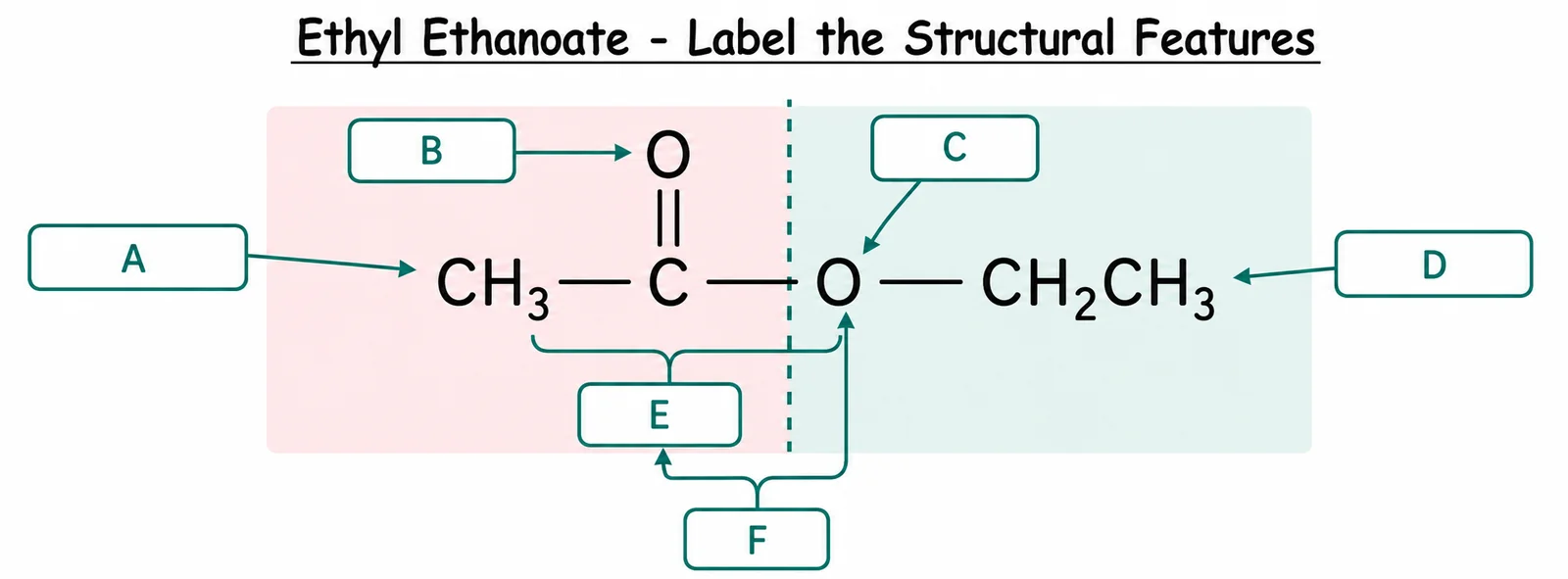
The diagram below shows the condensed structural formula of ethyl ethanoate with six labelled positions. Write the correct label for each box A–F. Choose from: acid-derived half (ethanoate); alcohol-derived half (ethyl); carbonyl oxygen (C=O); ester oxygen (single-bond O); ester linkage –COO–; cannot donate H-bonds. 6 marks
| Box | Your label |
|---|---|
| A | |
| B | |
| C | |
| D | |
| E | |
| F |
2. Term–definition match
The ten definitions below are shuffled. In the right-hand column write the matching term from this list: ester, esterification, saponification, acid hydrolysis, triglyceride, alkyl alkanoate, ester linkage (–COO–), Le Chatelier’s Principle, reflux, percentage yield. 10 marks
| # | Definition (shuffled) | Matching term |
|---|---|---|
| 2.1 | An organic compound with the functional group –C(=O)–O–; formed when a carboxylic acid reacts with an alcohol. | |
| 2.2 | The reversible condensation reaction between a carboxylic acid and an alcohol, producing an ester and water, catalysed by concentrated H₂SO₄. | |
| 2.3 | Base-catalysed hydrolysis of an ester with NaOH; irreversible; produces a carboxylate salt (soap) and an alcohol. | |
| 2.4 | Hydrolysis of an ester using aqueous acid; the reverse of esterification; a reversible process that regenerates the carboxylic acid and alcohol. | |
| 2.5 | A triester of glycerol (propane-1,2,3-triol) with three long-chain fatty acids; the chemical name for fats and oils. | |
| 2.6 | The IUPAC naming system for esters: the alcohol-derived portion is named first (alkyl), the acid-derived portion second (alkanoate). | |
| 2.7 | The –C(=O)–O– functional group that connects the two carbon chains in an ester molecule. | |
| 2.8 | The principle stating that a system at equilibrium responds to an applied stress by shifting to oppose that stress. | |
| 2.9 | A technique in which a condenser returns volatile vapours to the reaction flask, keeping all reactants and products in contact at the boiling point. | |
| 2.10 | The ratio of the actual mass of product obtained to the theoretical maximum mass, expressed as a percentage. |
3. True or false — with correction
For each statement, circle T or F. If the statement is false, write the corrected version on the line below it. 10 marks (1 T/F + 1 correction where false)
3.1 In IUPAC naming, the acid-derived portion of an ester is listed first and the alcohol-derived portion is listed second (e.g. “ethanoate ethyl”). T / F
3.2 Esterification is a reversible equilibrium reaction and should be written with a double-headed (reversible) arrow. T / F
3.3 Concentrated H₂SO₄ is a reactant in esterification — it is consumed during the reaction and appears in the products. T / F
3.4 Esters can form hydrogen bonds with each other because they have two oxygen atoms. T / F
3.5 Saponification (base hydrolysis of an ester with NaOH) is irreversible because the carboxylate salt produced cannot re-esterify under basic conditions. T / F
4. Function recall
Answer each in 1–2 sentences using precise lesson terms. 8 marks (2 each)
4.1 Why do esters have lower boiling points than alcohols of similar molecular mass?
4.2 What is the function of the Na₂CO₃ wash step when isolating an ester using a separating funnel?
4.3 Why does the esterification equilibrium favour neither side completely under standard conditions?
4.4 Why are fats solid and oils liquid at room temperature, given that both are triglycerides?
5. Fill the blanks — esterification and naming
Use the word bank to complete the passage. Each word is used once. 8 marks (1 each)
Esters are named using the alkyl alkanoate system: the alcohol-derived part is named as an group (e.g. “ethyl” from ethanol), while the acid-derived part is named as an (e.g. “ethanoate” from ethanoic acid). The reaction that forms an ester is called esterification; it uses concentrated H₂SO₄ as a and requires heating under to prevent volatile components from escaping the flask. Esterification is a reversible reaction, so 100% yield is never achieved without modification. The reverse reaction, which regenerates the acid and alcohol by adding , is called . Unlike acid hydrolysis, base hydrolysis (saponification) is because the carboxylate salt produced cannot re-esterify under basic conditions.
6. Build a concept map
Draw labelled arrows between the six terms below to show how they are connected. Each arrow must carry a linking phrase (e.g. “is reversed by”, “produces”, “is catalysed by”). Aim for at least 6 labelled arrows. 6 marks
Supplied terms: esterification • carboxylic acid + alcohol • ester + water • Le Chatelier’s Principle • saponification • equilibrium yield.
Q1 — Ester diagram labels
A: acid-derived half (ethanoate). B: carbonyl oxygen (C=O). C: ester oxygen (single-bond O). D: alcohol-derived half (ethyl). E: ester linkage –COO–. F: cannot donate H-bonds (no O–H bond present).
Q2 — Term–definition matches
2.1 ester • 2.2 esterification • 2.3 saponification • 2.4 acid hydrolysis • 2.5 triglyceride • 2.6 alkyl alkanoate • 2.7 ester linkage (–COO–) • 2.8 Le Chatelier’s Principle • 2.9 reflux • 2.10 percentage yield.
Q3 — True / False
3.1 False. Correction: the alcohol-derived portion (alkyl) is listed first and the acid-derived portion (alkanoate) is listed second. The correct name is e.g. “ethyl ethanoate” not “ethanoate ethyl”.
3.2 True.
3.3 False. Correction: concentrated H₂SO₄ is a catalyst — it is not consumed during esterification and does not appear in the products. It also acts as a dehydrating agent but remains classified as a catalyst overall.
3.4 False. Correction: esters have no O–H bond and therefore cannot donate hydrogen bonds. They can only accept H-bonds via the lone pairs on their two oxygens. Ester–ester interactions are dipole–dipole only, not H-bonding.
3.5 True.
Q4 — Function recall
4.1 Esters have no O–H bond and therefore cannot donate hydrogen bonds; ester–ester interactions are limited to dipole–dipole forces. Alcohols have an O–H bond that acts as both a donor and acceptor of H-bonds, which are stronger than dipole–dipole forces, so alcohols require more energy to vaporise and have higher boiling points despite similar or lower molecular mass.
4.2 The Na₂CO₃ wash reacts with residual carboxylic acid in the ester layer (equation: 2RCOOH + Na₂CO₃ → 2RCOONa + H₂O + CO₂) and neutralises any residual H₂SO₄. Both products are water-soluble and remain in the lower aqueous layer, which is drained off, leaving a purer ester in the upper organic layer.
4.3 Esterification is a reversible equilibrium (Keq ≈ 1–4 for simple acids and primary alcohols). At equilibrium, both the forward reaction (esterification) and the reverse reaction (acid hydrolysis) occur simultaneously, and all four species — acid, alcohol, ester, and water — are present at appreciable concentrations. Conversion is typically only 50–70% under standard conditions.
4.4 Both fats and oils are triesters (triglycerides), but fats have saturated fatty acid chains that are straight and pack closely together, giving strong cumulative dispersion forces and a high melting point (solid). Oils have unsaturated fatty acid chains with cis C=C kinks that prevent close packing, giving weaker dispersion forces and a lower melting point (liquid at room temperature).
Q5 — Cloze
In order: alkyl • alkanoate • catalyst • reflux • equilibrium • water • hydrolysis • irreversible.
Q6 — Sample concept map
Acceptable arrows include: carboxylic acid + alcohol —react in→ esterification; esterification —produces→ ester + water; esterification —is a reversible→ equilibrium yield; Le Chatelier’s Principle —predicts how to shift→ equilibrium yield; ester + water —shifts equilibrium left under→ Le Chatelier’s Principle (excess water); ester —is irreversibly hydrolysed in→ saponification. Award 1 mark per correctly labelled causal arrow (minimum 6).