Chemistry • Year 12 • Module 7 • Lesson 13
Aldehydes & Ketones: Structure, Properties & Tests
Lock in the key vocabulary, structural features, IUPAC naming, and test results for aldehydes and ketones before tackling exam-style application.
1. Label the carbonyl structure diagram
The diagram below shows key structural features of an aldehyde and a ketone. Write the missing labels into boxes A–H. Each label is drawn from this lesson's Key Terms. 8 marks
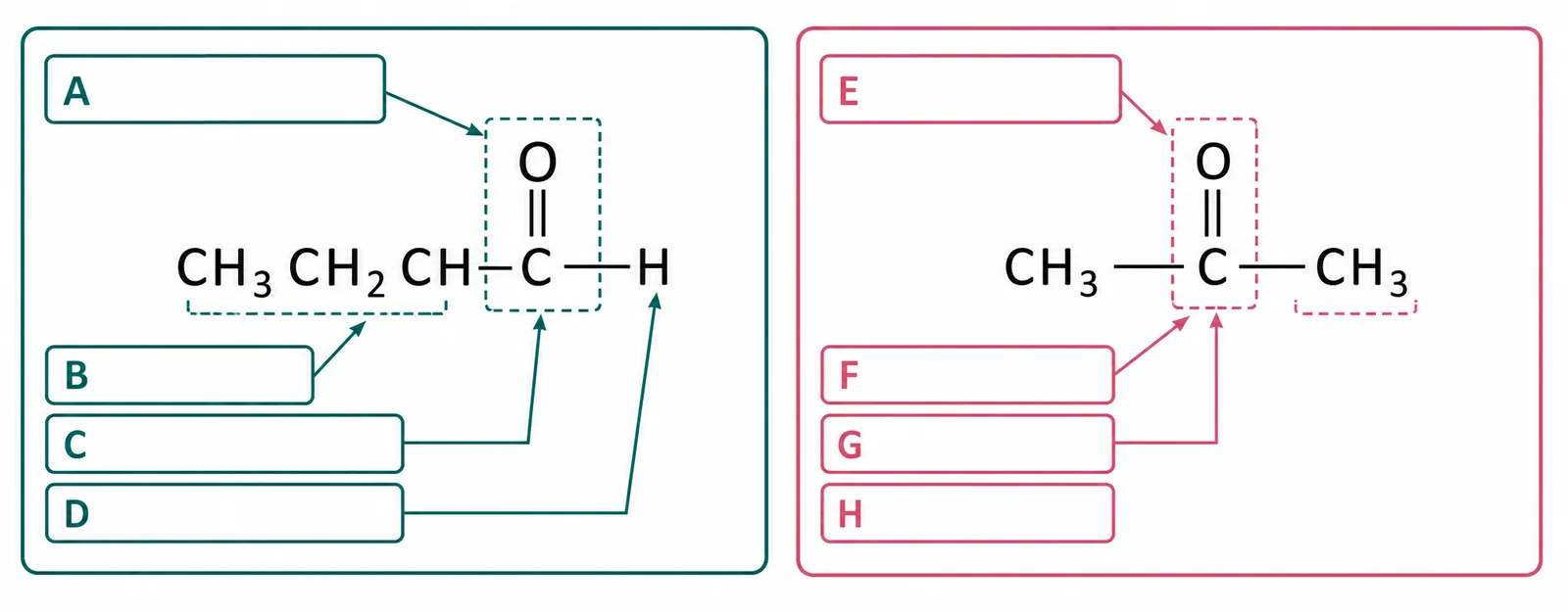
| Box | Your label |
|---|---|
| A | |
| B | |
| C | |
| D | |
| E | |
| F | |
| G | |
| H |
2. Term–definition match
The ten definitions below are shuffled. In the right-hand column write the matching term from this list: aldehyde, ketone, carbonyl group, Tollens’ reagent, Fehling’s solution, methanal, propanone, nucleophilic addition, boiling point, functional group isomers. 10 marks
| # | Definition (shuffled) | Matching term |
|---|---|---|
| 2.1 | The C=O bond that is the defining feature of both aldehydes and ketones; strongly polar with δ+ on C and δ− on O. | |
| 2.2 | A carbonyl compound where the C=O is at the terminal carbon of the chain; general formula RCHO; carries an H on the carbonyl carbon. | |
| 2.3 | A carbonyl compound where the C=O is bonded to two carbon atoms within the chain; general formula RCOR'; no H on carbonyl carbon. | |
| 2.4 | Ammoniacal silver nitrate solution; produces a silver mirror on glass in the presence of an aldehyde; no reaction with ketones. | |
| 2.5 | A blue Cu²⁺ solution reduced to brick-red Cu₂O precipitate by an aldehyde; no reaction with ketones. | |
| 2.6 | The simplest aldehyde, HCHO; used in building materials (e.g. particle board resins); a known respiratory irritant regulated by Safe Work Australia. | |
| 2.7 | The simplest ketone, CH₃COCH₃; used as the active solvent in nail polish remover; fully miscible with water. | |
| 2.8 | Compounds that have the same molecular formula but different functional groups; propanal and propanone are an example at C₃H₆O. | |
| 2.9 | The temperature at which a substance’s vapour pressure equals atmospheric pressure; influenced by the strength of intermolecular forces. | |
| 2.10 | The reaction type common to aldehydes and ketones where a nucleophile attacks the electrophilic carbonyl carbon; e.g. HCN addition to form a cyanohydrin. |
3. True or false — with correction
For each statement, circle T or F. If the statement is false, write the corrected version on the line below. 10 marks (1 for T/F, 1 for the correction where needed)
3.1 The H atom in the −CHO group of an aldehyde is bonded to oxygen, enabling the aldehyde to donate H-bonds between its own molecules. T / F
3.2 Ketones give a positive Fehling’s test result because they contain a C=O group. T / F
3.3 Propanal and propanone are functional group isomers because they share the molecular formula C₃H₆O but differ in the position of the C=O group. T / F
3.4 The boiling point of butanal is higher than that of butan-1-ol because aldehydes have stronger intermolecular forces than alcohols. T / F
3.5 A ketone cannot be oxidised to a carboxylic acid under normal laboratory conditions because there is no H on the carbonyl carbon for the oxidising agent to remove. T / F
4. Cloze — carbonyl chemistry in context
Fill in each blank using a word or short phrase from the word bank below. Each word is used once. 9 marks
The two main classes of carbonyl compound are the __________ and the __________. In an __________, the C=O group is located at the __________ carbon of the chain and carries an H on the carbonyl carbon, while in a __________ the C=O is __________ within the chain and there is no H on the carbonyl carbon. Because neither class has an O–H bond, molecules of each class attract each other through __________ forces rather than hydrogen bonds, giving lower boiling points than comparable alcohols. When Tollens’ reagent is added to an aldehyde a __________ forms on the glass, whereas Fehling’s solution produces a __________ precipitate of Cu₂O. Acidified K₂Cr₂O₇ turns __________ when an aldehyde is present because the aldehyde is __________ to a carboxylic acid.
5. Build a concept map
Draw labelled arrows between the six terms below to show how they connect. Each arrow must carry a linking phrase (e.g. “has no H on”, “gives positive”, “is oxidised by”). Aim for at least 6 labelled arrows. 6 marks
Supplied terms: aldehyde · ketone · Tollens’ reagent · carbonyl carbon (H present) · silver mirror · carboxylic acid.
Q1 — Labelled diagram
A: Aldehyde. B: –al (suffix). C: Terminal (C1). D: Yes — H is on the carbonyl carbon. E: Ketone. F: –one (suffix). G: Internal (C2 or higher). H: No — no H on the carbonyl carbon.
Q2 — Term–definition matches
2.1 carbonyl group • 2.2 aldehyde • 2.3 ketone • 2.4 Tollens’ reagent • 2.5 Fehling’s solution • 2.6 methanal • 2.7 propanone • 2.8 functional group isomers • 2.9 boiling point • 2.10 nucleophilic addition.
Q3 — True / false with correction
3.1 False. Correction: the H in −CHO is bonded to carbon (a C–H bond), not to oxygen. There is no O–H group in an aldehyde, so aldehydes cannot donate H-bonds between their own molecules.
3.2 False. Correction: Fehling’s test is specific for aldehydes only; ketones give a negative result — the solution remains blue. The test requires removal of H from the carbonyl carbon, which ketones lack.
3.3 True.
3.4 False. Correction: butan-1-ol has a higher boiling point than butanal (118 °C vs 75 °C). Alcohols form O–H hydrogen bonds (both donor and acceptor) between molecules, which are stronger than the dipole-dipole forces between aldehyde molecules.
3.5 True.
Q4 — Cloze answers (in order of blanks)
aldehyde • ketone • aldehyde • terminal • ketone • internal • dipole-dipole • silver mirror • brick-red • orange to green • oxidised.
Q5 — Sample concept map
A correct map should include arrows such as:
- aldehyde — has → carbonyl carbon (H present)
- ketone — lacks H on → carbonyl carbon (H present)
- aldehyde — reacts with → Tollens’ reagent
- Tollens’ reagent — produces → silver mirror
- aldehyde — is oxidised to → carboxylic acid
- ketone — gives no reaction with → Tollens’ reagent
Any biologically/chemically valid linking phrases are accepted. Award 1 mark per correctly labelled arrow that respects causal or chemical direction (max 6).