Chemistry • Year 12 • Module 7 • Lesson 9
Structure & Properties of Alcohols
Lock in the vocabulary and structural logic of primary, secondary, and tertiary alcohols, hydrogen bonding, and the solubility trend before moving to application tasks.
1. Label the alcohol classification diagram
The diagram below shows three alcohol molecules with key features indicated by boxes A–H. Write the correct label in each box. Labels are drawn from the lesson’s Key Terms and Card 2. 8 marks
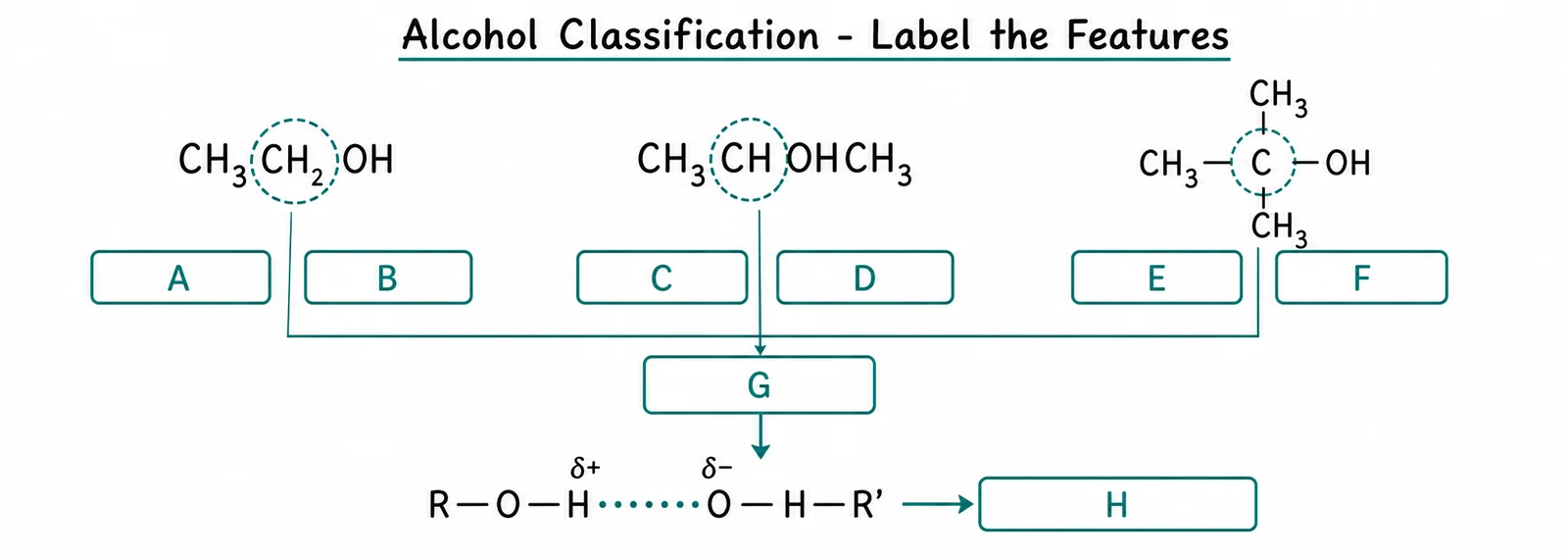
| Box | Your label |
|---|---|
| A | |
| B | |
| C | |
| D | |
| E | |
| F | |
| G | |
| H |
2. Term–definition match
The ten definitions below are shuffled. In the right-hand column write the matching term from this list: alcohol, hydroxyl group (-OH), hydrogen bond, primary alcohol (1°), secondary alcohol (2°), tertiary alcohol (3°), miscible, dispersion forces, boiling point, sp³ hybridisation. 10 marks
| # | Definition (shuffled) | Matching term |
|---|---|---|
| 2.1 | An organic compound containing a hydroxyl group bonded directly to a carbon atom. General formula R-OH. | |
| 2.2 | The functional group -OH; the oxygen has two lone pairs (acceptor) and the O-H bond makes H a strong donor. | |
| 2.3 | An electrostatic attraction between a δ+ H bonded to O, N, or F and a lone pair on O, N, or F of a neighbouring molecule (~20–25 kJ/mol). | |
| 2.4 | An alcohol where the C-OH carbon is bonded to only one other carbon (or none, as in methanol). General structure R-CH&sub2;OH. | |
| 2.5 | An alcohol where the C-OH carbon is bonded to two other carbons. General structure R-CH(OH)-R’. | |
| 2.6 | An alcohol where the C-OH carbon is bonded to three other carbons; no H on C-OH. General structure R-C(OH)(R’)(R”). | |
| 2.7 | Two liquids that dissolve completely in each other in all proportions. | |
| 2.8 | Weak, temporary forces between non-polar molecules arising from instantaneous dipoles; strength increases with molecular surface area. | |
| 2.9 | The temperature at which a substance transitions from liquid to gas at standard pressure; used to compare IMF strength. | |
| 2.10 | Carbon bonding arrangement with four σ-bonds in a tetrahedral geometry (~109.5°); the carbon state in all alcohols. |
3. True or false — with correction
For each statement, circle T or F. If the statement is false, write the corrected version on the line. 10 marks (1 T/F + 1 correction where needed)
3.1 A tertiary alcohol has a higher boiling point than its primary isomer because it has three alkyl groups giving greater dispersion forces. T / F
3.2 Tertiary alcohols cannot form hydrogen bonds because the C-OH carbon has no hydrogen atoms attached to it. T / F
3.3 Methanol is classified as a primary alcohol by convention, even though its C-OH carbon has no other carbon neighbours. T / F
3.4 In a hydrogen bond between two alcohol molecules, the oxygen atom is the hydrogen bond donor. T / F
3.5 Short-chain alcohols (C1–C3) are fully miscible with water because their -OH group can form hydrogen bonds with water molecules. T / F
4. Function recall
Answer each question in 1–2 sentences using precise lesson terms. 10 marks (2 each)
4.1 What is the function of the hydroxyl group (-OH) in determining the physical properties of alcohols?
4.2 Why do alcohols have much higher boiling points than alkanes of similar molecular mass?
4.3 What is the rule used to classify an alcohol as primary, secondary, or tertiary? State it precisely.
4.4 Why does solubility in water decrease as the carbon chain length of an alcohol increases?
4.5 In the context of IMF, why does branching in an alcohol lower its boiling point relative to its straight-chain isomer?
5. Fill in the blanks — alcohols and IMF
Complete the paragraph using the word bank below. Each word is used once. 8 marks
Word bank: hydrogen bonds • lone pairs • primary • dispersion forces • boiling point • non-polar • donor • miscible
Ethanol (CH3CH2OH) is a __________ (1) alcohol because the C-OH carbon is bonded to one other carbon. The O-H bond in ethanol is highly polar: the hydrogen is the __________ (2) of a hydrogen bond, while the oxygen’s __________ (3) act as acceptors. These __________ (4) require much more energy to break than the weak __________ (5) between ethane molecules, so ethanol has a much higher __________ (6) than ethane. Ethanol is fully __________ (7) with water because its small ethyl chain creates minimal disruption to water’s H-bond network. By contrast, hexan-1-ol is practically insoluble in water because its large __________ (8) chain overwhelms the contribution of the single -OH group.
6. Build a concept map — alcohols and IMF
Draw labelled arrows between the five terms below to show how they connect. Each arrow must carry a linking phrase (e.g. “enables”, “determines”, “decreases with”). Aim for at least 5 labelled arrows. 5 marks
Supplied terms: hydroxyl group (-OH) • hydrogen bond • boiling point • chain length • water solubility.
Q1 — Labelled diagram
A: Primary (1°). B: 1 other carbon. C: Secondary (2°). D: 2 other carbons. E: Tertiary (3°). F: 3 other carbons. G: Hydroxyl group (-OH). H: Hydrogen bonding (hydrogen bonds).
Q2 — Term–definition matches
2.1 alcohol • 2.2 hydroxyl group (-OH) • 2.3 hydrogen bond • 2.4 primary alcohol (1°) • 2.5 secondary alcohol (2°) • 2.6 tertiary alcohol (3°) • 2.7 miscible • 2.8 dispersion forces • 2.9 boiling point • 2.10 sp³ hybridisation.
Q3 — True/False with correction
3.1 False. Correction: a tertiary alcohol has a lower boiling point than its primary isomer. More branching = more compact shape = less molecular surface area = weaker dispersion forces = lower boiling point. The H-bonding from -OH is equivalent for all three classes.
3.2 False. Correction: tertiary alcohols do form hydrogen bonds. All alcohols have the -OH group, which provides both an O-H H-bond donor and lone-pair H-bond acceptors. Classification (1°/2°/3°) refers to the carbon skeleton around C-OH, not to the -OH group itself.
3.3 True. By convention, methanol is primary. Zero other carbons satisfies the “≤1 other carbon” condition for primary classification. There is no “0° alcohol” classification.
3.4 False. Correction: the hydrogen atom (on the O-H bond, carrying a δ+ partial charge) is the H-bond donor. The oxygen’s lone pairs are the H-bond acceptors.
3.5 True. The -OH group H-bonds with water, and the short 1–3 carbon non-polar chain creates minimal disruption to water’s H-bond network, so the -OH–water interaction is energetically sufficient for full miscibility.
Q4.1 — Function of -OH
The -OH group acts as both a hydrogen bond donor (via the δ+ O-H hydrogen) and a hydrogen bond acceptor (via the oxygen’s lone pairs). This enables alcohol molecules to form an extensive H-bond network with each other and with water, which dramatically raises boiling point and determines water solubility.
Q4.2 — Why alcohols have higher BPs than alkanes
Alcohols have a highly polar -OH group that enables hydrogen bonding between molecules (~20–25 kJ/mol per H-bond). Comparable alkanes have only C-H and C-C bonds, producing only weak London dispersion forces. Breaking the H-bond network in an alcohol requires far more energy than overcoming dispersion forces in an alkane of similar molecular mass, so alcohols have dramatically higher boiling points.
Q4.3 — Classification rule
Find the carbon bearing the -OH group. Count how many other carbons are directly bonded to that carbon. If 0 or 1: primary (1°). If 2: secondary (2°). If 3: tertiary (3°). Do not count H atoms or the oxygen; only count the other carbons directly bonded to C-OH.
Q4.4 — Solubility trend with chain length
As chain length increases, the non-polar hydrocarbon portion of the molecule grows while the -OH group remains constant at one per molecule. Accommodating the longer non-polar chain within water’s H-bond network requires disrupting more water–water H-bonds. Beyond about C4–C5, the energy cost of this disruption exceeds what the single -OH–water interaction can compensate for, and solubility falls sharply.
Q4.5 — Branching lowers BP
Branching makes a molecule more compact and spherical, reducing the effective surface area that can come into contact with neighbouring molecules. Less contact area means weaker London dispersion forces (which depend on surface area). Since all constitutional isomers have the same -OH group and equivalent H-bonding, the branching effect on dispersion forces is the deciding factor: more branching → weaker dispersion → lower boiling point.
Q5 — Cloze answers
(1) primary • (2) donor • (3) lone pairs • (4) hydrogen bonds • (5) dispersion forces • (6) boiling point • (7) miscible • (8) non-polar.
Q6 — Sample concept map
A correct map should include arrows such as:
- hydroxyl group (-OH) — enables → hydrogen bond
- hydrogen bond — raises → boiling point
- hydroxyl group (-OH) — contributes to → water solubility
- chain length — decreases → water solubility
- chain length — increases (via dispersion forces) → boiling point
Award 1 mark per correctly labelled, causally valid arrow (minimum 5).