Chemistry • Year 12 • Module 7 • Lesson 6
Reactions of Alkenes
Lock in the reagents, conditions, and products for all four alkene addition reactions — hydrogenation, halogenation, hydrohalogenation, and hydration — including Markovnikov’s rule and the bromine water test.
1. Label the reactions-of-alkenes overview diagram
The diagram below shows a central alkene surrounded by four addition reactions. Write the missing labels into boxes A–H using the word bank provided. 8 marks
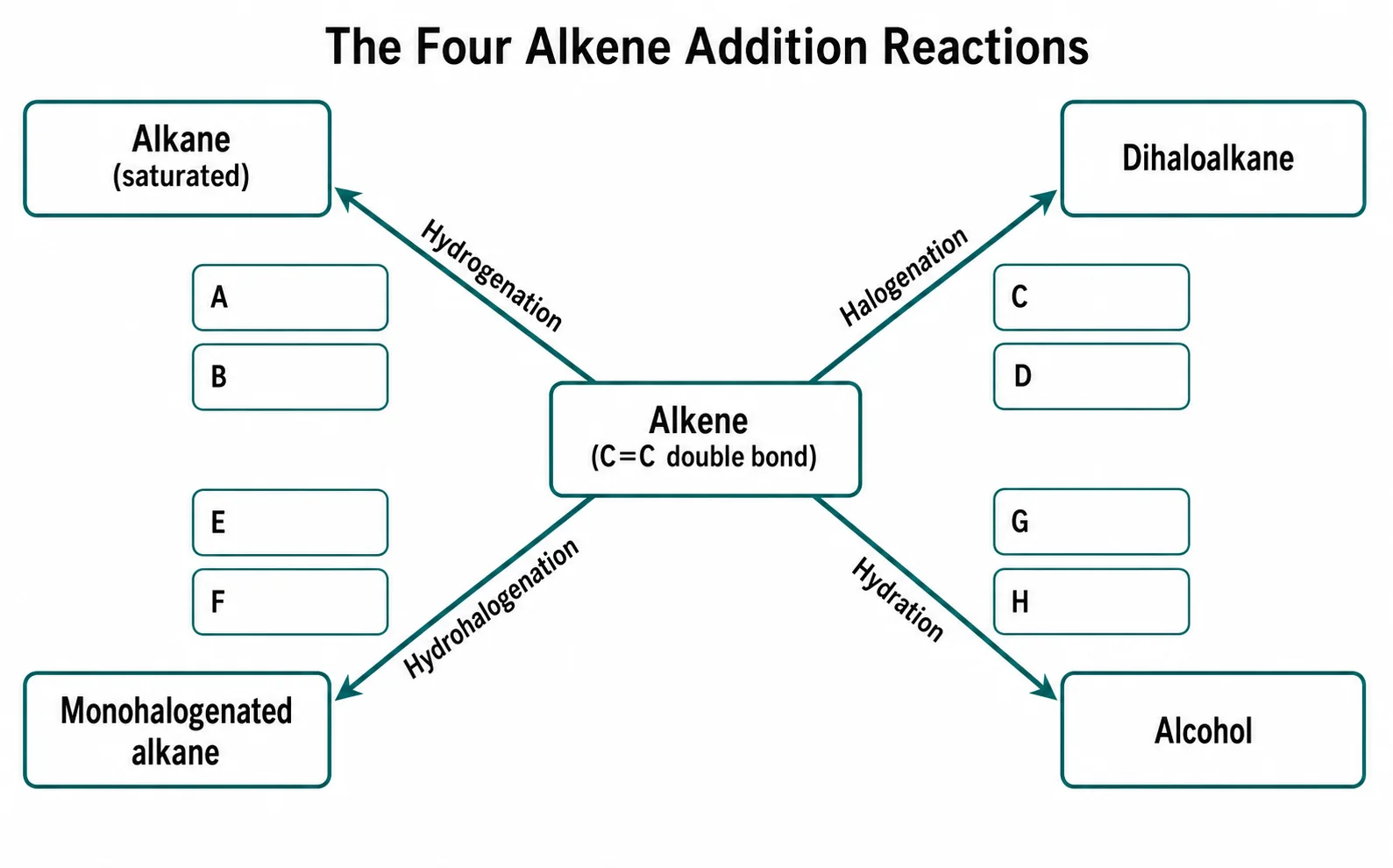
Word bank: H2 | Br2 | HBr | H2O (steam) | Ni/Pd/Pt catalyst ~150–200°C | no catalyst, room temperature | no catalyst, room temperature | H3PO4 catalyst ~300°C, high pressure
| Box | Your label |
|---|---|
| A (reagent: hydrogenation) | |
| B (conditions: hydrogenation) | |
| C (reagent: halogenation) | |
| D (conditions: halogenation) | |
| E (reagent: hydrohalogenation) | |
| F (conditions: hydrohalogenation) | |
| G (reagent: hydration) | |
| H (conditions: hydration) |
2. Term–definition match
Match each definition to its term from this list: addition reaction, pi bond, hydrogenation, halogenation, hydrohalogenation, hydration, Markovnikov’s rule, bromine water test, dihaloalkane, vicinal dihalide. 10 marks
| # | Definition | Matching term |
|---|---|---|
| 2.1 | A reaction in which two reactants combine to form one product, with no atoms lost. The C=C pi bond opens and the reagent adds across it. | |
| 2.2 | The weaker, more reactive component of the C=C bond, formed by sideways overlap of p-orbitals; sits above and below the molecular plane. | |
| 2.3 | The addition of H2 across a C=C bond to produce a saturated alkane. Requires a Ni, Pd, or Pt catalyst. | |
| 2.4 | The addition of X2 (Br2 or Cl2) across a C=C bond to produce a compound with one halogen on each carbon of the former double bond. | |
| 2.5 | The addition of HX (HCl, HBr, or HI) across a C=C bond to produce a monohalogenated alkane. | |
| 2.6 | The addition of H2O across a C=C bond to produce an alcohol. Requires an acid catalyst, ~300°C, and high pressure. | |
| 2.7 | When HX adds to an unsymmetrical alkene, H goes to the carbon with more H atoms and X goes to the more-substituted carbon. | |
| 2.8 | A qualitative test in which orange/brown Br2(aq) decolourises upon reaction with a C=C or C≡C bond. | |
| 2.9 | A compound containing two halogen atoms on adjacent carbons, produced by halogenation of an alkene. | |
| 2.10 | Another term for 2.9 — emphasising that the two halogens are on neighbouring carbons of the carbon chain. |
3. True or false — with correction
For each statement, circle T or F. If false, write the corrected version on the line provided. 8 marks (1 T/F + 1 correction where needed)
3.1 In every alkene addition reaction, two products are formed from two reactants. T / F
3.2 The bromine water test specifically confirms the presence of an alkene (C=C) and no other functional group. T / F
3.3 Industrial hydration of ethene requires a Ni catalyst, steam, and ~150–200°C. T / F
3.4 Markovnikov’s rule is only needed when the two carbons of the C=C double bond are different (unsymmetrical alkene). T / F
4. Complete the cloze paragraph
Fill each blank with the correct term or phrase from the word bank. Each blank is worth 1 mark. 8 marks
Word bank: pi bond · addition · sigma bond · Ni · colourless · orange/brown · Markovnikov’s · more substituted
Alkenes undergo __________________ reactions because their C=C double bond contains a __________________, which is weak and sits exposed above and below the molecular plane, making it reactive. The stronger __________________ framework bond remains intact during the reaction.
In hydrogenation, H2 is added across the C=C bond using a __________________ (or Pd or Pt) catalyst. This reaction is used industrially to harden vegetable oils into margarine by reducing the number of double bonds. The product is a saturated alkane.
The bromine water test uses Br2(aq), which is __________________ in colour. When an unsaturated compound such as an alkene is added, the bromine reacts by addition and the solution becomes __________________. This confirms the presence of unsaturation (C=C or C≡C).
When HBr adds to an unsymmetrical alkene, __________________ rule states that the H atom goes to the carbon with more hydrogen atoms and the Br atom goes to the __________________ carbon.
5. Function recall
Answer each in 1–2 sentences using precise terms from the lesson. 6 marks (2 each)
5.1 What is the function of the nickel catalyst in the hydrogenation of a vegetable oil?
5.2 What is the function of the H3PO4 catalyst in the industrial hydration of ethene?
5.3 What is the function of high pressure in the industrial hydration of ethene to produce ethanol?
6. Complete the reaction conditions table
Fill in the missing cells. Each cell is worth 1 mark. 8 marks
| Reaction type | Reagent added | Catalyst | Temperature / other conditions | Product type |
|---|---|---|---|---|
| Hydrogenation | Ni, Pd, or Pt | Alkane (saturated) | ||
| Halogenation | Br2 or Cl2 | Room temperature | ||
| Hydrohalogenation | None required | Monohalogenated alkane | ||
| Hydration | H2O (steam) | ~300°C, high pressure |
Q1 — Labelled diagram
A: H2. B: Ni/Pd/Pt catalyst, ~150–200°C. C: Br2 (or Cl2). D: no catalyst, room temperature. E: HBr (or HCl, HI). F: no catalyst, room temperature. G: H2O (steam). H: H3PO4 catalyst, ~300°C, high pressure.
Q2 — Term–definition matches
2.1 addition reaction • 2.2 pi bond • 2.3 hydrogenation • 2.4 halogenation • 2.5 hydrohalogenation • 2.6 hydration • 2.7 Markovnikov’s rule • 2.8 bromine water test • 2.9 dihaloalkane • 2.10 vicinal dihalide.
Q3 — True / false
3.1 False. Correction: in an addition reaction, two reactants combine to form one product — nothing is lost.
3.2 False. Correction: the bromine water test confirms the presence of unsaturation (C=C or C≡C). Alkynes also decolourise bromine water; the test is not specific to alkenes.
3.3 False. Correction: industrial hydration of ethene requires a H3PO4 (or H2SO4) catalyst, steam (H2O), ~300°C, and high pressure (~65 atm). Ni is the catalyst for hydrogenation, not hydration.
3.4 True. For symmetrical alkenes (e.g. but-2-ene), both C=C carbons are equivalent and only one product is possible, so Markovnikov’s rule is not needed.
Q4 — Cloze paragraph
In order: addition • pi bond • sigma bond • Ni • orange/brown • colourless • Markovnikov’s • more substituted.
Q5.1 — Function of the Ni catalyst in hydrogenation
The nickel catalyst provides a solid surface (heterogeneous catalysis) on which both the alkene and H2 adsorb, lowering the activation energy for H–H bond breaking. The catalyst is not consumed; it enables the reaction to occur at ~150–200°C rather than at the much higher uncatalysed temperature.
Q5.2 — Function of H3PO4 in hydration
H3PO4 (phosphoric acid) acts as an acid catalyst, protonating the alkene’s pi bond to initiate electrophilic addition. It lowers the activation energy for the reaction between ethene and steam, allowing the reaction to proceed at an industrially practical rate at ~300°C. The catalyst is not consumed.
Q5.3 — Function of high pressure in hydration
The hydration reaction is reversible: alkene + H2O ⇌ alcohol. High pressure (~65 atm) increases the concentration of the gaseous reactants and, by Le Chatelier’s principle, shifts the equilibrium toward the side with fewer moles of gas (the alcohol product), increasing the yield of ethanol.
Q6 — Reaction conditions table
Hydrogenation: reagent = H2; conditions = ~150–200°C, pressure vessel. Halogenation: catalyst = none; product = dihaloalkane (vicinal dihalide). Hydrohalogenation: reagent = HCl, HBr, or HI; conditions = room temperature. Hydration: catalyst = H3PO4 (or H2SO4); product = alcohol.