Chemistry • Year 12 • Module 7 • Lesson 5
Hydrocarbon Reactions
Apply combustion, substitution, addition and polymerisation to real Australian data, lab observations, and structured scenarios.
1. Interpret combustion emissions data — Black Summer fire season
During the 2019–20 Black Summer bushfire season, satellite measurements recorded average daily CO (carbon monoxide) and CO2 column concentrations over southeastern Australia. The stylised graph below captures the seasonal trend in CO anomaly (deviation from multi-year baseline) as a proxy for the intensity of incomplete combustion in the landscape. 8 marks
Stylised monthly CO anomaly over southeastern Australia, 2019–20. After Jones et al. (2020), Nature; satellite MOPITT data.
1.1 Describe the trend in CO anomaly from July 2019 to March 2020. Identify the month of peak concentration and give its approximate value. 2 marks
1.2 Using the lesson’s content on combustion products, explain why the December–January peak in CO anomaly indicates incomplete rather than complete combustion was dominant during the fire season. 3 marks
1.3 Predict how the CO2 anomaly for the same period would compare to the CO trend shown. Justify your prediction with reference to combustion chemistry. 3 marks
2. Cause-and-effect chain — free-radical substitution of methane
The cause boxes below describe the key stages of free-radical chlorination of methane. Complete the empty effect boxes and the overall outcome. 5 marks
3. Compare substitution and addition reactions
Complete the comparison table. Each cell may require 1–2 short phrases. 8 marks
| Feature | Substitution (alkane + halogen) | Addition (alkene + Br2) |
|---|---|---|
| Type of hydrocarbon involved | ||
| Bond type targeted in the reaction | ||
| Condition required | ||
| Observation with bromine water | ||
| Example equation (with methane or ethene) | ||
| Change in molecular formula | ||
| By-product (if any) | ||
| Named from lesson |
4. Predict-and-justify — Qenos polyethylene plant, Altona VIC
Qenos operates Australia’s only polyethylene manufacturing plant at Altona, Victoria. The process uses ethene gas as the monomer and a catalyst at elevated temperature and pressure to drive addition polymerisation. A process engineer changes the reactor conditions so that the reaction is quenched (stopped) after only a short time. 4 marks
4.1 Predict how this change would affect the chain length (molecular mass) of the polyethylene produced, compared with normal full-reaction conditions. Justify your prediction. 2 marks
4.2 The engineer finds that the short-chain product is more soluble in organic solvents than the full-length polyethylene. Explain this observation using your knowledge of polymer structure and intermolecular forces. 2 marks
5. Spot the errors — student’s polymerisation diagram
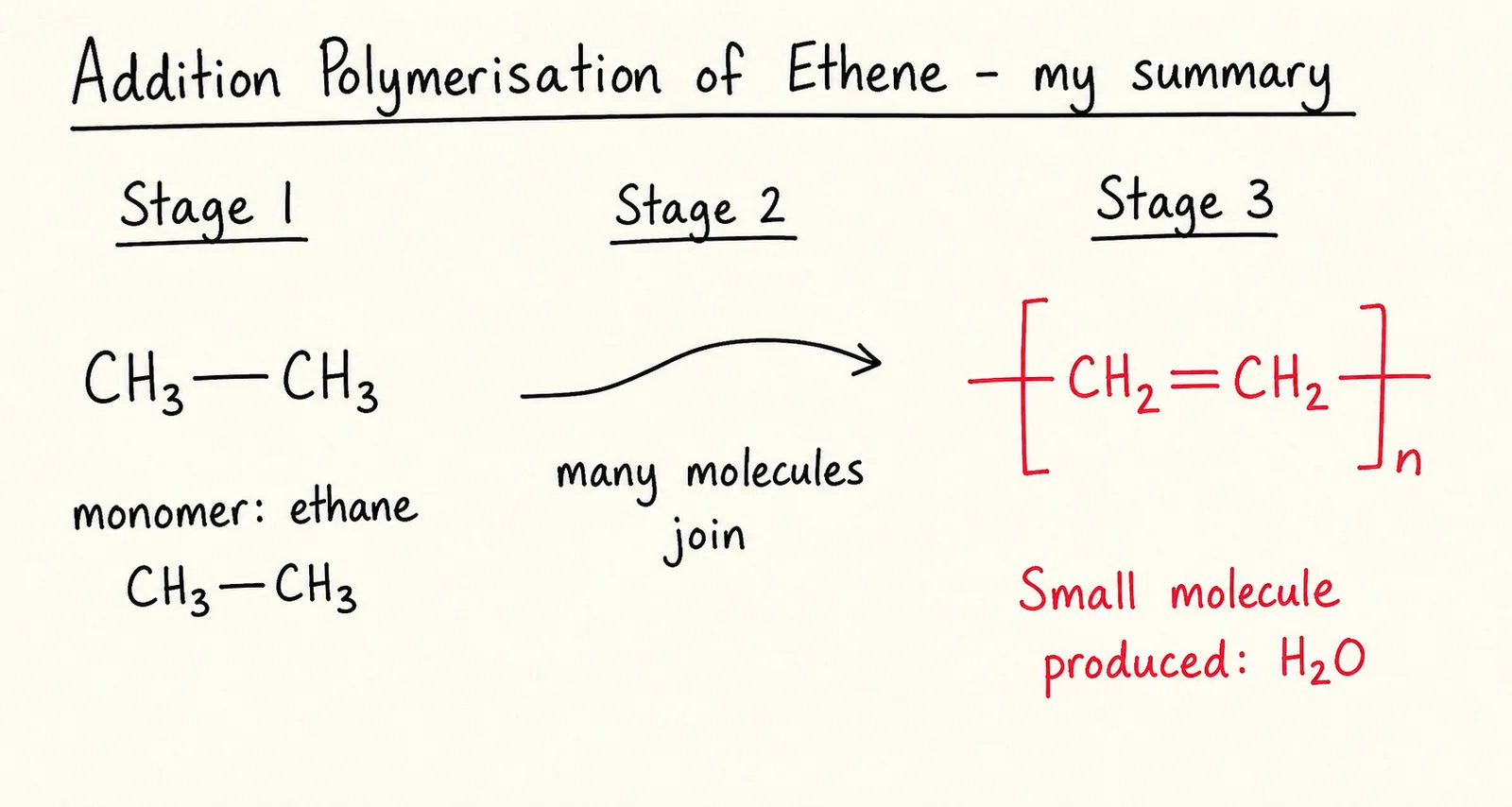
A student has drawn the diagram below to explain addition polymerisation of ethene. There are three chemical errors in the diagram. Identify each error and write the correction. 6 marks (2 per error: 1 identify, 1 correct)
5.1 Error 1: What is wrong?
Correction:
5.2 Error 2: What is wrong?
Correction:
5.3 Error 3: What is wrong?
Correction:
Q1.1 — Trend description (2 marks)
CO anomaly is very low (near baseline) from July to September 2019, then rises steadily through October–November, peaks at approximately 205 ppb in January 2020, and drops sharply by February–March 2020. The month of peak concentration is January 2020.
Mark notes: 1 mark for describing the rise and fall pattern; 1 mark for correctly identifying peak month and approximate value (±10 ppb).
Q1.2 — Incomplete vs complete combustion (3 marks)
CO is a product of incomplete combustion, which occurs when oxygen supply is limited [1]. In a large wildfire the interior of fuel masses (dense forest, leaf litter) is oxygen-starved, so carbon atoms in the biomass are only partially oxidised to CO rather than fully oxidised to CO2 [1]. The sharp seasonal peak in CO (not CO2) is therefore consistent with widespread incomplete combustion across a fire front where oxygen cannot reach all burning material uniformly [1].
Q1.3 — CO2 prediction (3 marks)
The CO2 anomaly would also show a seasonal peak during December–January, but it would be broader, larger in absolute magnitude (more carbon is always converted to CO2 than CO in any real fire), and would not drop as sharply [1]. This is because even during incomplete combustion, a large fraction of carbon atoms are still oxidised fully to CO2, and atmospheric CO2 has a much longer atmospheric lifetime than CO (years vs weeks) [1]. The CO2 curve would therefore extend further into the months following the fire season [1]. Accept other well-reasoned predictions.
Q2 — Cause-and-effect chain (5 marks)
Initiation: The UV light provides energy to break the Cl–Cl bond homolytically, generating two chlorine free radicals (Cl•) [1].
Propagation step 1: Cl• abstracts a hydrogen atom from CH4, forming HCl and a methyl free radical CH3• [1].
Propagation step 2: CH3• reacts with Cl2, forming chloromethane (CH3Cl) and regenerating Cl•, which can continue the chain [1].
Termination: Two free radicals combine (e.g. Cl• + Cl• → Cl2, or CH3• + Cl• → CH3Cl), removing radicals from the system and ending the chain [1].
Overall outcome: CH4 + Cl2 → CH3Cl + HCl; reaction type is free-radical substitution [1].
Q3 — Compare substitution and addition (8 marks, 1 per cell)
| Feature | Substitution | Addition |
|---|---|---|
| Hydrocarbon | Alkane (saturated) | Alkene (unsaturated) |
| Bond targeted | C–H single bond | C=C double bond (pi bond) |
| Condition | UV light | No special conditions needed for Br2 |
| Bromine water | No rapid decolourisation | Orange → colourless (decolourises) |
| Example equation | CH4 + Cl2 → CH3Cl + HCl | C2H4 + Br2 → C2H4Br2 |
| Change in formula | One H replaced by halogen; formula mass rises | Br2 adds; formula mass rises |
| By-product | HCl (or HBr) | None |
| Named example | Chlorination of methane | Bromine test for unsaturation |
Q4.1 — Chain length prediction (2 marks)
Quenching the reaction early means fewer addition steps occur before the reaction stops, so shorter polymer chains (lower molecular mass) are produced [1]. The number of repeating —CH2—CH2— units in each chain (the value of n) will be smaller than under full-reaction conditions [1].
Q4.2 — Solubility explanation (2 marks)
Shorter chains have lower molecular mass and therefore weaker London dispersion (van der Waals) intermolecular forces between chains [1]. Because the forces between the polymer and the organic solvent molecules can more easily overcome the weaker chain–chain forces, the short-chain polymer dissolves more readily in organic solvents [1].
Q5 — Diagram errors (6 marks)
5.1 Error 1 (monomer drawn as ethane): The monomer for addition polymerisation must contain a C=C double bond; CH3–CH3 is ethane (an alkane, no double bond) and cannot polymerise by addition. Correction: the monomer should be drawn as CH2=CH2 (ethene). [1+1]
5.2 Error 2 (repeating unit retains C=C): During addition polymerisation the double bond opens; the repeating unit must show only single bonds. Writing [–CH2=CH2–]n is wrong. Correction: the repeating unit is [–CH2–CH2–]n. [1+1]
5.3 Error 3 (H2O shown as by-product): Addition polymerisation produces no small molecule by-product; all atoms from the monomer end up in the polymer chain. Condensation polymerisation (not this lesson’s topic) does eliminate water. Correction: remove H2O from the product side. [1+1]