Chemistry • Year 12 • Module 7 • Lesson 5
Hydrocarbon Reactions
Lock in the vocabulary, product rules, and reaction-type classifications for combustion, substitution, addition and polymerisation.
1. Label the hydrocarbon reaction map
The diagram below shows four reaction pathways available to hydrocarbons. Write the missing labels into boxes A–H. Each label is drawn from the lesson's Key Terms or content cards. 8 marks
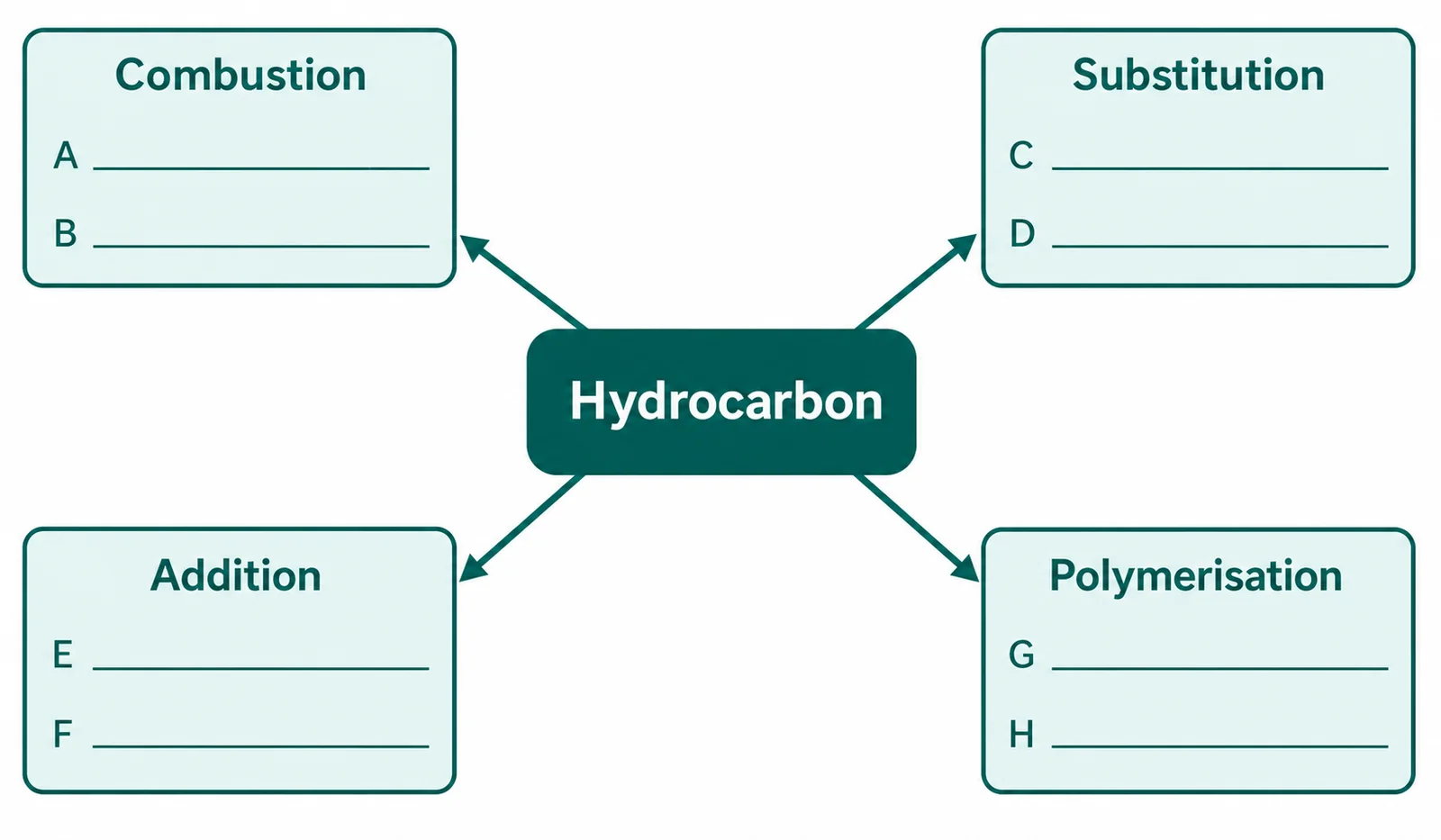
- A — reaction type when excess oxygen is supplied _______________
- B — main carbon-containing product of complete combustion _______________
- C — reaction type typical of alkanes with halogens + UV light _______________
- D — by-product formed alongside chloromethane when methane reacts with Cl2 _______________
- E — reaction type that opens the C=C bond _______________
- F — observation when bromine water reacts with an alkene _______________
- G — process that joins many alkene monomers without losing a small molecule _______________
- H — name of the polymer formed from ethene monomers _______________
| Box | Your label |
|---|---|
| A | |
| B | |
| C | |
| D | |
| E | |
| F | |
| G | |
| H |
2. Term–definition match
The ten definitions below are shuffled. In the right-hand column write the matching term from this list: combustion, complete combustion, incomplete combustion, substitution reaction, addition reaction, monomer, polymer, addition polymerisation, unsaturated hydrocarbon, saturated hydrocarbon. 10 marks
| # | Definition (shuffled) | Matching term |
|---|---|---|
| 2.1 | A reaction with oxygen that releases energy; for hydrocarbons it produces carbon oxides and water. | |
| 2.2 | Combustion in excess oxygen where every carbon atom is fully oxidised to CO2 and every hydrogen atom forms H2O. | |
| 2.3 | Combustion where limited oxygen means some carbon atoms form CO or solid carbon (soot) instead of CO2. | |
| 2.4 | A reaction in which one atom or group in a molecule is replaced by another atom or group; typical of alkanes with halogens under UV light. | |
| 2.5 | A reaction in which atoms or groups add across a multiple bond, converting it to a single bond and producing a more saturated product. | |
| 2.6 | A small repeating molecule that joins to other identical molecules to form a long-chain polymer. | |
| 2.7 | A large molecule composed of many repeating structural units covalently bonded together. | |
| 2.8 | A type of polymerisation where alkene monomers open their double bonds and link together; no small molecule is eliminated. | |
| 2.9 | A hydrocarbon containing at least one C=C or C≡C bond, making it capable of undergoing addition reactions. | |
| 2.10 | A hydrocarbon containing only C–C single bonds; it cannot undergo addition reactions under normal classroom conditions. |
3. True or false — with correction
For each statement, circle T or F. If the statement is false, write the corrected version on the line below. 8 marks (1 for T/F, 1 for the correction where needed)
3.1 Incomplete combustion of a hydrocarbon always produces only CO2 and H2O. T / F
3.2 Alkenes decolourise bromine water because the C=C bond undergoes an addition reaction with Br2. T / F
3.3 The reaction of methane with chlorine under UV light is an addition reaction because a chlorine atom is added to the molecule. T / F
3.4 In addition polymerisation, the repeating unit retains the C=C double bond from the monomer. T / F
4. Function recall
Answer each question in 1–2 sentences using precise terms from the lesson. 8 marks (2 each)
4.1 What is the role of UV light in the substitution reaction between methane and chlorine?
4.2 What structural feature of alkenes makes them more reactive than alkanes towards addition reactions?
4.3 Why is carbon monoxide (CO) produced during incomplete combustion considered more hazardous than CO2?
4.4 In addition polymerisation, what happens to the double bond of each monomer during the reaction?
5. Fill in the blanks — hydrocarbon reactions summary
Complete the paragraph by choosing from the word bank. Each word is used once. 8 marks
Word bank:
addition • bromine • C=C • carbon monoxide • chloromethane • complete • HCl • polyethene • saturated • UV light
When a hydrocarbon burns in excess oxygen, (1) ________ combustion occurs, producing CO2 and H2O. When oxygen is limited, (2) ________ may form alongside soot, increasing the health hazard. Alkanes are (3) ________ hydrocarbons; they cannot undergo addition reactions because they have no double bond. Instead, methane reacts with chlorine under (4) ________ to produce (5) ________ and the by-product (6) ________. This reaction is a substitution, not addition. In contrast, alkenes contain a reactive (7) ________ double bond. When ethene reacts with (8) ________, the bond opens and an addition product forms—the orange bromine water turns colourless. If many ethene molecules undergo repeated (9) ________ with each other, the product is the polymer (10) ________.
6. Connect the concepts
Draw labelled arrows between the six terms below to show how they connect. Each arrow must carry a linking phrase (e.g. “opens to form”, “requires”, “produces”). Aim for at least 6 labelled arrows. 6 marks
Supplied terms: alkane • alkene • C=C double bond • addition reaction • polymer • substitution reaction.
Q1 — Reaction map labels
A: complete combustion (or combustion). B: CO2 (carbon dioxide). C: substitution (free-radical substitution). D: HCl (hydrogen chloride). E: addition. F: bromine water decolourises (turns colourless/loses its orange colour). G: addition polymerisation. H: polyethene (polyethylene).
Q2 — Term–definition matches
2.1 combustion • 2.2 complete combustion • 2.3 incomplete combustion • 2.4 substitution reaction • 2.5 addition reaction • 2.6 monomer • 2.7 polymer • 2.8 addition polymerisation • 2.9 unsaturated hydrocarbon • 2.10 saturated hydrocarbon.
Q3 — True / false with correction
3.1 False. Correction: incomplete combustion (limited oxygen) produces carbon monoxide (CO) and/or solid carbon (soot) together with water, not CO2 and H2O as in complete combustion.
3.2 True.
3.3 False. Correction: the reaction is a substitution, not addition. One hydrogen atom on methane is replaced by a chlorine atom; there is no multiple bond on methane for atoms to add across.
3.4 False. Correction: in addition polymerisation, the C=C double bond opens (breaks) during the reaction. The repeating unit therefore contains only C–C single bonds: [—CH2—CH2—]n for polyethene.
Q4 — Function recall
4.1 UV light provides the energy needed to break the Cl–Cl bond (homolytic cleavage), generating chlorine free radicals that initiate the substitution chain reaction.
4.2 The electron-rich C=C (pi) double bond is the reactive site in alkenes. The pi bond can be broken and atoms or groups can add across it, whereas alkanes have only sigma single bonds that are stronger and less accessible.
4.3 Carbon monoxide is toxic because it binds strongly and irreversibly to haemoglobin, preventing oxygen transport in the blood. CO2 contributes to greenhouse warming but is not acutely toxic at normal concentrations.
4.4 The C=C double bond opens (the pi bond breaks) and each carbon forms a new single bond to the adjacent monomer, creating a repeating —CH2—CH2— unit in the growing chain.
Q5 — Cloze answers (in order)
(1) complete • (2) carbon monoxide • (3) saturated • (4) UV light • (5) chloromethane • (6) HCl • (7) C=C • (8) bromine • (9) addition • (10) polyethene.
Q6 — Sample concept map
A correct map should include arrows such as:
- alkene — contains → C=C double bond
- C=C double bond — opens in → addition reaction
- addition reaction — repeated to form → polymer
- alkane — lacks C=C so undergoes → substitution reaction
- alkane — is more saturated than → alkene
- addition reaction — decolourises bromine water unlike → substitution reaction
Award full marks for at least 6 correctly labelled arrows that respect causal direction.