Chemistry • Year 12 • Module 7 • Lesson 4
Hydrocarbon Structure & Bonding
Build HSC Band 5–6 extended-response technique by evaluating bonding data and critiquing a scientific claim about alkene rotation.
1. Evaluate hybridisation and bonding across three hydrocarbons (Band 5–6)
8 marks Band 5–6
Scenario. A Year 12 student is comparing three organic compounds — ethane (CH₃CH₃), ethene (CH₂=CH₂), and ethyne (HC≡CH) — and has been given the following experimental data.
| Compound | Molecular formula | C–C bond length (pm) | C–C bond energy (kJ mol−1) | Observed geometry at C |
|---|---|---|---|---|
| Ethane | C₂H₆ | 154 | 347 | tetrahedral |
| Ethene | C₂H₄ | 134 | 614 | trigonal planar |
| Ethyne | C₂H₂ | 120 | 839 | linear |
Data from: Atkins & Jones, Chemical Principles, 6th edn (2012).
Q1. Using the data above and your knowledge of hybridisation, evaluate the relationship between bond type, hybridisation, geometry, and the capacity for geometric isomerism across the three compounds. In your response you must:
- Identify the hybridisation state of the carbon atoms in each compound and link it to the observed geometry and bond angle.
- Explain how bond order accounts for the observed differences in bond length and bond energy using the data provided.
- Use the concept of sigma (σ) and pi (π) bonds to explain why ethene can display geometric isomerism (given appropriate substituents) but ethane cannot.
- Evaluate which compound would be most reactive towards an addition reagent (e.g. HBr) and justify your claim with reference to bond energy data.
- Reach an evidence-based judgement about how hybridisation state determines the physical and chemical behaviour of a hydrocarbon.
2. Source critique — student claim about alkene rotation (Band 5–6)
7 marks Band 5–6
Source: student study guide, Year 12 Chemistry, self-published, 2025.
“A carbon–carbon double bond (C=C) is simply two sigma bonds placed side by side. Because sigma bonds can always rotate freely, alkenes should also rotate freely around their double bond — just like alkanes rotate around single bonds. This means that cis-but-2-ene and trans-but-2-ene are not actually different compounds; they are the same molecule viewed from a different angle, and would interconvert instantly at room temperature.”
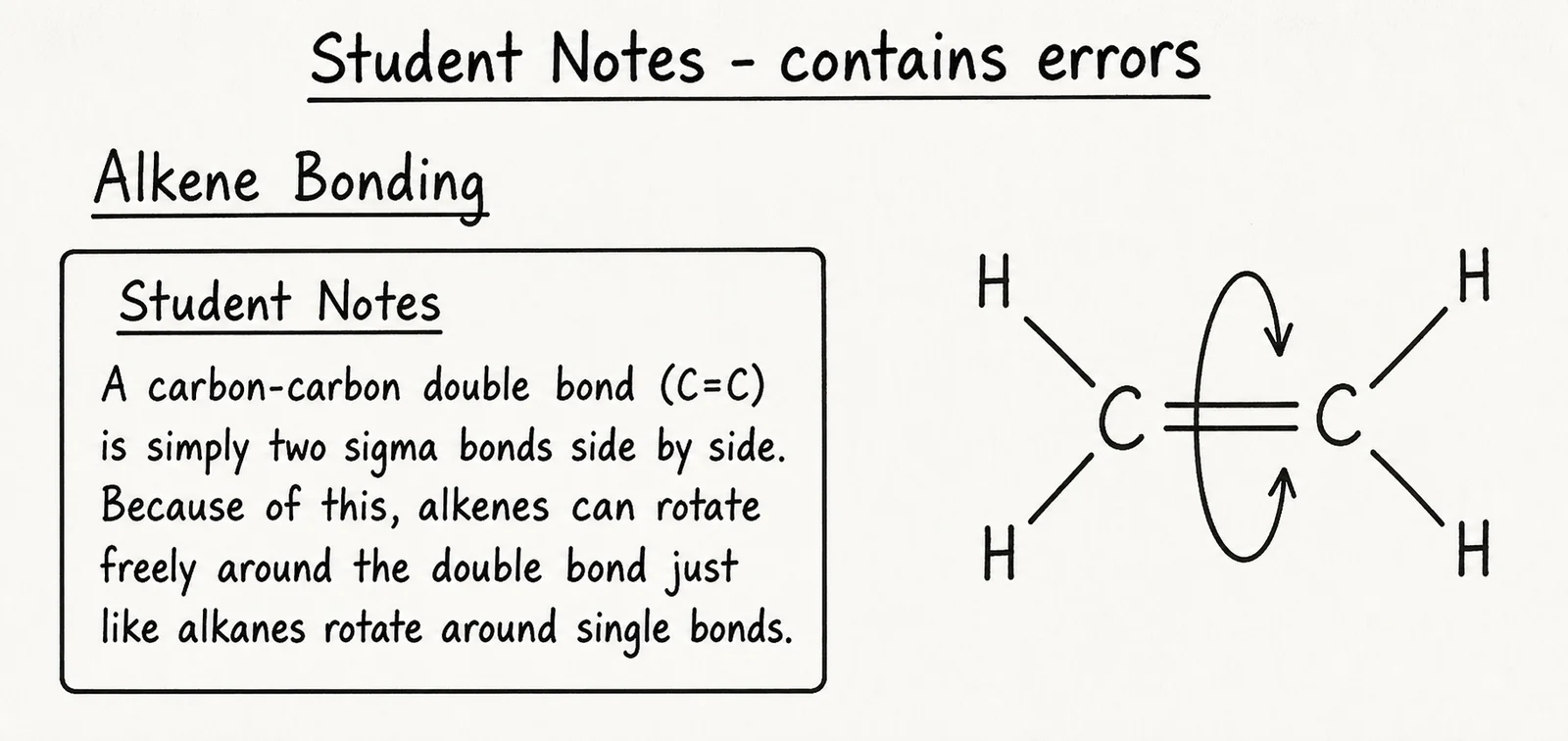
Q2. Critically evaluate the scientific accuracy of this student claim. In your response you must:
- Identify the specific scientific error in the claim regarding the structure of a C=C double bond.
- Explain the correct chemistry — including the roles of sigma and pi bonds and the concept of orbital overlap — that contradicts the claim.
- Use cis-but-2-ene and trans-but-2-ene as a named example to demonstrate that they are distinct compounds with different physical properties (e.g. boiling points), not the same molecule from a different angle.
- Propose one experimental observation that would conclusively distinguish between the two isomers and that would directly disprove the claim that they are the same compound.
Q1 — Marking guidance (8 marks)
Hybridisation and geometry (2 marks): Ethane — sp³, tetrahedral, 109.5° [½]; ethene — sp², trigonal planar, 120° [½]; ethyne — sp, linear, 180° [½]; general statement linking hybridisation to number of electron domains [½].
Bond order and data (2 marks): As bond order increases (1→2→3), bond length decreases (154→134→120 pm) [1] and bond energy increases (347→614→839 kJ mol−1) because each additional bond introduces more electron density between nuclei, drawing them closer together and requiring more energy to separate [1].
Sigma, pi, and geometric isomerism (2 marks): Ethane has only sigma bonds (sp³); sigma bonds allow free rotation, so substituents can interchange positions and no cis-trans isomers are possible [1]. Ethene has one sigma + one pi bond; the pi bond is formed by side-on p-orbital overlap and is broken by rotation, so rotation is restricted — if each sp² carbon carries different substituents, the locked geometry produces distinct cis and trans isomers [1].
Reactivity judgement (1 mark): Ethyne (or ethene) would be most reactive towards addition (accept either with justification). Ethene — the C=C pi bond (614 − 347 = 267 kJ mol−1) is weaker and more accessible than the sigma component, making it the site of electrophilic addition. Ethyne has two pi bonds (839 − 347 = 492 kJ mol−1 for both pi bonds combined), providing more electron density for addition, though sequential addition requires two steps. Ethane is unreactive towards addition because it has only sigma bonds [1].
Evaluative judgement (1 mark): Hybridisation state is the primary determinant of a hydrocarbon's geometry, bonding, reactivity, and capacity for isomerism: sp³ gives flexible, unreactive alkanes; sp² gives rigid, reactive alkenes capable of geometric isomerism; sp gives maximally unsaturated, highly reactive linear alkynes [1].
Q2 — Marking guidance (7 marks)
Identifying the error (1 mark): The claim incorrectly describes a C=C double bond as two sigma bonds. A C=C double bond consists of one sigma (σ) bond and one pi (π) bond — not two sigma bonds [1].
Correct chemistry of pi bond and rotation (2 marks): A sigma bond is formed by head-on orbital overlap along the internuclear axis; it allows rotation because rotating around the axis does not disrupt the overlap [1]. A pi bond is formed by side-on overlap of unhybridised p orbitals perpendicular to the internuclear axis. For the pi bond to remain intact, the two p orbitals must remain parallel; rotation by 90° would destroy this overlap and break the pi bond, requiring approximately 270 kJ mol−1 of energy — far more than is available at room temperature. Therefore rotation about C=C does not occur freely [1].
Named example with physical-property evidence (2 marks): cis-but-2-ene has a boiling point of approximately +3.7 °C, while trans-but-2-ene has a boiling point of approximately +0.9 °C [accept any stated different physical property]. These are demonstrably different values, confirming the two compounds are distinct species with different physical properties — not the same molecule from different viewing angles [1]. The difference arises because the cis isomer has both methyl groups on the same side, creating a greater dipole moment and stronger intermolecular interactions than the more symmetric trans isomer [1].
Experimental observation to disprove the claim (2 marks): Award 1 mark for a valid experimental observation (e.g. measuring boiling point of a pure sample of each isomer and recording different values; performing a fractional distillation to isolate two distinct fractions from a mixture; recording different IR or NMR spectra for each). Award 1 additional mark for explicitly linking the experimental result back to disproving the claim (e.g. “if they were the same compound, both fractions would have the same boiling point, but they do not”).