Chemistry • Year 12 • Module 7 • Lesson 4
Hydrocarbon Structure & Bonding
Recall the vocabulary of sigma bonds, pi bonds, hybridisation states, and geometric isomerism before moving to application questions.
1. Label the hybridisation diagram
The diagram below shows three carbon hybridisation states. Write the missing labels into boxes A–L. Each label is drawn from the lesson Key Terms or the hybridisation table. 12 marks
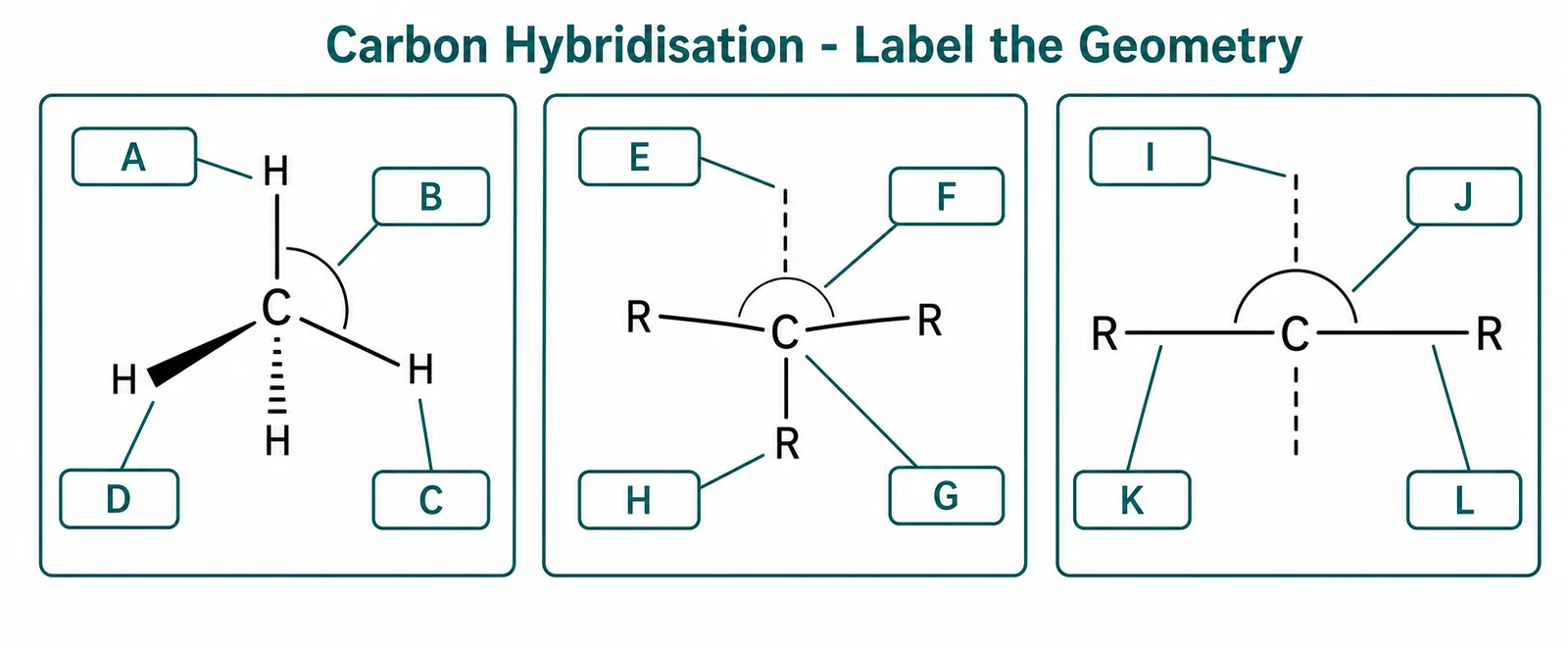
| Box | What to write | Your answer |
|---|---|---|
| A | Hybridisation state (Panel 1) | |
| B | Bond angle (Panel 1) | |
| C | Geometry name (Panel 1) | |
| D | Example molecule (Panel 1) | |
| E | Hybridisation state (Panel 2) | |
| F | Bond angle (Panel 2) | |
| G | Geometry name (Panel 2) | |
| H | Example molecule (Panel 2) | |
| I | Hybridisation state (Panel 3) | |
| J | Bond angle (Panel 3) | |
| K | Geometry name (Panel 3) | |
| L | Example molecule (Panel 3) |
2. Term–definition match
The definitions below are shuffled. Write the matching term from this list in the right-hand column: sigma bond (σ), pi bond (π), sp³ hybridisation, sp² hybridisation, sp hybridisation, geometric isomerism, cis isomer, trans isomer, bond length, bond energy. 10 marks
| # | Definition (shuffled) | Matching term |
|---|---|---|
| 2.1 | A covalent bond formed by head-on overlap of orbitals; it allows free rotation about the bond axis. | |
| 2.2 | A covalent bond formed by side-on overlap of orbitals; its presence restricts rotation about the C–C axis. | |
| 2.3 | The carbon hybridisation state found in alkanes; produces four equivalent bonds arranged tetrahedrally at 109.5°. | |
| 2.4 | The carbon hybridisation state found in alkenes; produces a trigonal planar arrangement with 120° bond angles. | |
| 2.5 | The carbon hybridisation state found in alkynes; produces a linear arrangement with 180° bond angles. | |
| 2.6 | A type of stereoisomerism in which identical substituents are on the same side of a C=C double bond. | |
| 2.7 | A type of stereoisomerism in which identical substituents are on opposite sides of a C=C double bond. | |
| 2.8 | The existence of two or more compounds with the same connectivity but different spatial arrangements due to restricted rotation about a double bond. | |
| 2.9 | The distance between the nuclei of two bonded atoms; shorter for double bonds than single bonds. | |
| 2.10 | The energy required to break one mole of a particular covalent bond in the gas phase; higher for triple bonds than double bonds. |
3. True or false — with correction
Circle T or F. If the statement is false, write the corrected version on the line provided. 10 marks (1 for T/F, 1 for the correction where needed)
3.1 A carbon–carbon double bond consists of two sigma bonds. T / F
3.2 sp³-hybridised carbon atoms are found in alkanes and produce a tetrahedral geometry with a bond angle of 109.5°. T / F
3.3 The pi bond in a double bond restricts rotation, which is why cis-trans isomers can exist in alkenes but not in alkanes. T / F
3.4 A C≡C triple bond is longer and requires less energy to break than a C=C double bond. T / F
3.5 In cis-but-2-ene, the two methyl groups are on opposite sides of the double bond. T / F
4. Fill the blanks — hydrocarbon bonding
Complete the paragraph using the word bank below. Each term is used once. 8 marks
Word bank: sigma (σ) • pi (π) • restricted • free • sp² • sp³ • 120° • geometric
In alkanes, every carbon atom is _______ hybridised, and each carbon forms four single bonds. These single bonds are all _______ bonds, which allow _______ rotation about the C–C axis. When a carbon atom is part of a C=C double bond, as in an alkene, it is _______ hybridised. The double bond consists of one _______ bond and one _______ bond. The _______ bond is formed by side-on overlap of p orbitals and prevents _______ rotation, making the molecule rigid around that axis. This rigidity allows _______ isomers (cis and trans forms) to exist. The bond angle around each sp² carbon is _______.
5. Build a concept map
Draw labelled arrows between the five terms below to show how they are connected. Each arrow must carry a linking phrase (e.g. "is present in", "restricts", "determines"). Aim for at least 5 labelled arrows. 5 marks
Supplied terms: pi bond · sigma bond · C=C double bond · restricted rotation · geometric isomerism.
Q1 — Hybridisation diagram labels
A: sp³. B: 109.5°. C: tetrahedral. D: methane (CH₄) or any alkane carbon. E: sp². F: 120°. G: trigonal planar. H: ethene (C₂H₄) or any alkene carbon. I: sp. J: 180°. K: linear. L: ethyne (C₂H₂) or any alkyne carbon.
Q2 — Term–definition matches
2.1 sigma bond (σ) • 2.2 pi bond (π) • 2.3 sp³ hybridisation • 2.4 sp² hybridisation • 2.5 sp hybridisation • 2.6 cis isomer • 2.7 trans isomer • 2.8 geometric isomerism • 2.9 bond length • 2.10 bond energy.
Q3 — True / false with corrections
3.1 False. Correction: a C=C double bond consists of one sigma bond and one pi bond.
3.2 True.
3.3 True.
3.4 False. Correction: a C≡C triple bond is shorter and requires more energy to break than a C=C double bond (bond energy increases: single < double < triple).
3.5 False. Correction: in cis-but-2-ene the two methyl groups are on the same side of the double bond; it is the trans isomer that has them on opposite sides.
Q4 — Cloze answers (in order)
sp³ / sigma (σ) / free / sp² / sigma (σ) / pi (π) / pi (π) / free (restricted) / geometric / 120°
Note: the blanks in order are: sp³, sigma, free, sp², sigma, pi, pi, (free) restricted, geometric, 120°.
Q5 — Sample concept map
Correct arrows include: sigma bond —is one component of→ C=C double bond; pi bond —is the second component of→ C=C double bond; pi bond —causes→ restricted rotation; restricted rotation —makes possible→ geometric isomerism; sigma bond —allows→ (free rotation, contrasting with pi bond). Award 1 mark per correctly labelled directed arrow (max 5).