Chemistry • Year 12 • Module 7 • Lesson 1
Introduction to Organic Chemistry & IUPAC Nomenclature I
Lock in the key vocabulary, homologous series concepts, hybridisation states, and systematic IUPAC naming for straight-chain alkanes, alkenes, and alkynes.
1. Label the hybridisation diagram
The diagram below shows three carbon atoms in different bonding situations, each labelled A–F. Write the correct hybridisation state, geometry, and bond angle for each labelled carbon. 6 marks (1 per row)
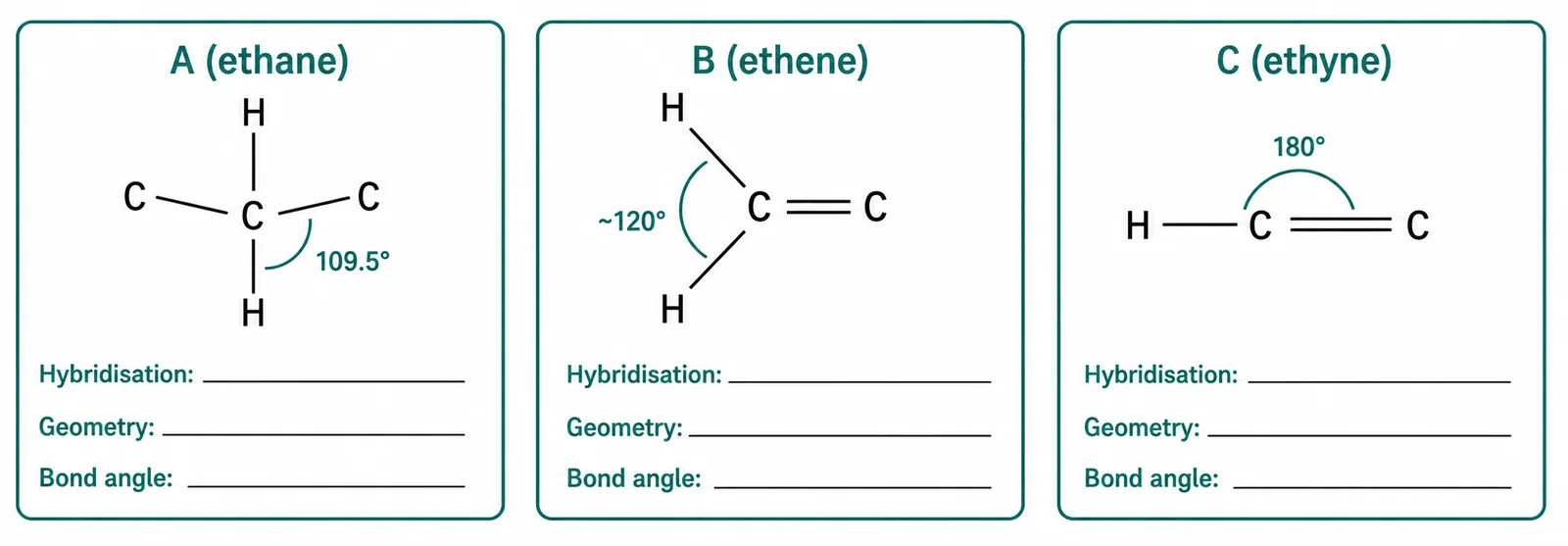
| Carbon | Hybridisation state | Geometry | Bond angle |
|---|---|---|---|
| A (ethane) | |||
| B (ethene) | |||
| C (ethyne) |
2. Term–definition match
The twelve definitions below are shuffled. In the right-hand column write the matching term from this list: organic chemistry, hydrocarbon, functional group, homologous series, isomers, tetravalency, alkane, alkene, alkyne, IUPAC, locant, parent chain. 12 marks
| # | Definition (shuffled) | Matching term |
|---|---|---|
| 2.1 | The study of carbon-containing compounds, regardless of their biological or industrial origin. | |
| 2.2 | An organic compound containing only carbon and hydrogen atoms. | |
| 2.3 | A specific atom or group of atoms responsible for the characteristic reactions of a compound. | |
| 2.4 | A family of compounds sharing the same functional group and general formula, differing by one –CH2– unit between consecutive members. | |
| 2.5 | Compounds with the same molecular formula but different structural arrangements. | |
| 2.6 | Carbon's property of forming exactly four covalent bonds, enabling straight chains, branched chains, and rings. | |
| 2.7 | A saturated hydrocarbon with only C–C single bonds; general formula CnH2n+2. | |
| 2.8 | An unsaturated hydrocarbon containing one C=C double bond; general formula CnH2n. | |
| 2.9 | An unsaturated hydrocarbon containing one C≡C triple bond; general formula CnH2n−2. | |
| 2.10 | The international body that sets systematic naming rules for chemical compounds; its rules give every structure a unique name. | |
| 2.11 | A number placed before a suffix or substituent name to indicate the carbon position in the chain (e.g. the "2" in but-2-ene). | |
| 2.12 | The longest continuous carbon chain in a molecule; it provides the base name in IUPAC nomenclature. |
3. True or false — with correction
For each statement, circle T or F. If the statement is false, write the corrected version. 10 marks (1 T/F + 1 correction where false)
3.1 Organic chemistry studies only compounds produced by living organisms. T / F
3.2 An sp3-hybridised carbon has a bond angle of 109.5° and forms only single bonds. T / F
3.3 Members of a homologous series have the same molecular formula but different structural arrangements. T / F
3.4 In IUPAC naming, the parent chain must include the C=C double bond when naming an alkene. T / F
3.5 When numbering an alkane chain with a branch, you should number from the end farthest from the branch to give the highest possible locant. T / F
4. Function recall
Answer each in 1–2 sentences using precise lesson terms. 8 marks (2 each)
4.1 What property of carbon allows it to form millions of different organic compounds?
4.2 Why do consecutive members of a homologous series have predictably increasing boiling points?
4.3 What does the suffix “–ene” tell you about the functional group and hybridisation in a molecule?
4.4 Why is natural gas (methane and ethane) from the Karratha LNG facility classified as organic chemistry, given that it is not made by a living organism?
5. Fill the blanks — IUPAC naming rules
Use the word bank to complete the passage. Each word is used once. 8 marks (1 each)
To name an organic compound using IUPAC rules, the first step is to identify the longest continuous carbon chain, called the . This gives the base name of the compound. If the compound contains a C=C bond, it is an alkene and the IUPAC changes from “–ane” to “–ene”; if it contains a C≡C bond, it is an and the suffix becomes “–yne”. The chain is numbered from the end that gives the possible locant to the first or functional group. If a compound has both a branch and a , the double bond takes numbering priority. The one-carbon substituent –CH3 is called a group. When a compound has two or more different substituents, they are listed in order as prefixes before the parent chain name.
6. Build a concept map
Draw labelled arrows between the six terms below to show how they connect. Each arrow must carry a linking phrase (e.g. “determines”, “gives rise to”, “differs by”). Aim for at least 6 labelled arrows. 6 marks
Supplied terms: carbon (tetravalency) • functional group • homologous series • IUPAC name • hybridisation state • boiling point trend.
Q1 — Hybridisation labels
A (ethane): sp3 — tetrahedral — 109.5°.
B (ethene): sp2 — trigonal planar — ~120°.
C (ethyne): sp — linear — 180°.
Q2 — Term–definition matches
2.1 organic chemistry • 2.2 hydrocarbon • 2.3 functional group • 2.4 homologous series • 2.5 isomers • 2.6 tetravalency • 2.7 alkane • 2.8 alkene • 2.9 alkyne • 2.10 IUPAC • 2.11 locant • 2.12 parent chain.
Q3 — True / False
3.1 False. Organic chemistry studies all carbon-containing compounds regardless of origin; many are synthesised industrially.
3.2 True.
3.3 False. That is the definition of isomers. Members of a homologous series have different molecular formulae, each differing by one CH2 unit.
3.4 True.
3.5 False. The chain must be numbered from the end nearest the branch (or functional group) to give the lowest possible locant.
Q4 — Function recall
4.1 Carbon's tetravalency (ability to form four covalent bonds with itself and other elements) allows it to form straight chains, branched chains, and rings of essentially unlimited length, generating millions of structurally distinct compounds.
4.2 Each additional –CH2– unit increases molecular mass and the contact surface area between molecules, strengthening London (dispersion) forces. Stronger dispersion forces require more kinetic energy to overcome, raising the boiling point.
4.3 The suffix “–ene” indicates a C=C double bond (alkene functional group). The two carbons of the double bond are sp2-hybridised with trigonal planar geometry and ~120° bond angles.
4.4 Organic chemistry is defined by the presence of carbon-based molecular structure, not by biological origin. Methane (CH4) and ethane (C2H6) are carbon-containing compounds and are classified as alkanes within the organic chemical framework, even though they formed from geological processes.
Q5 — Cloze
In order: parent chain • suffix • alkyne • lowest • branch • double bond • methyl • alphabetical.
Q6 — Sample concept map
Acceptable arrows include: carbon (tetravalency) enables → homologous series; functional group defines → homologous series; hybridisation state determines → functional group; homologous series shows predictable → boiling point trend; functional group encoded in → IUPAC name; IUPAC name includes → hybridisation state (via suffix). Award 1 mark per correctly labelled causal arrow (minimum 6).