Chemistry • Year 12 • Module 5 • Lesson 3
Collision Theory Applied to Equilibrium
Lock in the key vocabulary, the approach-to-equilibrium mechanism, activation energy diagrams, and the catalyst rule — the language you need before any extended response.
1. Term–definition match
The ten definitions below are shuffled. In the right-hand column write the matching term from this list: collision theory, activation energy (Ea), effective collision, Maxwell–Boltzmann distribution, forward rate, reverse rate, dynamic equilibrium, catalyst, enthalpy change (ΔH), frequency factor. 10 marks
| # | Definition (shuffled) | Matching term |
|---|---|---|
| 1.1 | States that reactions occur only when particles collide with correct orientation and energy at or above a minimum threshold. | |
| 1.2 | The minimum energy that colliding particles must possess for the collision to result in bond breaking and the formation of products. | |
| 1.3 | A collision that results in bond rearrangement and the production of new chemical species. | |
| 1.4 | A graph showing the spread of kinetic energies among particles in a gas or solution at a fixed temperature; the area beyond Ea represents the fraction of effective collisions. | |
| 1.5 | The rate at which reactants are converted into products; proportional to reactant concentration and decreases as reactants are consumed. | |
| 1.6 | The rate at which products are converted back into reactants; starts at zero and increases as products accumulate. | |
| 1.7 | The state of a reversible reaction in which the forward rate equals the reverse rate and macroscopic concentrations remain constant, yet both processes continue at the molecular level. | |
| 1.8 | A substance that increases reaction rate by providing an alternative lower-energy pathway, while being regenerated unchanged. | |
| 1.9 | The difference in energy between products and reactants; equal to Ea(forward) minus Ea(reverse). | |
| 1.10 | The number of collisions per unit time between reactant particles, regardless of whether those collisions are effective. |
2. True or false — with correction
Circle T or F. If false, write the corrected version on the line. 10 marks (1 T/F + 1 correction where needed)
2.1 When a reversible reaction starts with pure reactants, the reverse rate is at its maximum and decreases over time. T / F
2.2 At dynamic equilibrium, the forward rate equals the reverse rate and both are non-zero. T / F
2.3 For an exothermic forward reaction, Ea(forward) is greater than Ea(reverse). T / F
2.4 A catalyst increases the equilibrium yield of a reversible reaction by lowering the activation energy of the forward reaction more than the reverse. T / F
2.5 NO2 is a brown gas and N2O4 is colourless in the equilibrium 2NO2(g) ⇌ N2O4(g). T / F
3. Function recall
Answer each in 1–2 sentences using precise terms from Lesson 3. 8 marks (2 each)
3.1 Why does the forward rate decrease as a reversible reaction proceeds?
3.2 Why does the reverse rate increase as a reversible reaction proceeds?
3.3 Why does a catalyst not change the equilibrium position or Keq?
3.4 How does the Maxwell–Boltzmann distribution explain why increasing temperature shifts an exothermic equilibrium to the left?
4. Cloze passage — approaching dynamic equilibrium
Complete the passage using words from the word bank. Each word is used once. 8 marks
Word bank: decreases, increases, forward, reverse, zero, non-zero, equal, effective, concentration, collision
When a reversible reaction is initiated from pure reactants, the ________ rate is at its maximum because the ________ of reactants is highest. This means the frequency of ________ collisions in the forward direction is also at its maximum. The ________ rate is initially ________ because no products are present yet. As the reaction proceeds, reactants are consumed, so the forward rate ________. Products accumulate, so the reverse ________ rate rises. Dynamic equilibrium is reached when the forward rate and reverse rate are ________ and ________ — molecular activity continues at the same pace in both directions simultaneously.
5. Build a concept map
Draw labelled arrows between the six terms to show how they connect. Each arrow must carry a linking phrase. Aim for at least 6 labelled arrows. 6 marks
Supplied terms: collision theory · activation energy (Ea) · effective collision · forward rate · reverse rate · dynamic equilibrium.
6. Label the energy profile
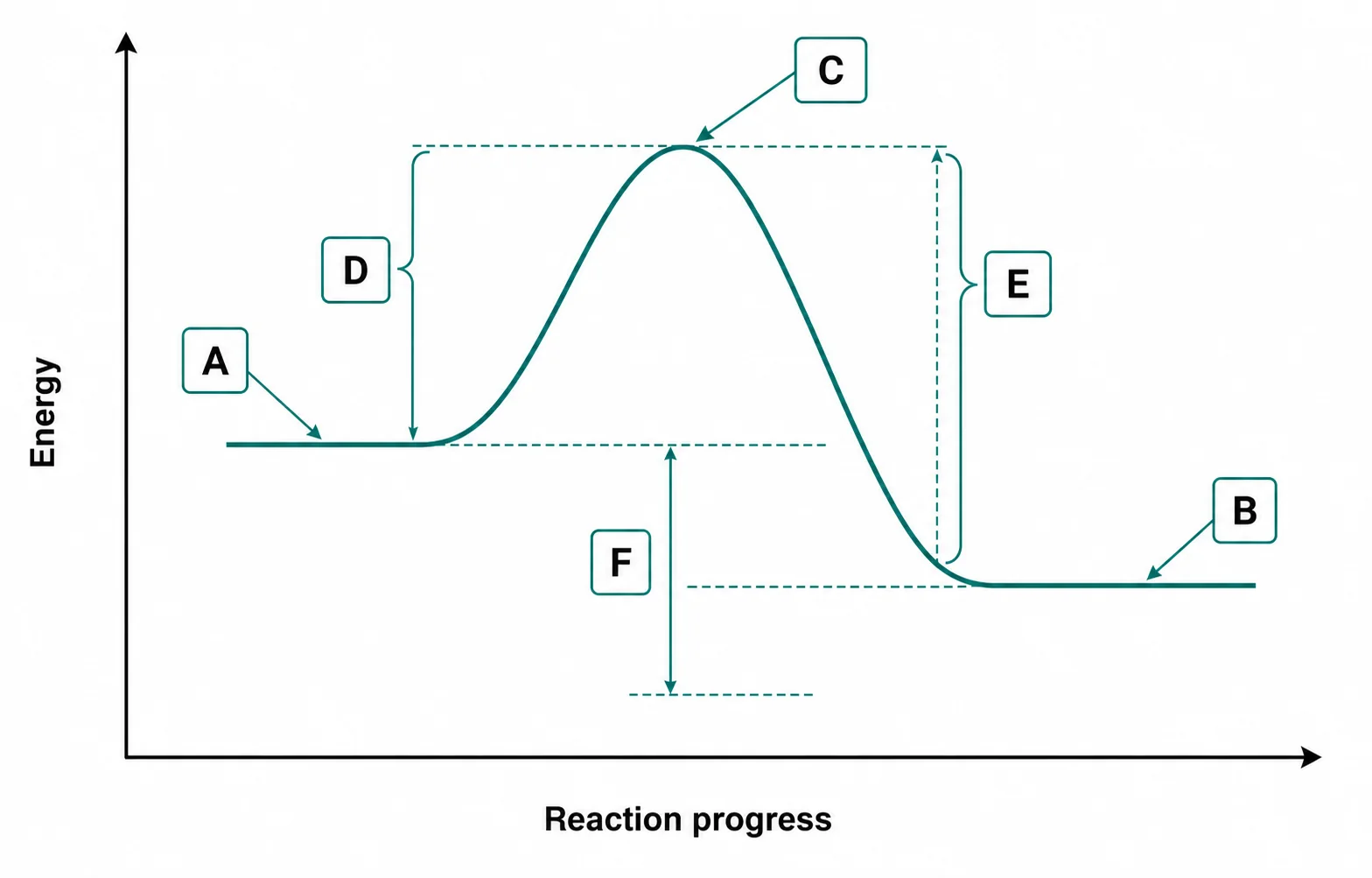
The diagram below shows an energy profile for a reversible reaction. Write the correct labels for positions A–F. Use terms from Lesson 3. 6 marks
| Label | Your answer |
|---|---|
| A | |
| B | |
| C | |
| D | |
| E | |
| F |
Q1 — Term–definition match
1.1 collision theory • 1.2 activation energy (Ea) • 1.3 effective collision • 1.4 Maxwell–Boltzmann distribution • 1.5 forward rate • 1.6 reverse rate • 1.7 dynamic equilibrium • 1.8 catalyst • 1.9 enthalpy change (ΔH) • 1.10 frequency factor.
Q2 — True / False with correction
2.1 False. Correction: when a reversible reaction starts with pure reactants, the forward rate is at its maximum; the reverse rate is initially zero because no products are present.
2.2 True.
2.3 False. Correction: for an exothermic forward reaction, Ea(forward) is less than Ea(reverse), because products are at a lower energy level than reactants. ΔH = Ea(fwd) − Ea(rev) = negative value.
2.4 False. Correction: a catalyst lowers Ea equally for both the forward and reverse reactions, so equilibrium yield and Keq are unchanged. Only temperature changes equilibrium position and Keq.
2.5 True.
Q3 — Function recall
3.1 As the reaction proceeds, reactants are consumed and their concentration decreases. This reduces the frequency of reactant–reactant collisions per unit time, so the frequency of effective forward collisions decreases — the forward rate decreases.
3.2 As the reaction proceeds, products accumulate and their concentration increases. This increases the frequency of product–product collisions per unit time, so the frequency of effective reverse collisions increases — the reverse rate increases.
3.3 A catalyst lowers Ea equally for both the forward and reverse reactions. Both rates increase by the same factor, so their ratio is unchanged. Since it is the ratio of forward to reverse rates that determines Keq, neither Keq nor the equilibrium position changes. Keq depends only on temperature.
3.4 The Maxwell–Boltzmann distribution shifts to higher average kinetic energy when temperature rises. Both the forward and reverse rates increase, but the rate increases proportionally more for the reaction with the higher Ea. For an exothermic equilibrium, Ea(reverse) > Ea(forward), so the reverse (endothermic) rate increases more — reverse rate > forward rate — equilibrium shifts left.
Q4 — Cloze passage
forward / concentration / effective / reverse / zero / decreases / (collision) / equal / non-zero. (Accept in order: forward, concentration, effective, reverse, zero, decreases, reverse, equal, non-zero.)
Q5 — Sample concept map
Valid links include: collision theory —states reactions require→ activation energy; activation energy —threshold for→ effective collision; effective collision —determines→ forward rate; effective collision —determines→ reverse rate; forward rate —when equal to→ reverse rate —establishes→ dynamic equilibrium. Award 1 mark per correct labelled arrow (max 6).
Q6 — Energy diagram labels
A — Reactants (energy level). B — Products (energy level, lower than A for exothermic). C — Transition state (peak of the curve). D — Ea(forward) (energy gap from reactants to transition state). E — Ea(reverse) (energy gap from products to transition state, larger than D). F — ΔH (downward arrow from reactants to products, negative value for exothermic).