Chemistry • Year 11 • Module 4 • Lesson 2
Calorimetry — Combustion
Build the core vocabulary, lock in the q = mcΔT formula variables, and map the five sources of systematic error in spirit burner calorimetry.
1. Label the calorimeter setup
The diagram below shows a spirit burner calorimeter. Write the name of each labelled component (A–G) and give a one-line function for components C, D and F. 7 marks (1 per label)
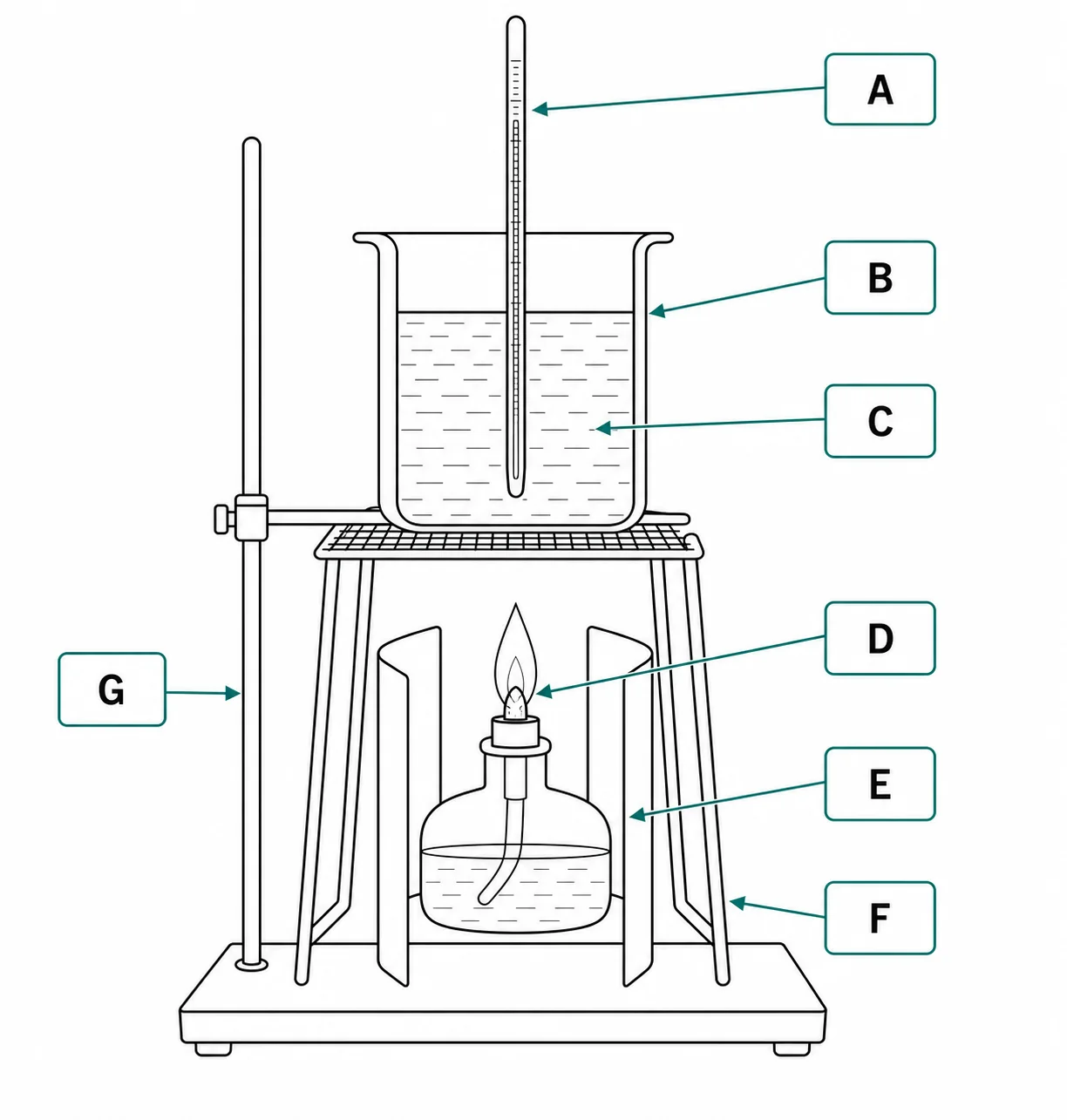
- A — ___________________________________________
- B — ___________________________________________
- C — ___________________________________________
- D — ___________________________________________
- E — ___________________________________________
- F — ___________________________________________
- G — ___________________________________________
2. Term–definition match
Match each term to its definition. Write the correct term in the right-hand column. Terms: calorimetry, heat of combustion (ΔHc), specific heat capacity (c), temperature change (ΔT), q = mcΔT, moles (n), bomb calorimeter, incomplete combustion, percentage error, exothermic reaction. 10 marks
| # | Definition | Matching term |
|---|---|---|
| 2.1 | The experimental measurement of heat changes in a chemical reaction using an insulated apparatus. | |
| 2.2 | The enthalpy change when one mole of a substance burns completely in oxygen under standard conditions; always negative for fuels. | |
| 2.3 | The heat equation that links energy absorbed by water to its mass, specific heat capacity, and temperature rise. | |
| 2.4 | The energy required to raise 1 g of a substance by 1 K; for water this equals 4.18 J g−1 K−1. | |
| 2.5 | T(final) minus T(initial); positive when temperature rises during an exothermic process. | |
| 2.6 | The amount of substance in moles; calculated using n = m ÷ M. | |
| 2.7 | A sealed high-pressure calorimeter that measures ΔHc at constant volume; gives the accepted standard value. | |
| 2.8 | Combustion that yields carbon monoxide or soot because oxygen supply is insufficient; releases less energy per mole than complete combustion. | |
| 2.9 | A reaction that releases energy to the surroundings, causing the temperature of the surroundings to rise; ΔH is negative. | |
| 2.10 | The ratio of the absolute difference between experimental and accepted values to the accepted value, expressed as a percentage. |
3. True or false — with correction
Circle T or F. If false, write the corrected statement on the line provided. 10 marks (1 for T/F, 1 for each correction where needed)
3.1 In q = mcΔT, ‘m’ refers to the mass of fuel burned. T / F
3.2 The specific heat capacity of water is 4.18 J g−1 K−1. T / F
3.3 The molar enthalpy of combustion (ΔHc) is always a positive value because combustion releases energy. T / F
3.4 A spirit burner calorimeter gives a ΔHc that is always less negative than the accepted bomb calorimeter value because of heat loss to the surroundings. T / F
3.5 Leaving the spirit burner uncapped after extinguishing makes the calculated ΔHc appear more negative than the true value. T / F
4. Function recall
Answer each question in 1–2 sentences using precise terms from the lesson. 8 marks (2 each)
4.1 What is the role of the draught shield in a spirit burner calorimeter, and why does it not fully solve the heat-loss problem?
4.2 Why is copper used for the calorimeter cup rather than glass or plastic?
4.3 Why must the thermometer bulb be fully submerged in the water during the experiment?
4.4 Why do we divide q (in kJ) by n (in mol) rather than by mass of fuel in grams when calculating ΔHc?
5. Fill-in-the-blank paragraph
Use the word bank to complete the passage. Each word is used once. 8 marks
Word bank: exothermic, negative, water, moles, accepted, heat loss, incomplete combustion, less negative
Combustion reactions are _____________________ because they release energy to the surroundings. In a spirit burner calorimeter the thermal energy released by the fuel heats the _____________________ in the copper cup. The temperature rise is used to calculate q using q = mcΔT, and q is then divided by the _____________________ of fuel burned to give ΔHc. Because combustion is exothermic, ΔHc is always _____________________. The experimental ΔHc is always _____________________ than the _____________________ bomb calorimeter value for two main reasons: _____________________ carries a large proportion of combustion energy away before it can heat the water; and _____________________ means that some carbon is oxidised only to CO rather than CO2, releasing less energy per mole.
6. Concept map — calculation chain
Draw labelled arrows between the five terms below to show the full calculation chain from a spirit burner experiment to ΔHc. Each arrow must carry a brief linking phrase (e.g. “used in”, “divided by”, “converts to”). Aim for at least 5 labelled arrows. 5 marks
Terms: mass of fuel burned (g) • moles of fuel (n) • ΔT of water (°C) • heat absorbed by water (q, kJ) • ΔHc (kJ mol−1).
Q1 — Calorimeter labels
A: Thermometer (measures water temperature; bulb must be fully submerged). B: Copper calorimeter (high thermal conductivity, rapid heat transfer to water). C: Water (known mass; the substance whose temperature rise is measured). D: Wick (delivers fuel to flame by capillary action). E: Spirit burner / fuel reservoir (contains the fuel, e.g. ethanol or methanol). F: Draught shield (reduces — but does not eliminate — heat loss to moving air). G: Retort stand / tripod (supports the calorimeter at a fixed height above the flame).
Q2 — Term–definition matches
2.1 calorimetry • 2.2 heat of combustion (ΔHc) • 2.3 q = mcΔT • 2.4 specific heat capacity (c) • 2.5 temperature change (ΔT) • 2.6 moles (n) • 2.7 bomb calorimeter • 2.8 incomplete combustion • 2.9 exothermic reaction • 2.10 percentage error.
Q3 — True / False
3.1 False. Correction: ‘m’ in q = mcΔT is the mass of water in the calorimeter; the formula measures how much heat the water absorbed, not the fuel.
3.2 True.
3.3 False. Correction: ΔHc is always negative for combustion reactions because energy is released to the surroundings (exothermic); the convention ΔHc = −q/n applies a negative sign.
3.4 True.
3.5 False. Correction: leaving the burner uncapped causes fuel to evaporate from the wick. This makes the recorded mass of fuel burned appear larger than the mass actually combusted, overestimating n and making the calculated ΔHc less negative than the true experimental value.
Q4 — Function recall
4.1 The draught shield reduces convection currents of cooler air sweeping past the flame and calorimeter, decreasing the rate of heat loss to the surrounding air. However, it does not fully solve the problem because some heat still radiates outward through the shield and heats the air trapped inside it rather than the water.
4.2 Copper has very high thermal conductivity, so heat from the flame is rapidly conducted through the copper walls into the water, minimising the temperature gradient between flame and water and reducing measurement lag.
4.3 If the bulb is not fully submerged, part of it measures the temperature of air above the water, which is cooler than the water. This causes ΔT to be underestimated, making q (and therefore |ΔHc|) appear smaller than the true value.
4.4 ΔHc is a molar quantity — it represents energy released per mole of fuel, not per gram. Expressing it in kJ mol−1 allows direct comparison between fuels of different molar masses.
Q5 — Cloze paragraph
exothermic • water • moles • negative • less negative • accepted • heat loss • incomplete combustion.
Q6 — Concept map sample
Correct arrows include: mass of fuel burned ⟶divided by M gives→ moles of fuel (n); ΔT of water ⟶used with m and c in q = mcΔT to calculate→ heat absorbed (q, kJ); heat absorbed (q, kJ) + moles of fuel (n) ⟶combined in ΔHc = −q/n to give→ ΔHc. Award 1 mark per correctly directed and labelled arrow (minimum 5 required for full marks).