Chemistry • Year 11 • Module 3 • Lesson 12
Factors Affecting Reaction Rate
Lock in the five rate factors, the collision-theory vocabulary, and the distinction between how temperature/catalysts affect particle energy versus how concentration/surface area affect collision frequency.
1. Label the Maxwell-Boltzmann distribution diagram
The diagram below shows energy distributions at two temperatures for the same gas sample. Write the missing labels into boxes A–H. Each label is drawn from the lesson's Key Terms or Cards 1 and 4. 8 marks
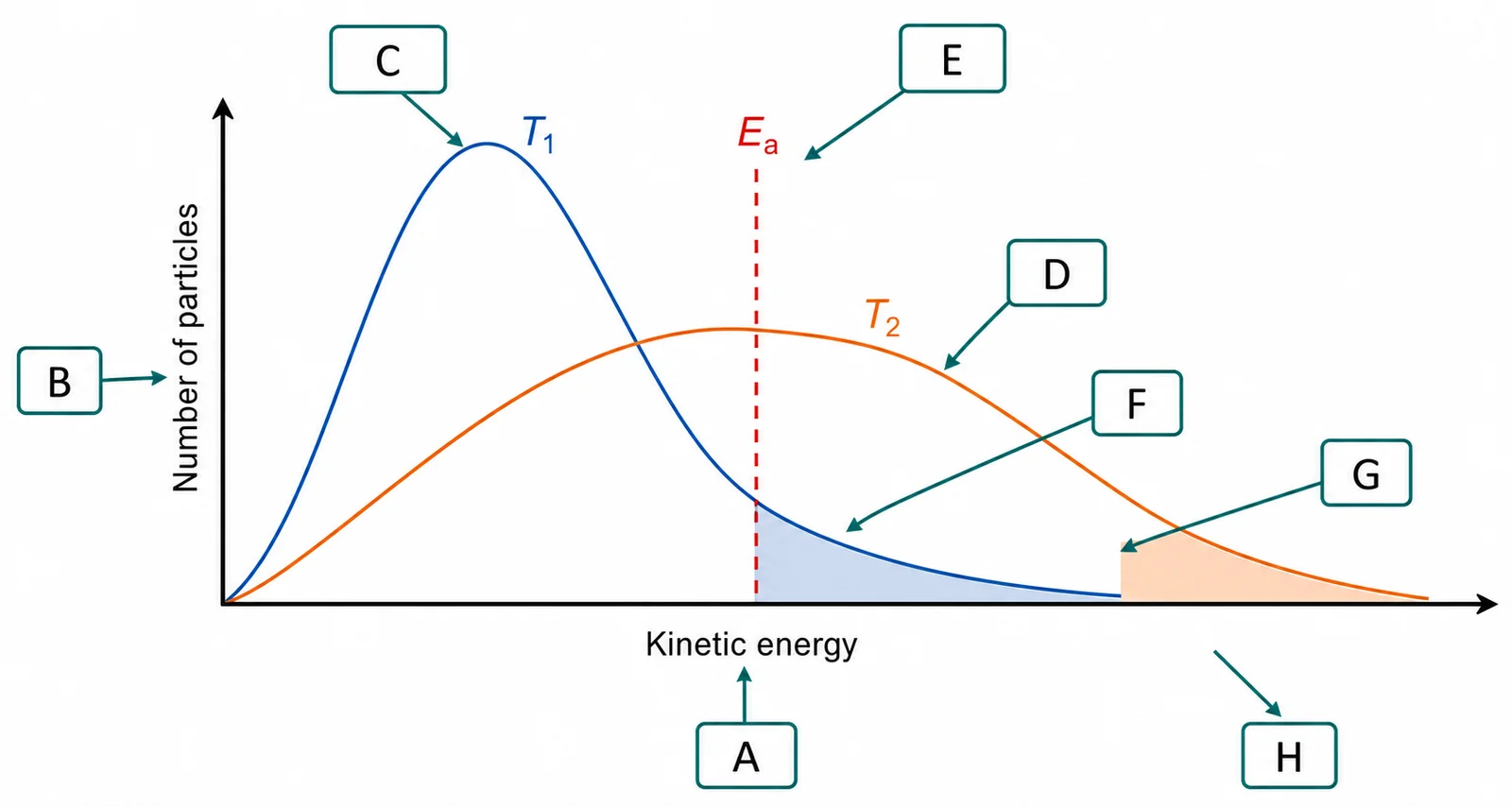
- A — label for the narrow, taller curve: _______________________ temperature
- B — label for the broad, lower curve: _______________________ temperature
- C — the vertical dashed line marked on the energy axis: _______________________
- D — what the blue shaded area beyond C represents: proportion of particles that can _______________________
- E — compared with D, the orange shaded area at T2 is (larger / smaller): _______________________
- F — x-axis label (with units): _______________________
- G — y-axis label: _______________________
- H — what is true about the total area under each curve: the areas are _______________________ (one word)
| Box | Your label |
|---|---|
| A | |
| B | |
| C | |
| D | |
| E | |
| F | |
| G | |
| H |
2. Term–definition match
The ten definitions below are shuffled. In the right-hand column write the matching term from this list: activation energy, catalyst, collision frequency, effective collision, heterogeneous catalyst, homogeneous catalyst, Maxwell-Boltzmann distribution, surface area effect, concentration effect, temperature effect. 10 marks
| # | Definition (shuffled) | Matching term |
|---|---|---|
| 2.1 | The minimum energy that colliding particles must possess for a reaction to occur. | |
| 2.2 | A graph showing the number of particles plotted against their kinetic energy for a sample at a given temperature. | |
| 2.3 | A collision between reactant particles that results in a chemical reaction because the particles have sufficient energy and correct orientation. | |
| 2.4 | The number of collisions between reactant particles per unit time. | |
| 2.5 | A substance that increases reaction rate without being consumed; provides an alternative pathway with lower activation energy. | |
| 2.6 | A catalyst in the same phase as the reactants (e.g. H+(aq) in ester hydrolysis). | |
| 2.7 | A catalyst in a different phase from the reactants (e.g. solid Pt catalysing gas-phase reactions). | |
| 2.8 | Increasing the amount of dissolved reactant per unit volume increases collision frequency, raising the reaction rate. | |
| 2.9 | Grinding a solid reactant into smaller particles exposes more solid surface to collisions with the other reactant, raising the rate. | |
| 2.10 | Raising this variable shifts the Maxwell-Boltzmann curve to higher energies, increasing the proportion of particles exceeding Ea. |
3. True or false — with correction
For each statement, circle T or F. If the statement is false, write the corrected version on the line provided. 10 marks (1 for T/F, 1 for the correction where needed)
3.1 Increasing the concentration of a reactant increases the rate because the particles gain more kinetic energy. T / F
3.2 A catalyst lowers the activation energy by providing an alternative reaction pathway. T / F
3.3 When temperature is increased, the peak of the Maxwell-Boltzmann curve moves to a higher position (taller peak) on the y-axis. T / F
3.4 Adding a catalyst to a reaction changes the enthalpy change (ΔH) of the reaction. T / F
3.5 Surface area is only a relevant rate factor when at least one reactant is a solid. T / F
4. Function recall
Answer each in 1–2 sentences using precise collision-theory language. 8 marks (2 each)
4.1 What is the function of the activation energy in collision theory?
4.2 Explain what a heterogeneous catalyst does at the molecular level (mention adsorption, surface reaction, desorption).
4.3 Why does the total area under the Maxwell-Boltzmann curve remain the same when temperature increases?
4.4 What is the function of the ceramic honeycomb structure inside a catalytic converter?
5. Cloze paragraph — collision theory and rate factors
Fill in each blank using the word bank. Each word is used once. 10 marks
Word bank: activation energy • adsorption • catalyst • collision frequency • consumed • enthalpy • heterogeneous • Maxwell-Boltzmann • proportion • surface area
Reaction rate depends on the frequency of effective collisions. Increasing temperature both raises _________________ and increases the _________________ of particles that exceed the _________________. This is shown on the _________________ distribution, where the curve shifts right at higher temperature. Increasing concentration also increases _________________ frequency, but does not affect particle energy. For reactions involving a solid reactant, grinding the solid to a powder increases _________________, exposing more solid particles to collisions. A _________________ provides an alternative reaction pathway with a lower activation energy. A _________________ catalyst is in a different phase from the reactants; it operates by _________________ of reactant molecules onto its surface. Importantly, a catalyst is not _________________ in the overall reaction, so the _________________ change (ΔH) of the reaction is unchanged.
Q1 — Maxwell-Boltzmann labels
A: lower (T1, lower temperature). B: higher (T2, higher temperature). C: activation energy (Ea). D: undergo effective collisions / react. E: larger (the high-energy tail is more extended at T2, so the shaded area beyond Ea is larger). F: kinetic energy (kJ mol−1 or eV). G: number of particles. H: equal (the total number of particles is the same at both temperatures).
Q2 — Term–definition matches
2.1 activation energy • 2.2 Maxwell-Boltzmann distribution • 2.3 effective collision • 2.4 collision frequency • 2.5 catalyst • 2.6 homogeneous catalyst • 2.7 heterogeneous catalyst • 2.8 concentration effect • 2.9 surface area effect • 2.10 temperature effect.
Q3 — True / False with corrections
3.1 False. Correction: increasing concentration increases the number of reactant particles per unit volume, which raises collision frequency. It does not change the kinetic energy of the particles; that is affected by temperature.
3.2 True.
3.3 False. Correction: at higher temperature the peak of the Maxwell-Boltzmann curve is lower (not taller) and shifted to the right. The curve becomes broader and flatter because the same number of particles is distributed over a wider energy range.
3.4 False. Correction: a catalyst does not change ΔH. Because the reactants and products are chemically identical in both the catalysed and uncatalysed pathways, the energy difference between them (ΔH) is unchanged — only the height of the activation energy barrier is lowered.
3.5 True. Surface area is only relevant for heterogeneous reactions involving a solid reactant. For homogeneous (all-liquid or all-gas) reactions, surface area is not a variable.
Q4.1 — Function of activation energy
The activation energy is the minimum kinetic energy that colliding particles must possess for a reaction to occur. Only collisions where both particles have energy equal to or greater than Ea result in bond breaking and product formation — it acts as an energy threshold that filters which collisions are effective.
Q4.2 — Mechanism of heterogeneous catalyst
Reactant molecules from the gas or liquid phase adsorb onto the solid catalyst surface, binding at active sites. The adsorbed molecules then react on the surface (surface reaction), and the product molecules desorb from the surface as free molecules. The catalyst surface is regenerated at the end of each cycle — it is not consumed.
Q4.3 — Total area under the Maxwell-Boltzmann curve
The total area under the curve represents the total number of particles in the sample. Since raising the temperature does not create or destroy particles (the sample size is fixed), the total number of particles — and therefore the total area under the curve — remains constant. The energy is redistributed across the same population of particles.
Q4.4 — Function of ceramic honeycomb in catalytic converter
The ceramic honeycomb provides an extremely large surface area coated with platinum (Pt) and palladium (Pd). A large surface area maximises the number of active sites available for adsorption of exhaust gas molecules (CO, NOx, unburned hydrocarbons), increasing the rate of the catalytic reactions that convert them to CO2, H2O and N2.
Q5 — Cloze paragraph answers (in order)
collision frequency • proportion • activation energy • Maxwell-Boltzmann • collision • surface area • catalyst • heterogeneous • adsorption • consumed • enthalpy
Note: "collision frequency" appears as the first blank and again as "collision frequency" in blank 5 — accept in either position as long as the sense is correct.