Chemistry • Year 11 • Module 3 • Lesson 11
Collision Theory & Reaction Rate
Lock in the core vocabulary of collision theory — effective collisions, activation energy, reaction rate — and the particle-level explanation of why not every collision leads to a reaction.
1. Label the energy profile diagram
The diagram below shows an exothermic reaction energy profile. Write the missing labels into boxes A–H. Each label is drawn from the lesson's Key Terms or from the content cards. 8 marks
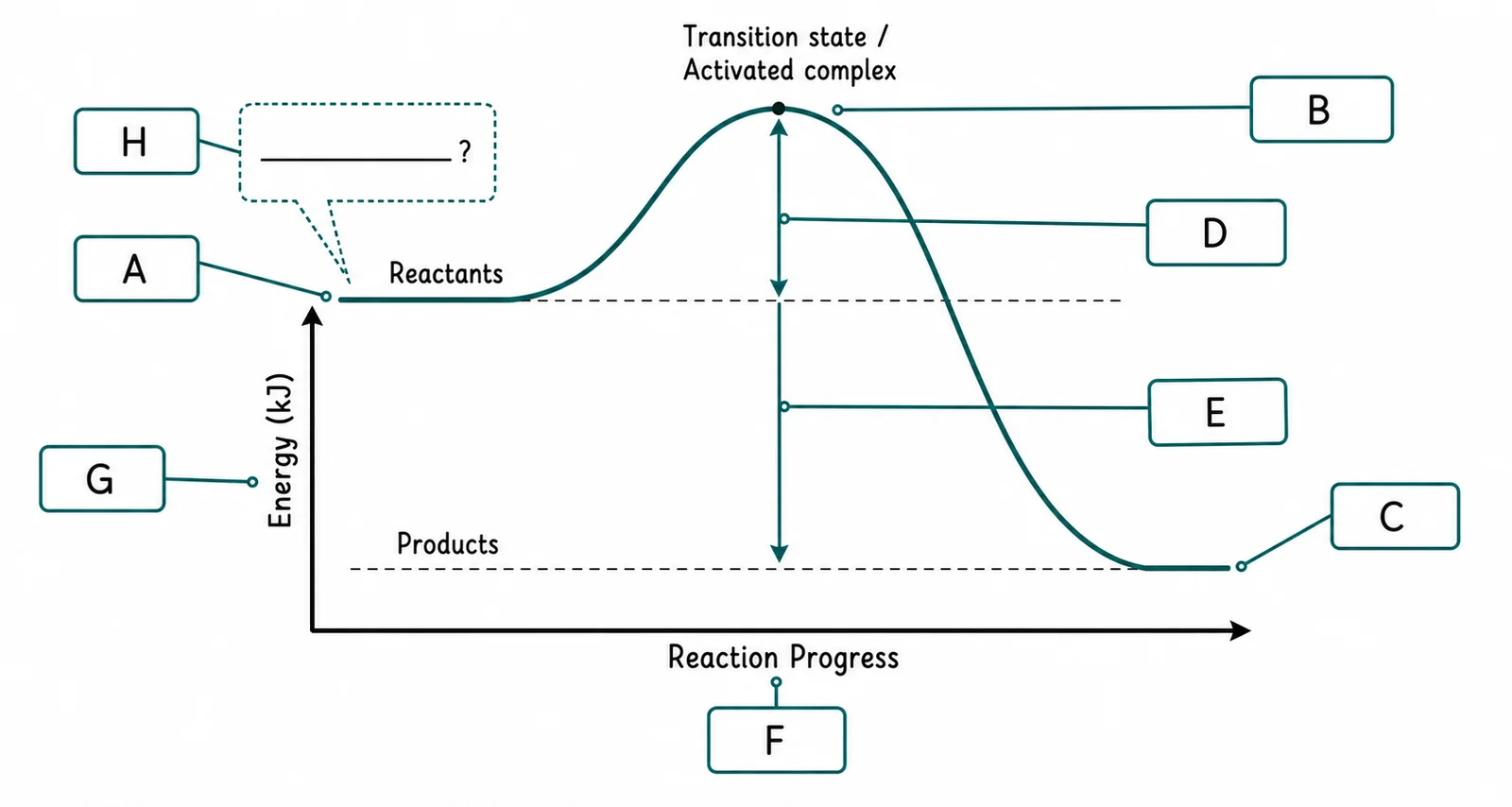
- A — the starting energy level (left side) _______________________
- B — the highest point on the curve _______________________
- C — the ending energy level (right side) _______________________
- D — the energy arrow from A to B _______________________
- E — the energy difference between A and C _______________________
- F — the x-axis label _______________________
- G — the y-axis label _______________________
- H — what happens to particles with energy below D? _______________________
| Box | Your label |
|---|---|
| A | |
| B | |
| C | |
| D | |
| E | |
| F | |
| G | |
| H |
2. Term–definition match
The definitions below are shuffled. In the right-hand column write the matching term from this list: collision theory, activation energy (Ea), effective collision, reaction rate, Maxwell–Boltzmann distribution, transition state (activated complex), collision frequency, ineffective collision. 8 marks
| # | Definition (shuffled) | Matching term |
|---|---|---|
| 2.1 | The change in concentration of a reactant or product per unit time; measured in mol L−1 s−1. | |
| 2.2 | The minimum kinetic energy colliding particles must have for a collision to result in a chemical reaction. | |
| 2.3 | A model stating that reactions occur only when particles collide with sufficient energy and in the correct orientation. | |
| 2.4 | A collision that results in the formation of products; requires energy ≥ Ea AND correct orientation simultaneously. | |
| 2.5 | The high-energy, unstable intermediate formed briefly at the peak of the energy profile diagram during the collision. | |
| 2.6 | A graph showing the spread of kinetic energies among particles; the area under the curve to the right of Ea represents the fraction of particles capable of an effective collision. | |
| 2.7 | The number of collisions per second between reactant particles in a given volume; increases with concentration and temperature. | |
| 2.8 | A collision between particles that does NOT result in a reaction because it lacks sufficient energy or the correct orientation (or both). |
3. True or false — with correction
For each statement, circle T or F. If the statement is false, write a corrected version on the line provided. 8 marks (1 for T/F, 1 for the correction where needed)
3.1 Every collision between reactant particles results in a chemical reaction. T / F
3.2 Activation energy (Ea) is measured from the reactant energy level to the transition state peak on an energy diagram. T / F
3.3 For a collision to be effective, a particle only needs to have kinetic energy ≥ Ea; orientation does not matter. T / F
3.4 Reaction rate typically decreases over time because reactant concentration falls, reducing collision frequency. T / F
3.5 Adding a catalyst to a reaction increases the enthalpy change (ΔH) of the reaction. T / F
3.6 In an exothermic reaction, the products are at a higher energy level than the reactants on an energy diagram. T / F
4. Function recall
Answer each in 1–2 sentences using precise terms from the lesson. 8 marks (2 each)
4.1 What is the function of activation energy in a chemical reaction?
4.2 What is the function of correct orientation in making a collision effective?
4.3 Why does a glow stick in hot water glow more brightly than the same glow stick in icy water?
4.4 Why does the rate of a reaction typically decrease as the reaction proceeds?
5. Fill in the blanks
Complete the paragraph using the word bank below. Each word is used once. 8 marks (1 per blank)
Word bank: collision frequency · activation energy · effective · orientation · kinetic energy · transition state · mol L−1 s−1 · decreases
Reaction rate measures the change in concentration of a reactant or product per unit time, expressed in units of _______________ (1). It is not constant throughout a reaction — as reactants are consumed, their concentration falls, reducing the _______________ (2) between particles, so the rate _______________ (3) over time.
At the particle level, collision theory states that not every collision is _______________ (4). For a collision to produce a reaction, two conditions must be met simultaneously: the particles must collide with _______________ (5) equal to or greater than the _______________ (6), and they must have the correct _______________ (7) so that reactive sites face each other. Collisions that satisfy both conditions pass through an unstable intermediate called the _______________ (8), and products are formed.
6. Build a concept map
Draw labelled arrows between the five terms below to show how they connect. Each arrow must carry a linking phrase (e.g. "determines", "must exceed", "results in"). Aim for at least 5 labelled arrows. 5 marks
Supplied terms: kinetic energy of particles · activation energy (Ea) · effective collision · reaction rate · correct orientation.
Q1 — Energy profile diagram labels
A: Reactants (reactant energy level). B: Transition state / activated complex (peak of the curve). C: Products (product energy level). D: Activation energy (Ea) — the energy barrier from reactant level to the peak. E: Enthalpy change (ΔH) — the net energy difference between reactants and products; negative for exothermic. F: Reaction Progress. G: Energy (kJ). H: Particles with energy below Ea bounce apart (elastically) without reacting — no products are formed.
Q2 — Term–definition matches
2.1 reaction rate • 2.2 activation energy (Ea) • 2.3 collision theory • 2.4 effective collision • 2.5 transition state (activated complex) • 2.6 Maxwell–Boltzmann distribution • 2.7 collision frequency • 2.8 ineffective collision.
Q3 — True / false with correction
3.1 False. Correction: only effective collisions result in a chemical reaction. A collision must have sufficient energy (≥ Ea) AND correct orientation; many collisions simply bounce apart without reacting.
3.2 True. Ea is measured from the reactant energy level to the transition state peak — not from zero and not from the product level.
3.3 False. Correction: for a collision to be effective, BOTH conditions must be met simultaneously — kinetic energy ≥ Ea AND correct orientation. Energy alone is not sufficient; even high-energy collisions between the wrong parts of molecules do not produce products.
3.4 True. As reactants are consumed, their concentration falls, lowering collision frequency. Fewer collisions per second means fewer effective collisions per second, so rate decreases.
3.5 False. Correction: a catalyst lowers the activation energy (Ea) but does NOT change ΔH. The enthalpy change of the reaction is unaffected by the presence of a catalyst.
3.6 False. Correction: in an exothermic reaction, the products are at a lower energy level than the reactants (ΔH < 0). Energy is released to the surroundings.
Q4.1 — Function of activation energy
Activation energy sets the minimum kinetic energy barrier that colliding particles must overcome before bonds in the reactants can break and atoms can rearrange into products. It acts as an "energy hurdle": particles that reach or exceed Ea can form the transition state and proceed to products; those below Ea bounce apart without reacting.
Q4.2 — Function of correct orientation
Correct orientation ensures that the reactive sites (the specific parts of the molecules that must bond together) are facing each other during the collision. Even if particles have sufficient kinetic energy (≥ Ea), if they collide with the wrong parts of their structures facing each other, atoms cannot rearrange into the desired products and no reaction occurs.
Q4.3 — Glow stick brightness and temperature
Hot water increases the average kinetic energy of the reactant particles inside the glow stick. A larger proportion of these particles now have kinetic energy ≥ Ea, so more collisions per second are effective. More effective collisions per second means more product (light) is produced per second — the glow is brighter. In icy water, fewer particles exceed Ea, effective collisions are rarer, and the glow is dimmer.
Q4.4 — Why rate decreases over time
As a reaction proceeds, reactant particles are consumed and their concentration decreases. A lower concentration means fewer reactant particles per unit volume, so particles collide less often (lower collision frequency). Fewer collisions per second means fewer effective collisions per second (assuming temperature and Ea are unchanged), so the reaction rate falls progressively toward zero as reactants run out.
Q5 — Cloze answers (in order)
(1) mol L−1 s−1 (2) collision frequency (3) decreases (4) effective (5) kinetic energy (6) activation energy (7) orientation (8) transition state.
Q6 — Sample concept map
A correct map should include arrows such as:
- kinetic energy of particles — must be ≥ → activation energy (Ea)
- kinetic energy of particles — together with → correct orientation
- kinetic energy of particles (sufficient) + correct orientation — both required for → effective collision
- activation energy (Ea) — is the barrier that determines → effective collision
- effective collision — frequency determines → reaction rate
Award full marks for at least 5 correctly labelled arrows that respect causal direction and use lesson terminology.