Chemistry • Year 11 • Module 3 • Lesson 10
Galvanic Cells — Inert Electrodes & Predicting Reactions
Lock in the core vocabulary and rules: active vs inert electrodes, the standard reduction potential table, and the conditions for spontaneous cell reactions.
1. Label the galvanic cell with an inert electrode
The diagram below shows a galvanic cell in which the Fe2+/Fe3+ half-cell (left) is connected to the Ag+/Ag half-cell (right) via a salt bridge. Write the correct label for each box A–H. Labels must be chosen from the lesson’s Key Terms and the Cell Notation section. 8 marks
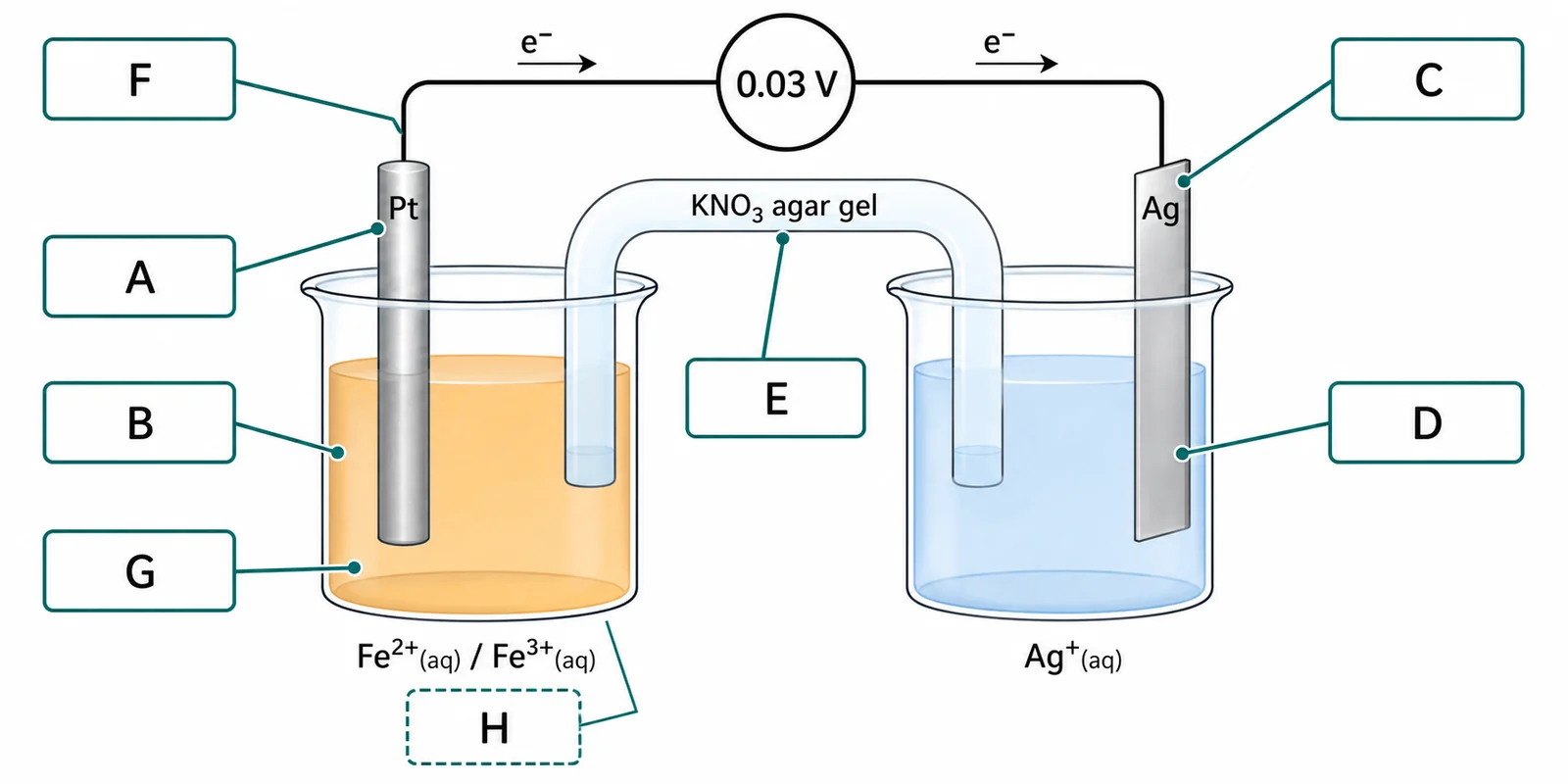
- A — material of left electrode ___________________________
- B — role of left electrode (anode or cathode?) ___________________________
- C — material of right electrode ___________________________
- D — role of right electrode (anode or cathode?) ___________________________
- E — function of the salt bridge ___________________________
- F — direction electrons travel in the external wire ___________________________
- G — half-reaction at the left electrode ___________________________
- H — classify the left electrode (active or inert?) ___________________________
2. Term–definition match
Match each definition to a term from this list: inert electrode, standard reduction potential (E°), standard hydrogen electrode (SHE), E°cell, anode, cathode, spontaneous reaction, cell notation, sacrificial anode, active electrode. Write the term in the right-hand column. 10 marks
| # | Definition | Matching term |
|---|---|---|
| 2.1 | The electrode at which oxidation occurs; negative terminal of a galvanic cell. | |
| 2.2 | The electrode at which reduction occurs; positive terminal of a galvanic cell. | |
| 2.3 | A conducting electrode that does not participate in the redox reaction — it only transfers electrons to or from ions in solution. | |
| 2.4 | A reference half-cell (E° = 0.00 V) consisting of H2(g) at 1 atm over a platinum electrode in 1 mol L−1 H+(aq). | |
| 2.5 | The voltage of a half-cell measured under standard conditions relative to the SHE; listed in tables for all common half-reactions. | |
| 2.6 | E°cathode − E°anode; positive value confirms the cell reaction is spontaneous as written. | |
| 2.7 | A reaction that proceeds without external energy input; occurs when E°cell > 0. | |
| 2.8 | A more reactive metal attached to a structure to protect it from corrosion by becoming the anode and oxidising preferentially. | |
| 2.9 | A shorthand summary of a galvanic cell: anode on the left, cathode on the right, with | for phase boundaries and || for the salt bridge. | |
| 2.10 | An electrode that participates directly in the half-reaction — it dissolves or gains mass during cell operation. |
3. True or false — with correction
Circle T or F for each statement. If false, write the correct version on the line below. 10 marks (1 mark T/F, 1 mark correction where needed)
3.1 A platinum electrode is used in the Fe2+/Fe3+ half-cell because platinum is very reactive and would dissolve quickly. T / F
3.2 The standard reduction potential table lists the strongest oxidant (most positive E°) at the top. T / F
3.3 A galvanic cell reaction is spontaneous when E°cell is negative. T / F
3.4 Zinc acts as a sacrificial anode for steel because zinc has a more negative standard reduction potential than iron. T / F
3.5 Any metal with a positive standard reduction potential will dissolve in dilute hydrochloric acid. T / F
4. Fill in the blanks
Complete the passage using the word bank below. Each word is used once. 10 marks
Word bank: anode cathode graphite inert negative oxidised platinum positive reduced spontaneous
In a galvanic cell, the half-reaction involving the species with the more ______________ standard reduction potential occurs at the ______________ (site of reduction), while the species with the more ______________ standard reduction potential is ______________ at the ______________. When a half-reaction involves only ions in solution or gases — such as Fe2+(aq)/Fe3+(aq) or Cl2(g)/Cl−(aq) — an ______________ electrode must be used. Common inert electrode materials include ______________ and ______________. A cell reaction is ______________ when E°cell is ______________.
5. Reading the standard reduction potential table
Use the partial E° table below to answer each question. Write your answer in the space provided. 6 marks)
| Half-reaction (as written in the table) | E° (V) |
|---|---|
| MnO4−(aq) + 8H+(aq) + 5e− → Mn2+(aq) + 4H2O(l) | +1.51 |
| Cl2(g) + 2e− → 2Cl−(aq) | +1.36 |
| Fe3+(aq) + e− → Fe2+(aq) | +0.77 |
| Cu2+(aq) + 2e− → Cu(s) | +0.34 |
| 2H+(aq) + 2e− → H2(g) | 0.00 |
| Fe2+(aq) + 2e− → Fe(s) | −0.44 |
| Zn2+(aq) + 2e− → Zn(s) | −0.76 |
| Al3+(aq) + 3e− → Al(s) | −1.66 |
| Mg2+(aq) + 2e− → Mg(s) | −2.37 |
5.1 Which species in the table is the strongest oxidising agent? How do you know from its E° value? 2 marks
5.2 Which species in the table is the strongest reducing agent? How do you know? 2 marks
5.3 Using only the table, identify two metals from the list that would dissolve in dilute sulfuric acid. Justify your selection by referring to E° values. 2 marks
6. Function recall
Answer each in 1–2 sentences using precise terms from the lesson. 8 marks (2 each)
6.1 What is the function of an inert electrode in a galvanic cell?
6.2 What is the function of the salt bridge in a galvanic cell?
6.3 Explain why the standard reduction potential table and the activity series encode the same reactivity ranking.
6.4 Why does zinc protect steel from corrosion via cathodic protection rather than acting as a physical barrier?
Q1 — Label answers
A: Platinum (Pt) — the inert electrode material. B: Anode — Fe2+ is oxidised (Fe2+ → Fe3+ + e−; E° = +0.77 V, the less positive value). C: Silver (Ag) — the metal electrode that participates directly. D: Cathode — Ag+ is reduced (Ag+ + e− → Ag(s); E° = +0.80 V, more positive). E: Maintains charge balance / allows ion flow between half-cells without mixing the solutions. F: From the platinum (anode) through the wire to the silver (cathode). G: Fe2+(aq) → Fe3+(aq) + e− (oxidation). H: Inert (both Fe2+ and Fe3+ are aqueous — no solid iron forms at the electrode).
Q2 — Term–definition matches
2.1 anode • 2.2 cathode • 2.3 inert electrode • 2.4 standard hydrogen electrode (SHE) • 2.5 standard reduction potential (E°) • 2.6 E°cell • 2.7 spontaneous reaction • 2.8 sacrificial anode • 2.9 cell notation • 2.10 active electrode
Q3 — True/False with correction
3.1 False. Platinum is used because it is inert (unreactive); it does not participate in the Fe2+/Fe3+ reaction, making it suitable as a conducting surface. It is chosen specifically because it does NOT dissolve.
3.2 True.
3.3 False. A galvanic cell reaction is spontaneous when E°cell is positive (greater than 0).
3.4 True.
3.5 False. Metals with a negative standard reduction potential will dissolve in dilute acid. Metals with positive E° (e.g. Cu, Ag) do not dissolve in dilute HCl.
Q4 — Cloze answers
positive → cathode; negative → oxidised → anode; inert; platinum; graphite; spontaneous; positive.
Full sentence: “…more positive E° occurs at the cathode (site of reduction), while the species with the more negative E° is oxidised at the anode. When a half-reaction involves only ions in solution or gases, an inert electrode must be used. Common inert electrode materials include platinum and graphite. A cell reaction is spontaneous when E°cell is positive.”
Q5.1 — Strongest oxidising agent
MnO4− (permanganate) at E° = +1.51 V. The most positive E° in the table means MnO4− most readily gains electrons (is most easily reduced), which is the definition of a strong oxidising agent.
Q5.2 — Strongest reducing agent
Mg (magnesium) from the half-reaction Mg2+/Mg at E° = −2.37 V. The most negative E° means Mg most readily loses electrons (is most easily oxidised) and is therefore the strongest reducing agent.
Q5.3 — Metals that dissolve in dilute sulfuric acid
Any metal whose E°(Mn+/M) < 0.00 V will dissolve. From the table: Fe (E° = −0.44 V), Zn (E° = −0.76 V), Al (E° = −1.66 V), and Mg (E° = −2.37 V) all qualify. Any two of these earn full marks.
Q6.1 — Function of the inert electrode
An inert electrode provides a conducting surface for electron transfer to or from ions in solution without itself being oxidised or reduced. Its mass does not change during cell operation — it is neither dissolved nor has material deposited onto it.
Q6.2 — Function of the salt bridge
The salt bridge allows ions to flow between the two half-cells to maintain electrical neutrality (balance charge) without allowing the solutions to mix. Without the salt bridge, charge would build up and the cell would stop producing current.
Q6.3 — E° table vs activity series
Both rank metals by their tendency to be oxidised (lose electrons). The activity series gives a qualitative order (“above hydrogen corrodes in acid”); the E° table gives exact numerical values that encode the same information. “Above hydrogen in the activity series” simply corresponds to E°(Mn+/M) < 0.00 V in the table.
Q6.4 — Why cathodic protection is not a physical barrier
Cathodic protection works even when the iron surface is exposed to seawater. Because zinc (E° = −0.76 V) has a more negative E° than iron (E° = −0.44 V), zinc is preferentially oxidised (acts as the anode) in any galvanic cell formed in the electrolyte. Iron is forced to be the cathode regardless of whether seawater contacts it — it undergoes reduction, not oxidation, so it cannot corrode.