Chemistry • Year 11 • Module 3 • Lesson 9
Galvanic Cells
Lock in the core vocabulary, electrode roles, cell notation and the rules for predicting spontaneous galvanic cell operation.
1. Label the Daniell cell diagram
The diagram below shows a zinc–copper galvanic cell (Daniell cell). Write the correct label for each box A–H. Labels are drawn from the lesson’s Key Terms and content cards. 8 marks
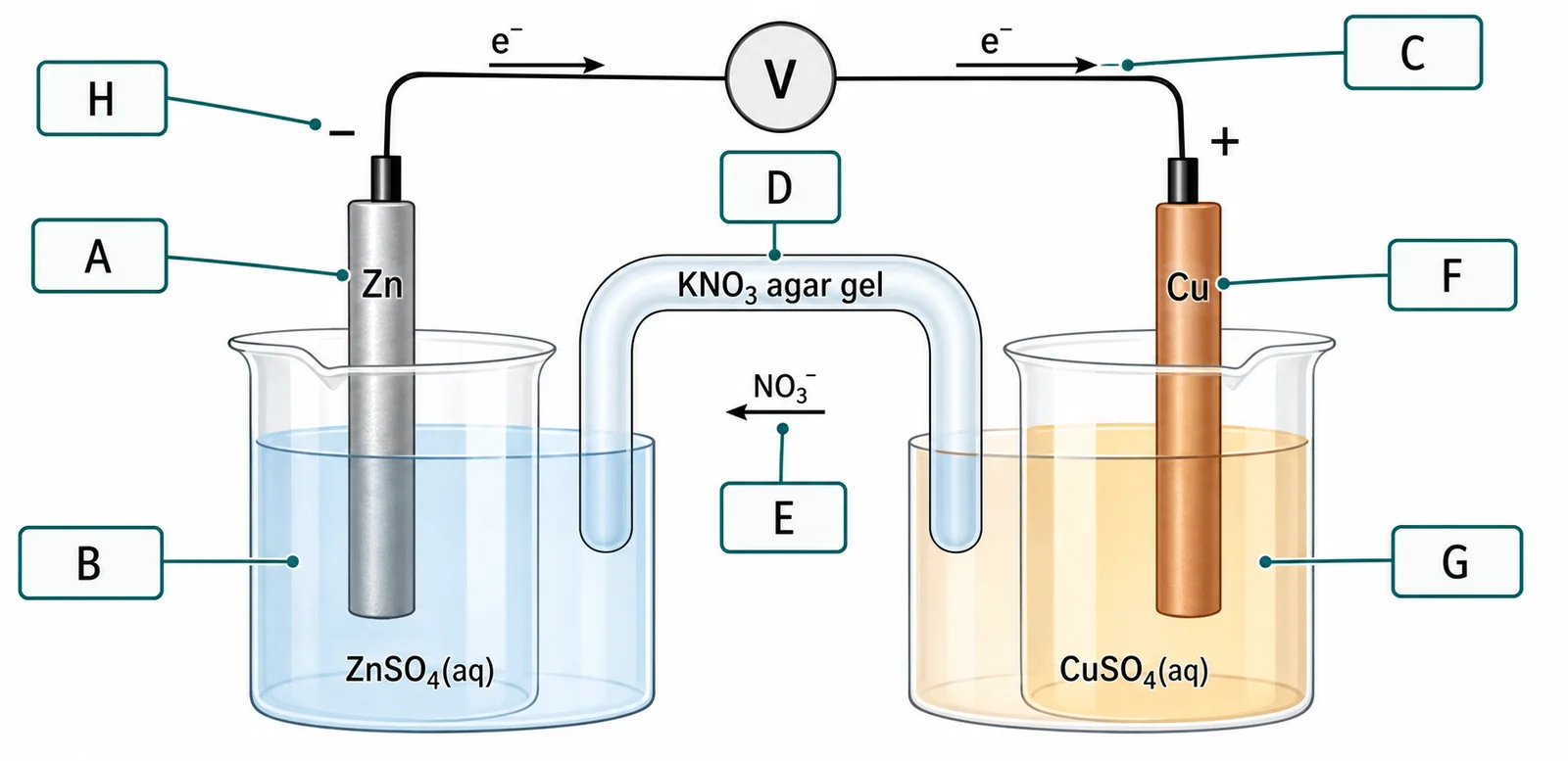
- A — name for the left (zinc) electrode _______________________
- B — type of reaction occurring at the left electrode _______________________
- C — direction electrons flow through the external wire _______________________
- D — name of the component connecting the two solutions _______________________
- E — which ions migrate through the salt bridge toward the left beaker _______________________
- F — name for the right (copper) electrode _______________________
- G — type of reaction occurring at the right electrode _______________________
- H — charge (polarity) of the left electrode in this galvanic cell _______________________
2. Term–definition match
Match each definition to the correct term. Choose from: galvanic cell, anode, cathode, salt bridge, electromotive force (EMF), standard reduction potential, half-cell, cell notation, electrolyte, spontaneous reaction. 10 marks
| # | Definition | Matching term |
|---|---|---|
| 2.1 | An electrochemical cell that converts chemical energy to electrical energy via a spontaneous redox reaction. | |
| 2.2 | The electrode at which oxidation occurs; the negative terminal in a galvanic cell. | |
| 2.3 | The electrode at which reduction occurs; the positive terminal in a galvanic cell. | |
| 2.4 | A U-tube containing an inert electrolyte that maintains electrical neutrality by allowing ion migration between half-cells. | |
| 2.5 | The voltage produced by a galvanic cell; equal to E°cathode − E°anode. | |
| 2.6 | A measure of the tendency of a species to be reduced, measured relative to the standard hydrogen electrode (0.00 V). | |
| 2.7 | One of the two compartments of a galvanic cell, each containing an electrode and its surrounding electrolyte solution. | |
| 2.8 | Shorthand for a galvanic cell: anode | anode solution || cathode solution | cathode. | |
| 2.9 | A solution that conducts electricity because it contains dissolved ions. | |
| 2.10 | A reaction that proceeds without an external energy input; has E°cell > 0. |
3. True or false — with correction
For each statement circle T or F. If false, write the corrected version on the line. 10 marks (1 T/F + 1 correction where needed)
3.1 In a galvanic cell, electrons flow from the anode to the cathode through the external wire. T / F
3.2 The anode is the positive electrode in a galvanic cell. T / F
3.3 Removing the salt bridge from a working galvanic cell will cause the current to stop almost immediately. T / F
3.4 When a galvanic cell operates, the mass of the cathode decreases because metal is dissolved into solution. T / F
3.5 A spontaneous galvanic cell always has E°cell > 0. T / F
4. Function recall
Answer each in 1–2 sentences using precise terms from the lesson. 8 marks (2 each)
4.1 What is the function of the salt bridge in a galvanic cell?
4.2 What is the function of the external wire in a galvanic cell?
4.3 What does a more positive standard reduction potential indicate about a species?
4.4 Why does the cell voltage of a galvanic cell decrease over time during operation?
5. Fill-in-the-blank paragraph
Complete the paragraph by writing one of the words from the word bank in each blank. Each word is used once. 8 marks
In a galvanic cell, a _________________ redox reaction is harnessed to produce electrical current. At the _________________, the metal undergoes _________________ and dissolves into solution, releasing _________________ into the external circuit. These particles travel through the wire to the _________________, where _________________ of metal cations from solution occurs and metal deposits on the electrode. The two half-cells are connected internally by a _________________ that allows _________________ to migrate and maintain electrical neutrality in both solutions.
6. Cell notation
Use the cell notation convention (anode | anode solution || cathode solution | cathode) to write the cell notation for each galvanic cell described below. 6 marks (2 each)
6.1 A galvanic cell with a zinc anode in zinc sulfate solution and a copper cathode in copper sulfate solution.
6.2 A galvanic cell with an iron anode in iron(II) sulfate solution and a silver cathode in silver nitrate solution.
6.3 A galvanic cell with a magnesium anode in magnesium sulfate solution and a lead cathode in lead(II) nitrate solution.
Q1 — Labelled Daniell cell
A: anode. B: oxidation. C: from anode to cathode (left to right). D: salt bridge. E: anions (e.g. NO₃⁻) migrate toward the anode half-cell. F: cathode. G: reduction. H: negative (−).
Q2 — Term–definition matches
2.1 galvanic cell • 2.2 anode • 2.3 cathode • 2.4 salt bridge • 2.5 electromotive force (EMF) • 2.6 standard reduction potential • 2.7 half-cell • 2.8 cell notation • 2.9 electrolyte • 2.10 spontaneous reaction.
Q3 — True / false with correction
3.1 True. Electrons flow from anode (negative) to cathode (positive) through the external wire.
3.2 False. Correction: the anode is the negative electrode in a galvanic cell (the cathode is positive). Students often confuse this with electrolytic cells where the anode is positive.
3.3 True. Without the salt bridge, charge imbalance builds up in both half-cells and current stops almost immediately.
3.4 False. Correction: during operation the cathode gains mass as metal ions are reduced and deposited as solid metal. It is the anode that decreases in mass as it dissolves.
3.5 True. E°cell = E°cathode − E°anode > 0 is the condition for a spontaneous galvanic cell.
Q4 — Function recall
4.1 The salt bridge allows ions to migrate between the two half-cells, maintaining electrical neutrality. Without it, charge imbalance would stop the cell. Anions migrate toward the anode half-cell and cations toward the cathode half-cell.
4.2 The external wire provides a pathway for electrons to flow from the anode (where they are released by oxidation) to the cathode (where they are consumed by reduction). This electron flow is the electrical current produced by the cell.
4.3 A more positive standard reduction potential indicates a stronger tendency for the species to be reduced — it is a better oxidising agent. Such a species will act as the cathode in a galvanic cell.
4.4 As the cell operates, the concentrations in both half-cells change (anode solution becomes more concentrated in metal ions; cathode solution becomes less concentrated). These changes reduce the driving force of the redox reaction, so the EMF gradually falls toward zero as the cell approaches equilibrium (“goes flat”).
Q5 — Cloze paragraph
spontaneous / anode / oxidation / electrons / cathode / reduction / salt bridge / ions.
Q6 — Cell notation
6.1 Zn(s) | Zn²⁺(aq) || Cu²⁺(aq) | Cu(s)
6.2 Fe(s) | Fe²⁺(aq) || Ag⁺(aq) | Ag(s)
6.3 Mg(s) | Mg²⁺(aq) || Pb²⁺(aq) | Pb(s)