Chemistry • Year 11 • Module 3 • Lesson 8
Redox Reactions & Oxidation States
Lock in OIL RIG, the rules for assigning oxidation states, and the structure of half-equations before moving to problem-solving.
1. Label the OIL RIG diagram
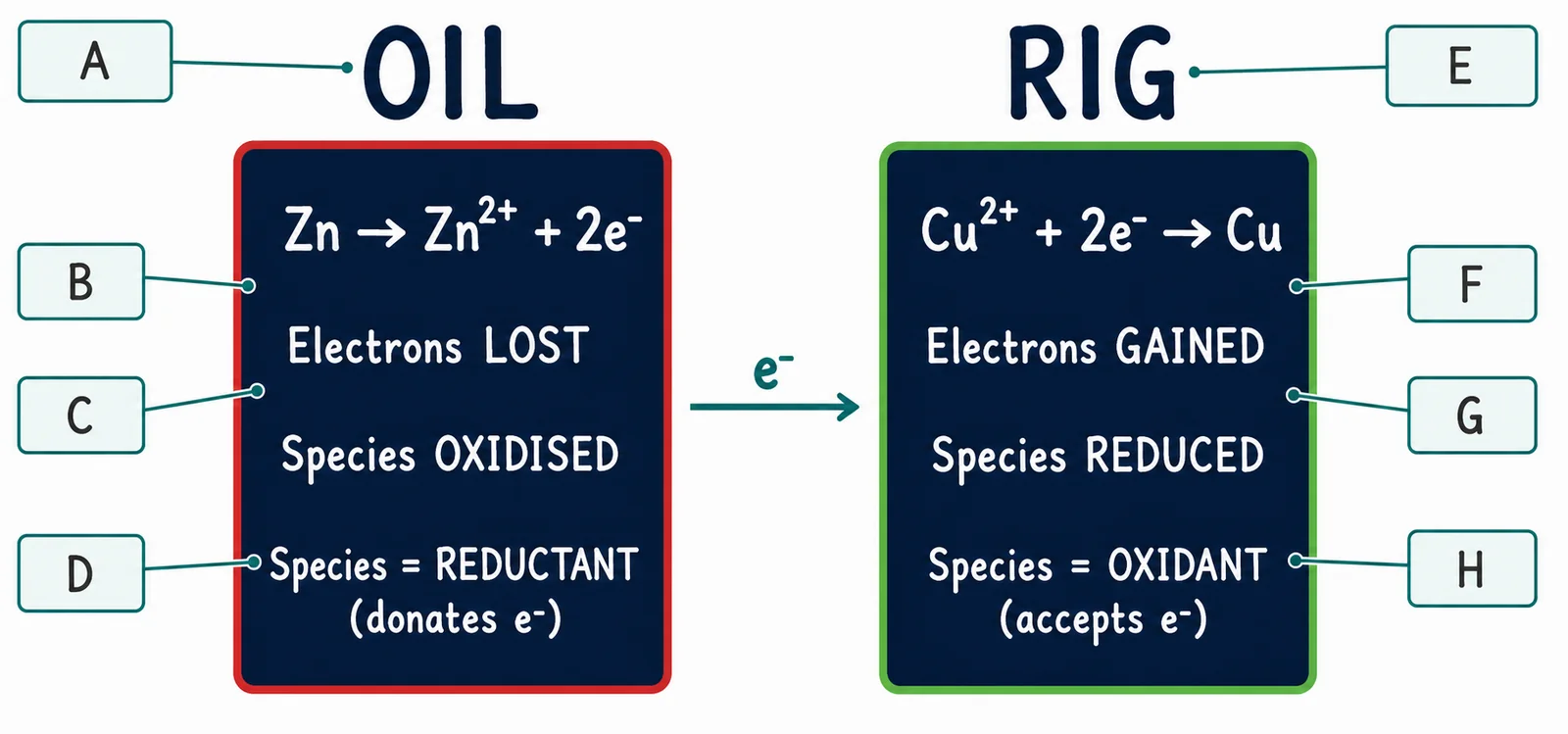
The diagram below shows the relationship between oxidation, reduction, the reductant and the oxidant. Write the missing labels into boxes A–H. Each label is drawn from the lesson's Key Terms and Card 2. 8 marks
| Box | Your label |
|---|---|
| A | |
| B | |
| C | |
| D | |
| E | |
| F | |
| G | |
| H |
2. Term–definition match
Match each definition to the correct term from this list: OIL RIG, oxidation state, oxidant (oxidising agent), reductant (reducing agent), half-equation, redox reaction, reduction, oxidation, rules for oxidation states, electron transfer. 10 marks
| # | Definition (shuffled) | Matching term |
|---|---|---|
| 2.1 | A reaction in which electrons are transferred from one species to another. | |
| 2.2 | The species that gains electrons in a redox reaction; it is itself reduced. | |
| 2.3 | An equation showing either only the oxidation or only the reduction step, with electrons explicitly shown. | |
| 2.4 | Loss of electrons by a species; shown by an increase in oxidation number. | |
| 2.5 | Gain of electrons by a species; shown by a decrease in oxidation number. | |
| 2.6 | A number assigned to each atom in a compound assuming all bonds are ionic; used to track electron movement. | |
| 2.7 | The mnemonic encoding: Oxidation Is Loss, Reduction Is Gain. | |
| 2.8 | The species that loses electrons in a redox reaction; it is itself oxidised. | |
| 2.9 | The set of priority rules used to assign oxidation numbers to atoms, including that O is usually −2, H is usually +1, and the sum of oxidation numbers equals zero in a neutral compound. | |
| 2.10 | The movement of electrons from the reductant to the oxidant; what defines a redox reaction at the particle level. |
3. True or false — with correction
Circle T or F for each statement. If false, write the corrected version on the line below. 8 marks (1 for T/F, 1 for correction where needed)
3.1 Oxidation can only occur when oxygen gas is directly involved in the reaction. T / F
3.2 In a redox reaction, the reductant is the species that loses electrons. T / F
3.3 The sum of oxidation states in a neutral compound equals the overall charge of the compound. T / F
3.4 In a reduction half-equation, electrons appear on the left side of the equation (as reactants). T / F
4. Oxidation state assignment table
Complete the table by applying the priority rules from the lesson. Show your algebraic working in the “Working” column. 14 marks (2 each)
| Species | Atom of interest | Working (algebraic equation) | Oxidation state |
|---|---|---|---|
| H2O | O | ||
| NaCl | Cl | ||
| SO42− | S | ||
| MnO4− | Mn | ||
| Fe2O3 | Fe | ||
| H2O2 | O | ||
| Cr2O72− | Cr |
5. Cloze — fill the blank paragraph
Complete the paragraph using the word bank below. Each word is used once. 8 marks
Word bank:
electrons • oxidant • reductant • oxidised • reduced • increase • decrease • simultaneously
In a redox reaction, two processes always occur ________. The species that loses ________ is said to be ________ and is called the ________. The species that gains electrons is said to be ________ and is called the ________. An ________ in oxidation number indicates oxidation has occurred, while a ________ in oxidation number indicates reduction.
6. Half-equation function recall
Answer each in 1–2 sentences using precise terms from the lesson. 6 marks (2 each)
6.1 What is the purpose of writing a half-equation, rather than the overall ionic equation, when studying a redox reaction?
6.2 Where do electrons appear in an oxidation half-equation — as reactants (left side) or products (right side)? Explain why using OIL RIG.
6.3 What two things must you check to verify that a half-equation is balanced?
Q1 — OIL RIG diagram labels
A: OIL (the mnemonic label for the oxidation panel). B: oxidation (the process name). C: electrons are lost / leave the species (electrons are products). D: reductant (the species that is oxidised; it donates electrons). E: RIG (the mnemonic label for the reduction panel). F: reduction (the process name). G: electrons are gained by the species (electrons are reactants). H: oxidant (the species that is reduced; it accepts electrons).
Q2 — Term–definition matches
2.1 redox reaction • 2.2 oxidant (oxidising agent) • 2.3 half-equation • 2.4 oxidation • 2.5 reduction • 2.6 oxidation state • 2.7 OIL RIG • 2.8 reductant (reducing agent) • 2.9 rules for oxidation states • 2.10 electron transfer.
Q3 — True / false
3.1 False. Correction: Oxidation is defined as loss of electrons, which may or may not involve oxygen gas. For example, Mg → Mg²♠ + 2e² is oxidation with no oxygen involved (OIL RIG).
3.2 True. The reductant loses electrons (is oxidised) and reduces the other species by donating electrons to it.
3.3 False. Correction: The sum of oxidation states in a neutral compound equals zero, not the charge (there is no overall charge on a neutral compound). For a polyatomic ion, the sum equals the charge of the ion.
3.4 True. In a reduction half-equation, electrons are reactants (left side) because the species is gaining them; e.g. Cu²♠(aq) + 2e² → Cu(s).
Q4 — Oxidation state table
H&sub2;O → O: Rule 3; O = −2.
NaCl → Cl: Na = +1 (Rule 2 pattern); sum = 0; Cl = −1.
SO&sub4;²²— → S: Sum = −2; 4(−2) = −8; S + (−8) = −2; S = +6.
MnO&sub4;²— → Mn: Sum = −1; 4(−2) = −8; Mn + (−8) = −1; Mn = +7.
Fe&sub2;O&sub3; → Fe: Sum = 0; 3(−2) = −6; 2Fe = +6; Fe = +3.
H&sub2;O&sub2; → O: This is a peroxide; Rule 3 exception: O = −1. (H = +1; 2(+1) + 2O = 0; O = −1.)
Cr&sub2;O&sub7;²²— → Cr: Sum = −2; 7(−2) = −14; 2Cr = +12; Cr = +6.
Q5 — Cloze answers (in order)
simultaneously • electrons • oxidised • reductant • reduced • oxidant • increase • decrease.
Q6.1 — Purpose of half-equations
A half-equation isolates either the oxidation or the reduction step so the exact number of electrons transferred is made explicit, making it easier to balance the overall equation and to clearly identify what is being oxidised and reduced.
Q6.2 — Electron position in oxidation half-equation
Electrons appear as products (right side) in an oxidation half-equation. OIL RIG: Oxidation Is Loss — the species is losing (releasing) electrons, so they appear on the right where products are written; e.g. Zn(s) → Zn²♠(aq) + 2e².
Q6.3 — Two checks for a balanced half-equation
(1) Atom balance: the same number of each type of atom appears on both sides. (2) Charge balance: the total charge is the same on both sides (including the charge contribution of the electrons).