Chemistry • Year 11 • Module 3 • Lesson 4
Combustion Reactions
Lock in the core vocabulary, complete vs incomplete combustion products, balancing equations, and the bushfire chemistry context introduced in this lesson.
1. Label the combustion diagram
The diagram below shows two contrasting combustion scenarios drawn from a bushfire. Write the correct labels into the boxes A–H. Each label is drawn from the lesson's Key Terms panel or from the Fire Triangle diagram. 8 marks
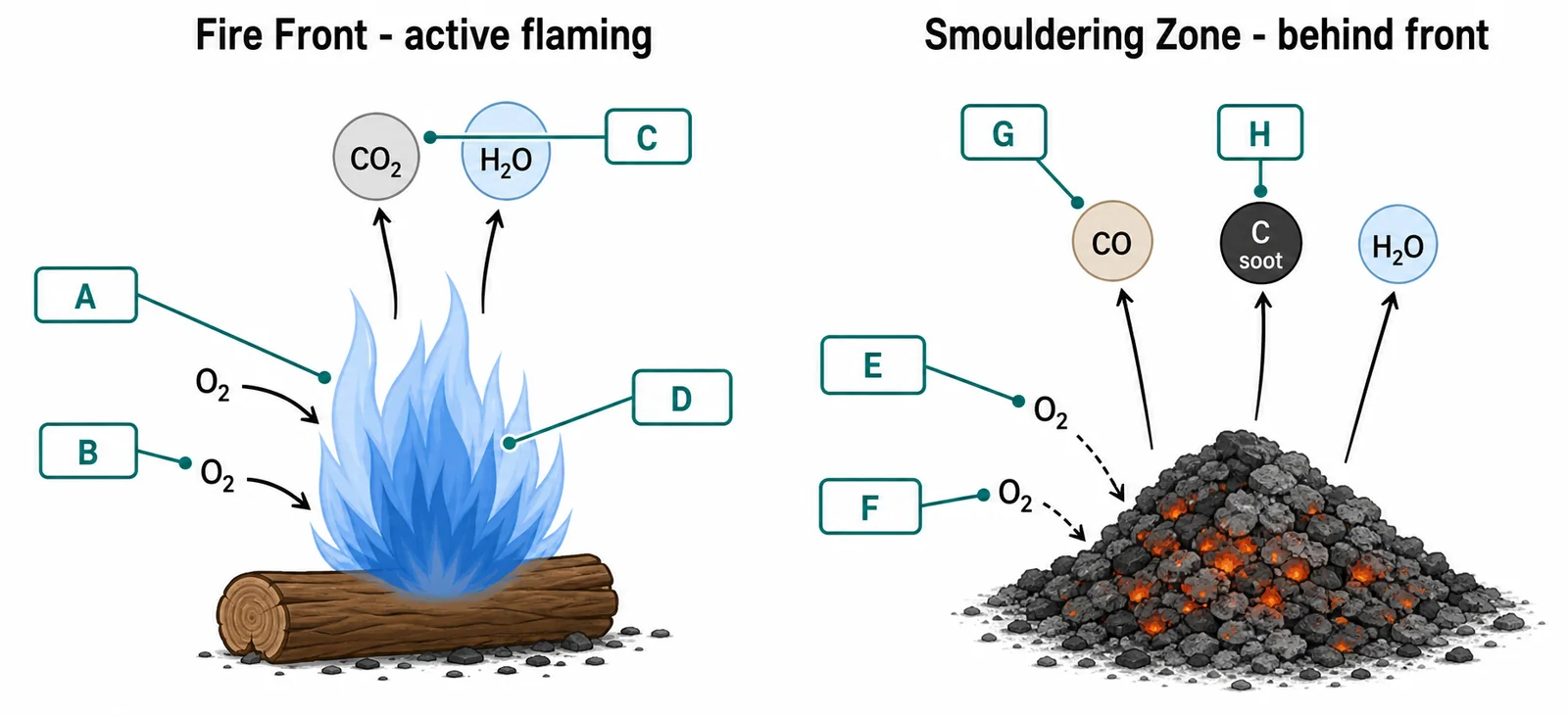
- A — combustion type at the fire front ___________________________
- B — oxygen availability at the fire front ___________________________
- C — main carbon-containing gaseous product at the fire front ___________________________
- D — flame colour at the fire front ___________________________
- E — combustion type in the smouldering zone ___________________________
- F — oxygen availability in the smouldering zone ___________________________
- G — toxic gas produced in the smouldering zone ___________________________
- H — solid carbon product (soot) formed in the smouldering zone ___________________________
| Box | Your label |
|---|---|
| A | |
| B | |
| C | |
| D | |
| E | |
| F | |
| G | |
| H |
2. Term–definition match
The ten definitions below are shuffled. In the right-hand column write the matching term from this list: combustion reaction, complete combustion, incomplete combustion, hydrocarbon combustion, heat of combustion, fossil fuels, carbon monoxide (CO), soot, haemoglobin, ventilation. 10 marks
| # | Definition (shuffled) | Matching term |
|---|---|---|
| 2.1 | The reaction of a fuel with oxygen, producing oxides of the elements present in the fuel. | |
| 2.2 | Combustion in which all carbon is fully oxidised to CO₂ and all hydrogen to H₂O; requires excess oxygen and produces a blue flame. | |
| 2.3 | Combustion in which insufficient oxygen is available; produces CO and/or solid carbon soot; flame is yellow or smoky. | |
| 2.4 | A compound containing only carbon and hydrogen; its combustion follows the pattern CₓH₫ + O₂ → CO₂ + H₂O. | |
| 2.5 | The energy released when one mole of a substance burns completely in oxygen; measured in kJ mol⁻¹. | |
| 2.6 | Non-renewable carbon-based fuels — coal, oil, natural gas — whose combustion releases stored solar energy and produces CO₂. | |
| 2.7 | A colourless, odourless gas formed during incomplete combustion; binds haemoglobin with ∼200× the affinity of O₂. | |
| 2.8 | Fine particles of solid carbon produced during incomplete combustion; the reason a candle or wood fire produces a yellow glow. | |
| 2.9 | The protein in red blood cells that normally transports O₂; its binding sites are blocked by CO during poisoning. | |
| 2.10 | The supply of fresh air to a space; essential for gas heaters and wood fires to prevent CO accumulation. |
3. True or false — with correction
For each statement, circle T or F. If the statement is false, write the corrected version on the line below. 8 marks (1 mark T/F, 1 mark correction where needed)
3.1 Complete combustion of a hydrocarbon always produces CO₂ and H₂O as the only products. T / F
3.2 Incomplete combustion occurs when too much oxygen is available for the amount of fuel. T / F
3.3 The defining hazardous products that distinguish incomplete from complete combustion are CO and/or soot — not CO₂. T / F
3.4 Carbon monoxide (CO) is dangerous at low concentrations because it displaces oxygen from the air we breathe, causing suffocation. T / F
4. Function recall
Answer each in 1–2 sentences using precise terms from the lesson. 10 marks (2 each)
4.1 What is the function of sufficient oxygen supply in a combustion reaction?
4.2 What is the role of haemoglobin in normal oxygen transport, and how does CO disrupt this?
4.3 What is the function of balancing coefficients in a combustion equation?
4.4 What is the function of ventilation for indoor combustion appliances such as gas heaters?
4.5 What does the heat of combustion value tell us about a fuel, and what units is it expressed in?
5. Cloze — fill the blanks
Complete the paragraph using words from the word bank below. Each word or phrase is used once only. 8 marks (1 per blank)
Word bank: complete combustion • blue • CO₂ • CO • limited oxygen • haemoglobin • 200 • soot • incomplete combustion • yellow
When a hydrocarbon burns with excess oxygen, _____________________ occurs. All carbon atoms are fully oxidised to _____________________, and the flame burns _____________________ in colour. If the oxygen supply is restricted, _____________________ takes place instead. The products shift from CO₂ to the toxic gas _____________________ and/or solid carbon particles called _____________________. The flame changes to an orange or _____________________ colour. CO is particularly dangerous because it binds to _____________________ with approximately _____________________ times the affinity of O₂, preventing oxygen transport to body cells. This is why gas heaters must be used with adequate ventilation, especially in enclosed spaces.
6. Build a concept map
Draw labelled arrows between the six terms below to show how they are connected. Each arrow must carry a linking phrase (e.g. “produces”, “requires”, “causes”, “prevents”). Aim for at least 6 labelled arrows. 6 marks
Supplied terms: combustion reaction · oxygen availability · complete combustion · incomplete combustion · CO poisoning · CO₂ + H₂O.
Q1 — Combustion diagram labels
A: complete combustion. B: sufficient (excess) oxygen. C: CO₂ (carbon dioxide). D: blue. E: incomplete combustion. F: limited (restricted) oxygen. G: CO (carbon monoxide). H: C (soot / solid carbon).
Q2 — Term–definition matches
2.1 combustion reaction • 2.2 complete combustion • 2.3 incomplete combustion • 2.4 hydrocarbon combustion • 2.5 heat of combustion • 2.6 fossil fuels • 2.7 carbon monoxide (CO) • 2.8 soot • 2.9 haemoglobin • 2.10 ventilation.
Q3 — True / false with correction
3.1 True.
3.2 False. Correction: incomplete combustion occurs when insufficient oxygen is available relative to the amount of fuel; excess oxygen promotes complete combustion.
3.3 True.
3.4 False. Correction: CO is dangerous at low concentrations because it binds to haemoglobin with ∼200 times the affinity of O₂, occupying binding sites and blocking oxygen transport to cells — not by displacing O₂ from the air (which requires very high concentrations).
Q4.1 — Function of sufficient oxygen
Sufficient oxygen allows all carbon in the fuel to be fully oxidised to CO₂ and all hydrogen to H₂O, producing complete combustion. Without adequate O₂, carbon can only be partially oxidised, forming toxic CO or solid soot instead.
Q4.2 — Function of haemoglobin / CO disruption
Haemoglobin binds O₂ in the lungs and releases it to tissues during normal respiration. CO binds to the same haemoglobin sites with ∼200× greater affinity than O₂, preventing O₂ from binding and causing cellular hypoxia (tissue oxygen starvation) even at very low CO concentrations.
Q4.3 — Function of balancing coefficients
Balancing coefficients ensures that the number of atoms of each element is the same on both sides of the equation, satisfying the law of conservation of mass. Coefficients show the molar ratio in which reactants combine and products form.
Q4.4 — Function of ventilation
Ventilation continuously replenishes the O₂ consumed during combustion, maintaining the oxygen supply needed for complete combustion. Without it, O₂ depletes in the enclosed space, shifting combustion toward incomplete conditions and causing CO to accumulate to toxic concentrations.
Q4.5 — Heat of combustion
The heat of combustion (ΔHϲ) tells us how much energy is released when one mole of the substance undergoes complete combustion in oxygen. It is measured in kJ mol⁻¹ and allows comparison of energy density between different fuels.
Q5 — Cloze paragraph
complete combustion → CO₂ → blue → incomplete combustion → CO → soot → yellow → haemoglobin → 200.
Q6 — Sample concept map
A correct map should include arrows such as:
- combustion reaction —type depends on→ oxygen availability
- oxygen availability (high) —leads to→ complete combustion
- oxygen availability (low) —leads to→ incomplete combustion
- complete combustion —produces→ CO₂ + H₂O
- incomplete combustion —produces CO which causes→ CO poisoning
- CO₂ + H₂O —does not cause→ CO poisoning
Award 1 mark per correctly labelled arrow that respects causal direction. Accept any biologically/chemically valid linking phrases.