Chemistry • Year 11 • Module 3 • Lesson 2
Synthesis & Decomposition
Lock in the core vocabulary, recognise synthesis and decomposition patterns, and practise balancing both reaction types using atom counting.
1. Term–definition match
Match each definition below to a term from this list: synthesis reaction, decomposition reaction, thermal decomposition, electrolytic decomposition, law of conservation of mass, coefficient, product, reactant. Write the matching term in the right-hand column. 8 marks (1 each)
| # | Definition | Your answer |
|---|---|---|
| 1.1 | A reaction in which two or more substances combine to form a single product (A + B → AB). | |
| 1.2 | A reaction in which a single compound breaks down into two or more simpler substances (AB → A + B). | |
| 1.3 | Decomposition driven by heat; for example, limestone breaking down to quicklime and carbon dioxide. | |
| 1.4 | Decomposition driven by an electric current; for example, splitting water into hydrogen and oxygen gases. | |
| 1.5 | The principle that total mass is conserved in a chemical reaction — atoms are neither created nor destroyed. | |
| 1.6 | A number placed in front of a chemical formula to show how many formula units are involved; the only number you may change when balancing. | |
| 1.7 | A substance present at the start of a chemical reaction, written on the left-hand side of the arrow. | |
| 1.8 | A substance formed in a chemical reaction, written on the right-hand side of the arrow. |
2. True or false — with correction
Circle T or F for each statement. If the statement is false, write the corrected version on the line provided. 10 marks (1 T/F + 1 correction where false)
2.1 In a synthesis reaction, the number of reactants is always greater than the number of products. T / F
2.2 Balancing an equation is done by changing the subscripts inside chemical formulas to make the atom counts equal on both sides. T / F
2.3 Thermal decomposition and electrolytic decomposition both produce the same products from the same starting material, regardless of conditions. T / F
2.4 In the reaction 2Mg(s) + O₂(g) → 2MgO(s), the coefficient 2 in front of Mg means two magnesium atoms are involved. T / F
2.5 Decomposition reactions can only be triggered by heat. T / F
3. Classify each reaction — and justify
For each equation below, identify whether it is synthesis or decomposition, and in one sentence justify your answer by referring to the number of reactants and products. 8 marks (1 classify + 1 justify each)
3.1 2Fe(s) + 3Cl₂(g) → 2FeCl₃(s)
Type: ___________________________ Justification:
3.2 2KClO₃(s) → 2KCl(s) + 3O₂(g)
Type: ___________________________ Justification:
3.3 CuCO₃(s) → CuO(s) + CO₂(g)
Type: ___________________________ Justification:
3.4 SO₂(g) + H₂O(l) → H₂SO₄(aq)
Type: ___________________________ Justification:
4. Cloze passage — fill the blanks
Complete the paragraph below by writing one term from the word bank in each blank. Use each term only once. 8 marks (1 per blank)
Word bank: synthesis, decomposition, thermal, electrolytic, coefficients, subscripts, conservation of mass, products
When two or more substances combine to form a single new substance, the reaction is called a
___________________ reaction. The reverse — where one substance breaks into two or more simpler substances —
is called a ___________________ reaction. When this breakdown is driven by heat, the specific name is
___________________ decomposition; when it is driven by an electric current, it is called
___________________ decomposition.
In both reaction types, the law of ___________________ states that atoms cannot be created or
destroyed. To apply this law when balancing, only the ___________________ (numbers placed in front of
formulas) may be adjusted — changing the ___________________ inside a formula would create an entirely
different substance. When the equation is balanced, the total number of atoms in the
___________________ equals the total in the reactants.
5. Label the decomposition trigger diagram
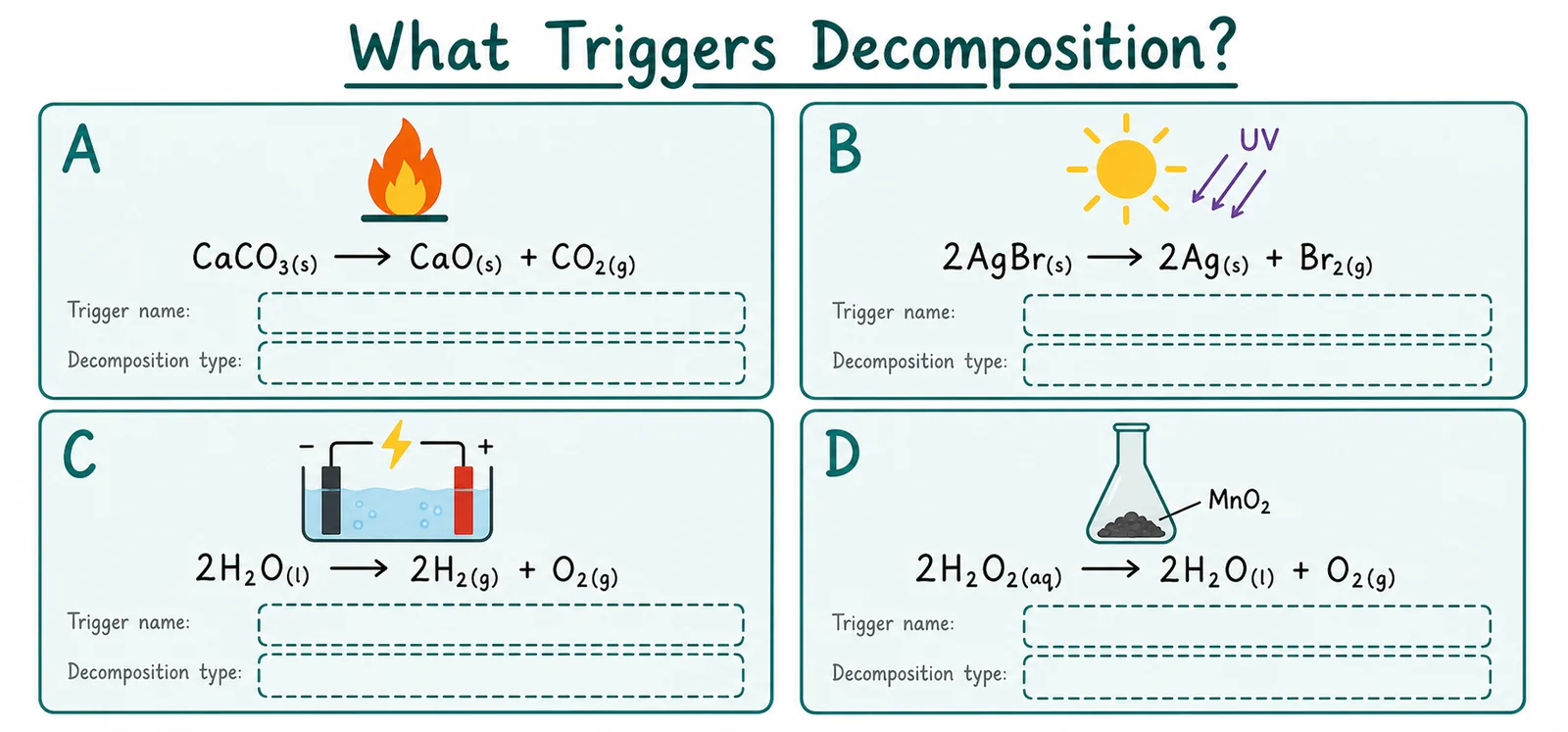
The diagram below shows four types of energy that can trigger decomposition reactions, with an example equation for each. Write the correct trigger name (from the box below) and the name of the decomposition type into labels A–D. 8 marks (1 per label)
Trigger names: Heat | Light | Electricity | Catalyst
Decomposition type names: Thermal decomposition | Photodecomposition | Electrolytic decomposition | Catalytic decomposition
| Panel | Trigger name | Decomposition type name |
|---|---|---|
| A | ||
| B | ||
| C | ||
| D |
6. Build a concept map
Draw labelled arrows between the six terms below to show how they connect. Each arrow must carry a linking phrase (e.g. "combines to form", "breaks down into", "applies", "determines"). Aim for at least 5 labelled arrows. 5 marks
Supplied terms: synthesis reaction · decomposition reaction · law of conservation of mass · balanced equation · coefficients · atom count
Q1 — Term–definition matches
1.1 synthesis reaction · 1.2 decomposition reaction · 1.3 thermal decomposition · 1.4 electrolytic decomposition · 1.5 law of conservation of mass · 1.6 coefficient · 1.7 reactant · 1.8 product.
Q2 — True / false with correction
2.1 True. In synthesis (A + B → AB) there are always more reactant substances than product substances (many → one). Accept "True — many reactants produce one product."
2.2 False. Correction: balancing is done by changing the coefficients (numbers in front of formulas) — never the subscripts inside formulas, which would change the identity of the substance.
2.3 False. Correction: the same compound can produce different products under different conditions. Ammonium nitrate, for example, produces N₂O + H₂O under gentle heating but N₂ + O₂ + H₂O under explosive conditions.
2.4 True. The coefficient 2 in 2Mg means 2 formula units (atoms) of magnesium.
2.5 False. Correction: decomposition reactions can be triggered by heat (thermal), electricity (electrolytic), light (photodecomposition), or a catalyst.
Q3 — Classify each reaction
3.1 Synthesis. Two reactants (Fe and Cl₂) combine to form one product (FeCl₃) — pattern A + B → AB.
3.2 Decomposition. One reactant (KClO₃) breaks into two products (KCl and O₂) — pattern AB → A + B.
3.3 Decomposition. One reactant (CuCO₃) breaks into two products (CuO and CO₂).
3.4 Synthesis. Two reactants (SO₂ and H₂O) combine to form one product (H₂SO₄) — pattern A + B → AB.
Q4 — Cloze paragraph
synthesis — decomposition — thermal — electrolytic — conservation of mass — coefficients — subscripts — products
Q5 — Decomposition trigger labels
A: Trigger = Heat; Type = Thermal decomposition. B: Trigger = Light; Type = Photodecomposition. C: Trigger = Electricity; Type = Electrolytic decomposition. D: Trigger = Catalyst; Type = Catalytic decomposition.
Q6 — Sample concept map arrows
- synthesis reaction — is a type of reaction governed by → law of conservation of mass
- decomposition reaction — is a type of reaction governed by → law of conservation of mass
- law of conservation of mass — requires → balanced equation
- balanced equation — is verified by checking → atom count
- balanced equation — is achieved by adjusting → coefficients
- coefficients — are changed to make equal → atom count
Award 1 mark per biologically valid linking arrow (up to 5), with a clearly stated linking phrase indicating causal direction.