Chemistry • Year 11 • Module 3 • Lesson 1
Physical & Chemical Change
Lock in the core vocabulary, the five indicators of chemical change, and the Law of Conservation of Mass before tackling harder questions.
1. Term–definition match
The definitions below are shuffled. In the right-hand column write the matching term from this list: physical change, chemical change, Law of Conservation of Mass, reversible reaction, irreversible reaction, synthesis reaction, precipitate, exothermic, endothermic, indicator of chemical change. 10 marks (1 each)
| # | Definition | Matching term |
|---|---|---|
| 1.1 | A change that alters the form or state of a substance without producing any new substance with different chemical properties. | |
| 1.2 | A change that produces one or more new substances with different chemical properties from the original reactants. | |
| 1.3 | The principle that the total mass of reactants equals the total mass of products in any closed chemical reaction. | |
| 1.4 | A reaction that can proceed in both forward and reverse directions under the same conditions; shown with ⇌. | |
| 1.5 | A reaction that proceeds essentially to completion in one direction only; shown with →. | |
| 1.6 | A reaction where two or more reactants combine to form a single product. | |
| 1.7 | A cloudy insoluble solid that forms and settles out when two solutions are mixed. | |
| 1.8 | A process that releases energy to the surroundings, causing a temperature increase in the system. | |
| 1.9 | A process that absorbs energy from the surroundings, causing a temperature decrease in the system. | |
| 1.10 | An observable piece of evidence that suggests a new substance has formed, such as a colour change, gas evolved, or precipitate. |
2. True or false — with correction
Circle T or F for each statement. If the statement is false, write the corrected version on the line below it. 12 marks (1 T/F + 1 correction each)
2.1 A physical change always produces a new substance with different chemical properties. T / F
2.2 A temperature change alone is sufficient evidence to confirm that a chemical change has occurred. T / F
2.3 Dissolving sugar in water is a chemical change because the sugar disappears. T / F
2.4 The Law of Conservation of Mass states that atoms are rearranged, not created or destroyed, in a chemical reaction. T / F
2.5 Rusting of iron is a physical change because only the surface colour appears to change. T / F
2.6 When balancing a chemical equation you must change subscripts inside formulas to ensure atom counts balance. T / F
3. Fill-in-the-blank paragraph
Use the word bank to complete the passage. Each word is used once. 8 marks (1 per blank)
Word bank:
coefficients · conservation · indicators · irreversible · new substance · phlogiston · physical · rearranged
A ___________ change alters the form or state of a substance without producing any new substance, whereas a chemical change always results in a ___________ with different properties. There are five observable ___________ of chemical change: colour change, gas evolved, precipitate formed, temperature change, and solid disappearing. Antoine Lavoisier established the Law of ___________ of Mass in the 1770s, disproving the ___________ theory of combustion. In a chemical reaction, atoms are ___________ into new arrangements; they are never created or destroyed. When balancing chemical equations, only ___________ (numbers in front of formulas) may be changed. Combustion of natural gas is an ___________ reaction because the products cannot be converted back to methane under the same conditions.
4. Function recall
Answer each question in 1–2 sentences using precise terms from the lesson. 8 marks (2 each)
4.1 What is the defining criterion for classifying a change as chemical rather than physical?
4.2 Why does the Law of Conservation of Mass require that a chemical equation be balanced?
4.3 What is the function of a precipitate as an indicator of chemical change?
4.4 Why can melting ice not be classified as a chemical change, even though energy is involved?
5. Build a concept map
Draw labelled arrows between the six terms below to show how they connect. Each arrow must carry a linking phrase (e.g. "produces", "is evidence of", "conserves"). Aim for at least 6 labelled arrows. 6 marks (1 per valid labelled arrow)
Supplied terms: chemical change · new substance · atoms · conservation of mass · indicator · balanced equation.
6. Label the five indicators of chemical change
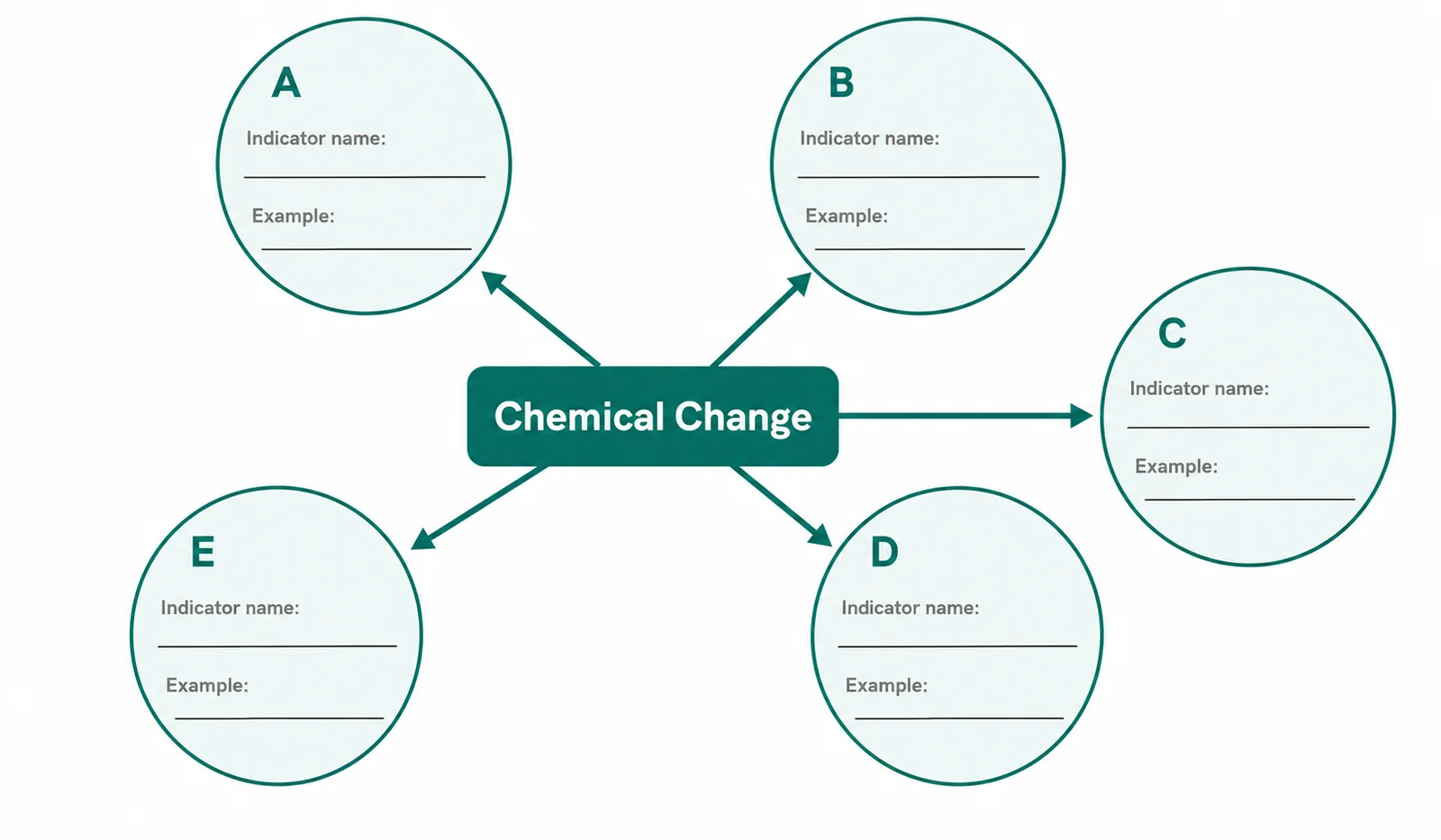
The diagram below shows five circles arranged around a central hub. Each circle represents one observable indicator of chemical change. Write the correct indicator name and one example into boxes A–E. 10 marks (1 label + 1 example each)
| Box | Indicator name | One example from chemistry or everyday life |
|---|---|---|
| A | ||
| B | ||
| C | ||
| D | ||
| E |
Q1 — Term–definition match
1.1 physical change • 1.2 chemical change • 1.3 Law of Conservation of Mass • 1.4 reversible reaction • 1.5 irreversible reaction • 1.6 synthesis reaction • 1.7 precipitate • 1.8 exothermic • 1.9 endothermic • 1.10 indicator of chemical change.
Q2 — True / false with correction
2.1 False. A physical change does NOT produce a new substance; the chemical identity remains the same (e.g. melting ice is still water).
2.2 False. A temperature change alone is NOT sufficient; it is an indicator only. Dissolving ammonium nitrate in water causes a temperature drop but is a physical change. The defining criterion is whether a new substance is formed.
2.3 False. Dissolving sugar is a physical change; sugar molecules remain chemically sucrose and can be recovered by evaporation. No new substance is formed.
2.4 True.
2.5 False. Rusting is a chemical change because iron(III) oxide (Fe2O3) is produced — a new substance with different properties from iron metal.
2.6 False. When balancing equations, only coefficients (numbers in front of formulas) may be changed. Changing subscripts changes the identity of the substance.
Q3 — Cloze paragraph
In order: physical / new substance / indicators / conservation / phlogiston / rearranged / coefficients / irreversible.
Q4.1 — Defining criterion for chemical change
The defining criterion is the formation of one or more new substances with different chemical properties from the original reactants. Indicators such as colour change or gas evolved are evidence of this, but the criterion itself is new substance formation.
Q4.2 — Why equations must be balanced
The Law of Conservation of Mass states that atoms are rearranged but never created or destroyed. A balanced equation ensures the same number of each type of atom appears on both sides, reflecting that no mass is gained or lost during the reaction.
Q4.3 — Function of a precipitate as indicator
A precipitate is an insoluble solid that forms when two solutions are mixed, indicating that a new substance with different solubility has been produced. Its formation confirms a chemical reaction has occurred. Example: yellow lead(II) iodide (PbI2) forms when lead nitrate solution is added to potassium iodide solution.
Q4.4 — Why melting ice is not a chemical change
Melting ice is a physical change because no new substance is formed — the water molecules (H2O) are chemically unchanged. Only the physical state changes from solid to liquid. The ice can be refrozen to recover the original substance, confirming no new chemical species were produced.
Q5 — Sample concept map
Correct maps should include arrows such as:
- chemical change — produces → new substance
- chemical change — is evidenced by → indicator
- atoms — are rearranged in → chemical change
- conservation of mass — requires → balanced equation
- atoms — are counted in → balanced equation
- new substance — is confirmed by → indicator
Award 1 mark per valid labelled arrow (minimum 6, maximum 6 marked).
Q6 — Five indicators of chemical change
A: Colour change — example: green copper carbonate forming on copper metal exposed to air. B: Gas evolved — example: CO2 gas produced when acid reacts with marble chips (CaCO3). C: Precipitate formed — example: yellow PbI2 when Pb(NO3)2(aq) is mixed with KI(aq). D: Temperature change — example: test tube warms during zinc + sulfuric acid (exothermic). E: Solid disappearing (consumed in reaction) — example: zinc metal dissolved in hydrochloric acid, forming ZnCl2 solution.
Accept any valid chemistry examples in correct indicator categories. Accept Australian examples (e.g. Port Kembla steelworks: iron ore + coke + oxygen → iron, with colour change and gas evolved).