Chemistry • Year 11 • Module 2 • Lesson 10
Volumetric Analysis & Titration
Lock in the core vocabulary, equipment names and purposes, and the structure of the 4-step titration calculation method before tackling harder problems.
1. Term–definition match
The definitions below are shuffled. In the right-hand column write the matching term from this list: titration, standard solution, equivalence point, end point, titre, concordant titres, analyte, titrant, indicator, burette. 10 marks (1 each)
| # | Definition | Matching term |
|---|---|---|
| 1.1 | A volumetric technique used to determine the concentration of an unknown solution by reacting it with a solution of known concentration. | |
| 1.2 | A solution whose concentration is accurately known, used as the reference solution in a titration. | |
| 1.3 | The point at which stoichiometrically equivalent amounts of acid and base have completely reacted; identified by a sharp change in pH. | |
| 1.4 | The point at which the indicator changes colour; should coincide with the equivalence point for an accurate result. | |
| 1.5 | The volume of standard solution delivered from the burette to reach the end point in one titration run. | |
| 1.6 | Two or more titre readings that agree within ±0.10 mL of each other; only these are averaged for calculation. | |
| 1.7 | The unknown solution whose concentration is being determined; it is placed in the conical flask. | |
| 1.8 | The solution of known concentration placed in the burette and added to the analyte. | |
| 1.9 | A substance added to the conical flask that changes colour at (or near) the equivalence point, allowing the end point to be detected visually. | |
| 1.10 | A graduated glass tube with a tap at the bottom used to deliver precise, variable volumes of titrant during a titration. |
2. True or false — with correction
Circle T or F for each statement. If the statement is false, write the corrected version on the line below it. 12 marks (1 T/F + 1 correction each)
2.1 The burette is filled with the analyte solution and placed above the conical flask. T / F
2.2 A rough titration is performed first and then included in the average titre calculation because it gives a useful estimate of the end point volume. T / F
2.3 Phenolphthalein is colourless in acidic solution and turns pink in alkaline solution. T / F
2.4 When calculating moles from concentration and volume, the volume must be expressed in millilitres. T / F
2.5 Rinsing the burette with the titrant solution (not water) before filling is necessary to prevent diluting the titrant and changing its concentration. T / F
2.6 For the reaction H2SO4 + 2NaOH → Na2SO4 + 2H2O, the mole ratio of H2SO4 to NaOH is 1:1, so the moles of each at the equivalence point are equal. T / F
3. Fill-in-the-blank paragraph
Use the word bank to complete the passage. Each word is used once. 8 marks (1 per blank)
Word bank:
analyte · burette · concordant · equivalence point · indicator · litres · mole ratio · titrant
In a titration, the solution of known concentration (the ___________) is placed in the ___________ and added drop by drop to the unknown solution (the ___________) in the conical flask. A few drops of ___________ are added to signal when the reaction is complete. The point at which stoichiometrically equivalent amounts have reacted is called the ___________. In the 4-step calculation, n = c × V, the volume must be in ___________, not millilitres. The balanced equation is essential because it gives the ___________ needed to convert moles of the known substance to moles of the unknown. Only ___________ titres (within ±0.10 mL of each other) are averaged for the final calculation.
4. Equipment function recall
Answer each question in 1–2 sentences using precise terms from the lesson. 8 marks (2 each)
4.1 State the purpose of a white tile in a titration and explain why it is used rather than a plain bench surface.
4.2 Explain why a pipette is used to deliver the analyte into the conical flask rather than a measuring cylinder.
4.3 State why a conical (Erlenmeyer) flask, rather than a beaker, is preferred as the vessel for the analyte during titration.
4.4 Explain what would happen to the calculated concentration of the unknown if the burette were rinsed with water instead of titrant before filling, and why.
5. Build a concept map
Draw labelled arrows between the six terms below to show how they connect in a titration. Each arrow must carry a linking phrase (e.g. “contains”, “is reached when”, “is detected by”). Aim for at least 6 labelled arrows. 6 marks (1 per valid labelled arrow)
Supplied terms: titrant · burette · equivalence point · indicator · concordant titres · mole ratio.
6. Label the titration apparatus
The diagram below shows a standard titration set-up. Write the correct label and its stated purpose into boxes A–E. 10 marks (1 label + 1 purpose each)
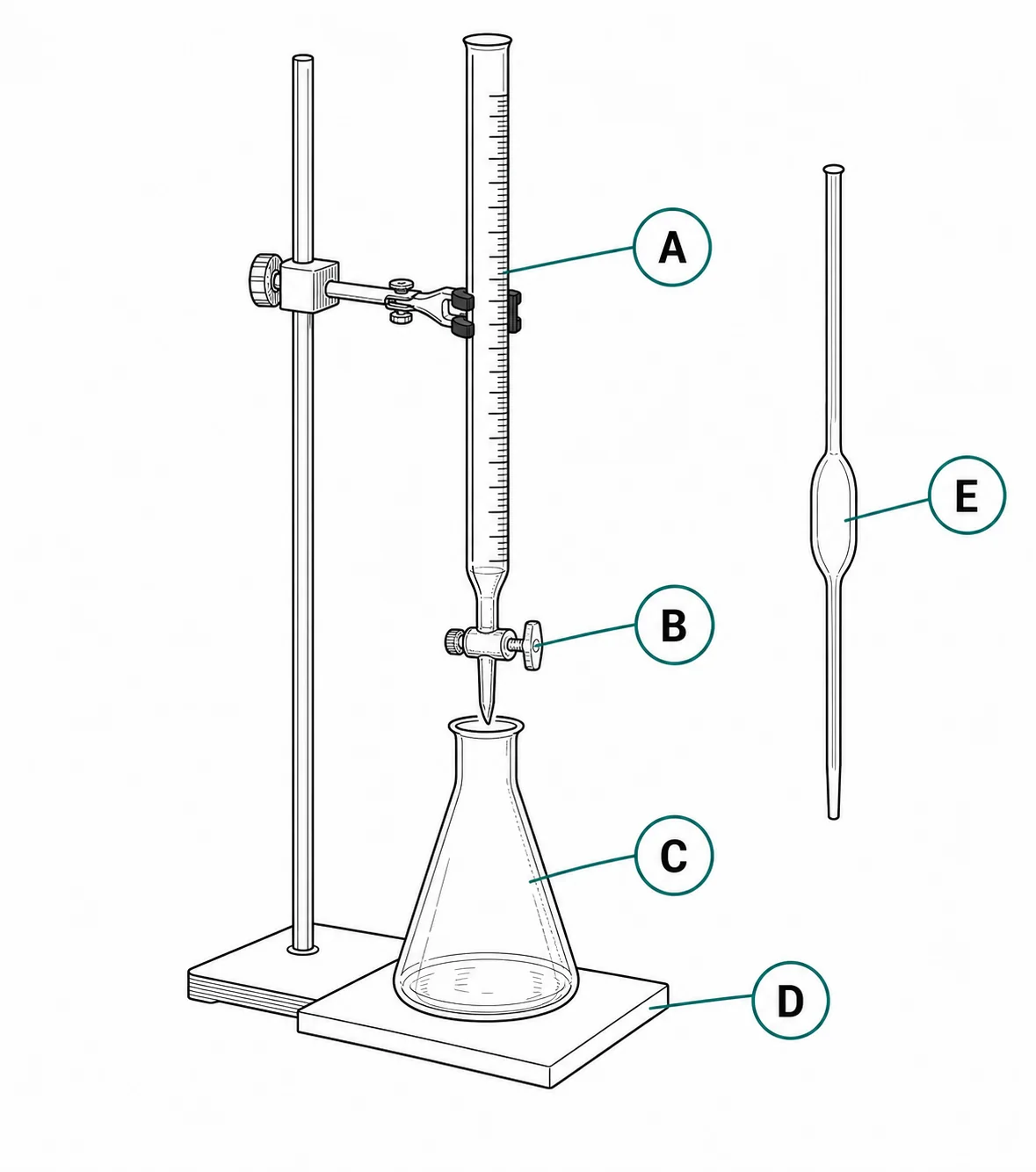
| Box | Equipment name | Purpose in the titration |
|---|---|---|
| A | ||
| B | ||
| C | ||
| D | ||
| E |
Q1 — Term–definition match
1.1 titration • 1.2 standard solution • 1.3 equivalence point • 1.4 end point • 1.5 titre • 1.6 concordant titres • 1.7 analyte • 1.8 titrant • 1.9 indicator • 1.10 burette.
Q2 — True / false with correction
2.1 False. The burette contains the titrant (standard solution), not the analyte. The analyte is placed in the conical flask below.
2.2 False. The rough titration is performed first to estimate the end point volume, but it is never included in the average. Only concordant accurate titres are averaged.
2.3 True.
2.4 False. The volume must be expressed in litres (not millilitres) when substituting into n = c × V to obtain moles.
2.5 True.
2.6 False. The mole ratio of H2SO4 to NaOH is 1:2 (from the balanced equation). At the equivalence point, 1 mol H2SO4 reacts with 2 mol NaOH — the moles are not equal.
Q3 — Cloze paragraph
In order: titrant / burette / analyte / indicator / equivalence point / litres / mole ratio / concordant.
Q4.1 — Purpose of white tile
The white tile is placed under the conical flask to provide a pale, uniform background that maximises contrast when the indicator changes colour. A plain bench surface is often coloured or patterned, making it harder to see the subtle colour change at the end point.
Q4.2 — Pipette vs measuring cylinder
A pipette delivers a fixed, precisely calibrated volume (uncertainty ±0.02 mL) to the conical flask each run, ensuring the same amount of analyte is present in every titration. A measuring cylinder has much greater uncertainty (±0.5–1 mL) and would introduce a significant systematic error in the amount of analyte.
Q4.3 — Conical flask vs beaker
The narrow neck of the conical flask prevents the solution from splashing out during swirling and minimises evaporation loss. It also makes it easier to mix the contents vigorously with a circular swirling action without spilling.
Q4.4 — Effect of rinsing with water
If the burette is rinsed with water, residual water dilutes the titrant, reducing its actual concentration below the stated value. As a result, a larger volume of titrant would be needed to reach the equivalence point, giving an overestimated titre. This would lead to an overestimated calculated concentration for the unknown.
Q5 — Sample concept map
Correct maps should include arrows such as:
- titrant — is placed in → burette
- burette — delivers volume (titre) to approach → equivalence point
- indicator — changes colour to signal → equivalence point
- concordant titres — are averaged to give average titre used with → mole ratio
- mole ratio — converts moles of titrant to moles of → analyte (unknown)
- equivalence point — is identified by → indicator
Award 1 mark per valid labelled arrow (minimum 6, maximum 6 marked).
Q6 — Titration apparatus labels
A: Burette — delivers variable, precise volumes of titrant; read from top (0 mL) to bottom (±0.05 mL).
B: Stopcock (tap) — controls the flow of titrant from the burette; closed between drops near the end point to avoid overshooting.
C: Conical flask — holds the analyte + indicator; narrow neck allows vigorous swirling without spilling.
D: White tile — placed under the conical flask to provide contrast so the indicator colour change is visible.
E: Pipette — used to deliver a fixed, precise volume of analyte into the conical flask before the titration begins.