Chemistry • Year 11 • Module 2 • Lesson 6
Concentration: Moles Per Litre
Lock in the core vocabulary, the formula c = n ÷ V, the critical mL→L conversion, and the connection between mol L−1 and g L−1 before tackling harder questions.
1. Term–definition match
The definitions below are shuffled. In the right-hand column write the matching term from this list: concentration, solute, solvent, solution, mol L−1, molar mass, aqueous solution, g L−1, c = n ÷ V, unit conversion. 10 marks (1 each)
| # | Definition | Matching term |
|---|---|---|
| 1.1 | A homogeneous mixture formed when a solute dissolves in a solvent. | |
| 1.2 | The substance that dissolves in a solution (e.g. NaCl in saltwater). | |
| 1.3 | The dissolving medium — usually water in chemistry experiments. | |
| 1.4 | The amount of solute per unit volume of solution; the standard unit is mol L−1. | |
| 1.5 | The SI unit for molar concentration; equivalent to M or mol/L. | |
| 1.6 | A concentration unit based on mass rather than moles; convert to mol L−1 by dividing by molar mass. | |
| 1.7 | A solution in which water is the solvent; denoted (aq) after the formula. | |
| 1.8 | The mass in grams of one mole of a substance (g mol−1); the bridge between mass and moles. | |
| 1.9 | The equation linking concentration, moles of solute, and volume of solution. | |
| 1.10 | The required step of dividing millilitres by 1000 before substituting into c = n ÷ V. |
2. True or false — with correction
Circle T or F for each statement. If the statement is false, write the corrected version on the line below it. 12 marks (1 T/F + 1 correction each)
2.1 Concentration in mol L−1 depends only on the number of moles of solute — the volume of solution does not matter. T / F
2.2 When using the formula c = n ÷ V, the volume V must be expressed in litres (L), not millilitres. T / F
2.3 A solution made by dissolving 1 mol of NaCl in 500 mL of solution has a concentration of 2.00 mol L−1. T / F
2.4 The volume used in c = n ÷ V is the volume of the final solution, not the volume of the solvent alone. T / F
2.5 To convert a concentration from g L−1 to mol L−1, you multiply by the molar mass. T / F
2.6 Adding 250 mL of water to 0.50 mol of glucose produces a solution with concentration c = 0.50 ÷ 250 = 0.002 mol L−1. T / F
3. Fill-in-the-blank paragraph
Use the word bank to complete the passage. Each word or phrase is used once. 8 marks (1 per blank)
Word bank:
moles · litres · 1000 · molar mass · homogeneous · solute · divide · volume
A solution is a ___________ mixture formed when a ___________ dissolves in a solvent. Concentration is defined as the number of ___________ of solute per litre of solution, so it depends on both the amount of solute and the ___________ of the solution. The standard formula is c = n ÷ V, where V must be in ___________. If a volume is given in millilitres, you must ___________ it by ___________ before substituting. To convert a concentration given in g L−1 to mol L−1, divide by the ___________ of the solute.
4. Function recall
Answer each question in 1–2 sentences using precise terms from the lesson. 8 marks (2 each)
4.1 Why must the volume be in litres (not millilitres) when using c = n ÷ V?
4.2 What is the function of molar mass (MM) when converting between g L−1 and mol L−1?
4.3 Explain why dissolving more solute in a larger volume does not guarantee a higher concentration.
4.4 State the three rearrangements of c = n ÷ V and identify which quantity each form solves for.
5. Build a concept map
Draw labelled arrows between the six terms below to show how they are connected. Each arrow must carry a linking phrase (e.g. “is divided by”, “is measured in”, “must be converted to”). Aim for at least 6 labelled arrows. 6 marks (1 per valid labelled arrow)
Supplied terms: concentration (c) · moles (n) · volume (V) · mol L−1 · molar mass · g L−1.
6. Label the formula triangle
The diagram below shows the concentration formula triangle with three compartments labelled A, B, and C. Identify each compartment, state the unit for that quantity, and write the formula you would use to find it if the other two are known. 9 marks (1 label + 1 unit + 1 formula each)
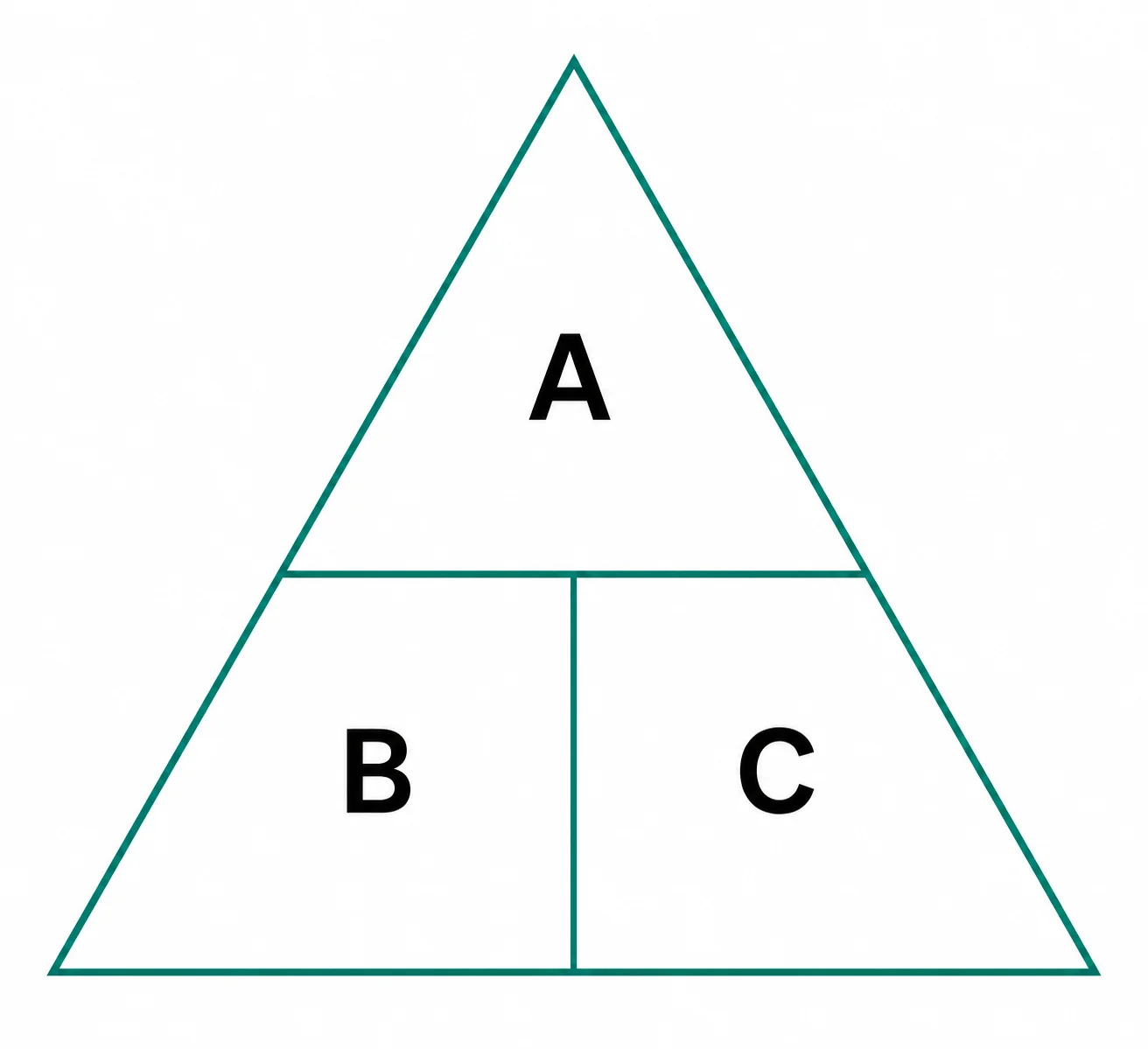
| Compartment | Quantity name & symbol | Unit | Formula to find this quantity |
|---|---|---|---|
| A | |||
| B | |||
| C |
Q1 — Term–definition match
1.1 solution • 1.2 solute • 1.3 solvent • 1.4 concentration • 1.5 mol L−1 • 1.6 g L−1 • 1.7 aqueous solution • 1.8 molar mass • 1.9 c = n ÷ V • 1.10 unit conversion.
Q2 — True / false with correction
2.1 False. Concentration depends on both the number of moles of solute and the volume of solution (c = n ÷ V). More solute in a larger volume can give a lower concentration than less solute in a small volume.
2.2 True.
2.3 False. V must be converted to litres: 500 mL ÷ 1000 = 0.500 L. c = 1 ÷ 0.500 = 2.00 mol L−1. The value is actually correct (2.00 mol L−1), but only because the student has (coincidentally) done the right arithmetic. Accept “True” only if the student recognises that they must convert 500 mL to 0.500 L first; the numerical result 2.00 mol L−1 is correct. Marking note: award the mark if the student writes True and notes the conversion is still required, OR if they write False and explain 500 mL = 0.500 L giving the same numerical answer.
2.4 True.
2.5 False. To convert from g L−1 to mol L−1, you divide by the molar mass: c (mol L−1) = c (g L−1) ÷ MM.
2.6 False. The volume must be converted: 250 mL ÷ 1000 = 0.250 L. c = 0.50 ÷ 0.250 = 2.00 mol L−1, not 0.002 mol L−1. Substituting mL directly gives an answer 1000 times too small.
Q3 — Cloze paragraph
In order: homogeneous / solute / moles / volume / litres / divide / 1000 / molar mass.
Q4.1 — Why V must be in litres
The unit mol L−1 has litres in the denominator. If V is in mL, the result of n ÷ V would be in mol mL−1, which is 1000 times too small. Converting mL to L ensures the units are consistent and the numerical answer is correct.
Q4.2 — Function of molar mass in unit conversion
Molar mass (MM, in g mol−1) is the bridge between mass and moles. To convert g L−1 to mol L−1, divide by MM: c (mol L−1) = c (g L−1) ÷ MM. This converts the mass of solute per litre into the number of moles of solute per litre.
Q4.3 — More solute in larger volume
Concentration is a ratio: c = n ÷ V. If both the moles of solute and the volume increase proportionally, the concentration can remain the same or even decrease. For example, 2 mol in 4 L (c = 0.5 mol L−1) is less concentrated than 1 mol in 0.5 L (c = 2.0 mol L−1), even though the first has more solute.
Q4.4 — Three rearrangements of c = n ÷ V
Find c: c = n ÷ V (mol L−1) • Find n: n = c × V (mol) • Find V: V = n ÷ c (L).
Q5 — Sample concept map
Correct maps should include arrows such as:
- moles (n) — is divided by → volume (V) — gives → concentration (c)
- concentration (c) — is measured in → mol L−1
- g L−1 — divided by → molar mass — converts to → mol L−1
- volume (V) — must be expressed in litres for → concentration (c)
Award 1 mark per valid labelled arrow (minimum 6, maximum 6 marked).
Q6 — Formula triangle labels
A (top): Moles of solute, symbol n, unit mol. Formula: n = c × V. • B (bottom-left): Concentration, symbol c, unit mol L−1. Formula: c = n ÷ V. • C (bottom-right): Volume of solution, symbol V, unit L. Formula: V = n ÷ c.
Marking: 1 mark for correct quantity name & symbol per compartment; 1 mark for correct unit; 1 mark for correct formula. Accept V in L or mL provided student converts: V(L) = V(mL) ÷ 1000.