Chemistry • Year 11 • Module 2 • Lesson 1
The Mole Concept
Lock in the core vocabulary, the N vs n distinction, Avogadro's number, and the formula N = n × NA before tackling harder calculations.
1. Term–definition match
The definitions below are shuffled. In the right-hand column write the matching term from this list: mole, amount of substance, Avogadro's constant (NA), elementary entity, N (capital), n (lowercase), SI base unit, mol−1, carbon-12, counting unit. 10 marks (1 each)
| # | Definition | Matching term |
|---|---|---|
| 1.1 | The SI base unit for amount of substance; symbol n; abbreviated mol. | |
| 1.2 | A measure of how many elementary entities are present in a sample of a substance. | |
| 1.3 | 6.022 × 10²³ mol−1 — the number of entities in exactly one mole of any substance. | |
| 1.4 | The specific particle being counted in any mole calculation — always state whether it is an atom, molecule, ion or formula unit. | |
| 1.5 | The actual number of particles in a sample; a dimensionless count with no units. | |
| 1.6 | The amount of substance in a sample, measured in mol; calculated as N ÷ NA. | |
| 1.7 | The classification of the mole in the International System of Units — it is one of the seven fundamental measurement categories. | |
| 1.8 | The units of Avogadro's constant — indicating that each mole contains this number of entities “per mole”. | |
| 1.9 | The isotope used to define the original mole: one mole of this isotope has a mass of exactly 12 grams. | |
| 1.10 | A collective noun for a specific quantity, analogous to a dozen (12) or a century (100), but on an atomic scale. |
2. True or false — with correction
Circle T or F for each statement. If the statement is false, write the corrected version on the line below it. 12 marks (1 T/F + 1 correction each)
2.1 A mole is a unit of mass, similar to a gram or kilogram. T / F
2.2 Capital N and lowercase n both represent the number of moles in a sample. T / F
2.3 Avogadro's constant (NA) has units of mol−1. T / F
2.4 When you multiply n (mol) × NA (mol−1), the mol units cancel and the answer N has no units. T / F
2.5 The mole was defined using carbon-12 so that the molar mass of any element in g/mol equals its relative atomic mass from the periodic table. T / F
2.6 One mole of hydrogen gas (H2) and one mole of oxygen gas (O2) contain the same mass of substance because both are one mole. T / F
3. Fill-in-the-blank paragraph
Use the word bank to complete the passage. Each word or phrase is used once. 8 marks (1 per blank)
Word bank:
amount · Avogadro's number · carbon-12 · counting · dimensionless · mol−1 · 6.022 × 1023 · rearranged
The mole is the SI unit of ___________ of substance. It is a ___________ unit — like a dozen (12) — but on an atomic scale. The specific number of entities in one mole is ___________, a value known as ___________. This constant was chosen because one mole of ___________ atoms has a mass of exactly 12 grams, making molar masses numerically equal to relative atomic masses. Avogadro's constant has units of ___________, so that when it is multiplied by an amount in moles the result N is ___________ — a pure count of particles with no units. Note that the word “___________” does not apply here; it describes what happens to atoms in a chemical reaction, not what happens in a mole calculation.
4. Function recall
Answer each question in 1–2 sentences using precise terms from the lesson. 8 marks (2 each)
4.1 What is the purpose of Avogadro's constant in chemistry?
4.2 Why do chemists use the mole rather than counting atoms directly?
4.3 What is the difference between N (capital) and n (lowercase) in the formula N = n × NA?
4.4 If you know the number of molecules in a sample, what formula do you use to find the number of moles?
5. Build a concept map
Draw labelled arrows between the six terms below to show how they connect. Each arrow must carry a linking phrase (e.g. “converts to”, “is measured in”, “equals”). Aim for at least 6 labelled arrows. 6 marks (1 per valid labelled arrow)
Supplied terms: N (number of particles) · n (moles) · NA (Avogadro's constant) · mole · carbon-12 · amount of substance.
6. Label the formula triangle
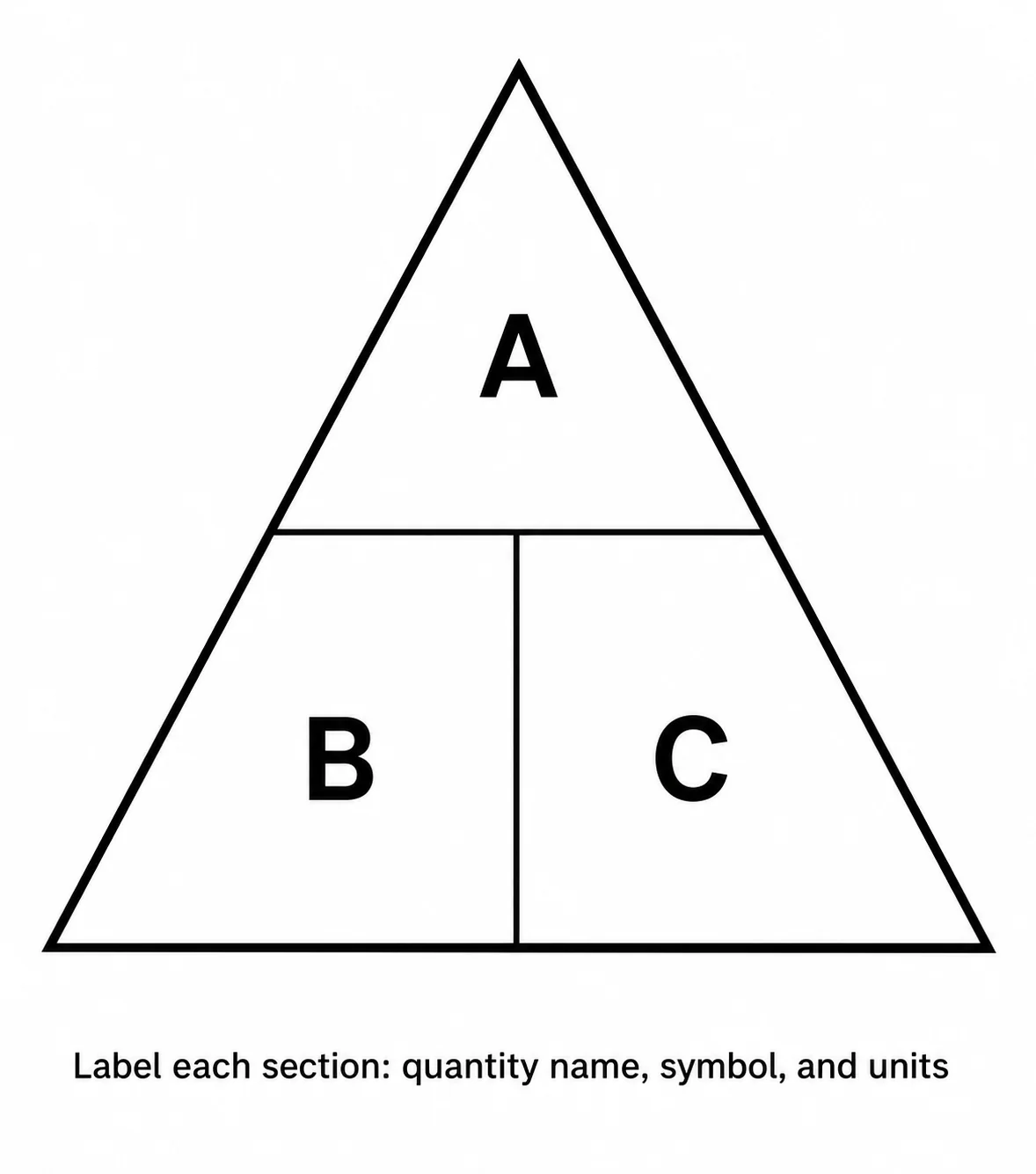
The diagram below is a formula triangle for N = n × NA. The three sections are labelled A, B, and C. Write the correct quantity, symbol, and units (where applicable) for each section. Then write the three rearrangements of the formula in the table below the diagram. 6 marks (1 per label, 1 per rearrangement formula)
| Section | Quantity name | Symbol | Units |
|---|---|---|---|
| A (top) | |||
| B (bottom-left) | |||
| C (bottom-right) |
| To find … | Write the formula here |
|---|---|
| N (number of particles) | |
| n (moles) | |
| NA (Avogadro's constant) |
Q1 — Term–definition match
1.1 mole • 1.2 amount of substance • 1.3 Avogadro's constant (NA) • 1.4 elementary entity • 1.5 N (capital) • 1.6 n (lowercase) • 1.7 SI base unit • 1.8 mol−1 • 1.9 carbon-12 • 1.10 counting unit.
Q2 — True / false with correction
2.1 False. A mole is a unit of amount (how many particles), not mass. Mass is measured in grams or kilograms; amount is measured in moles.
2.2 False. Capital N is the actual number of particles (a dimensionless count, e.g. 1.2 × 1024). Lowercase n is the amount in moles (e.g. 2 mol). They are related by n = N ÷ NA.
2.3 True.
2.4 True.
2.5 True.
2.6 False. One mole of H2 and one mole of O2 contain the same number of molecules (NA molecules each), but they have different masses: H2 has a molar mass of 2 g/mol and O2 has a molar mass of 32 g/mol.
Q3 — Cloze paragraph
In order: amount / counting / 6.022 × 10²³ / Avogadro's number / carbon-12 / mol−1 / dimensionless / rearranged.
Q4.1 — Purpose of Avogadro's constant
Avogadro's constant (NA = 6.022 × 10²³ mol−1) is the conversion factor that links the number of particles (N) to the amount in moles (n). It allows chemists to move between the atomic scale (individual particles) and the laboratory scale (measurable amounts of substance).
Q4.2 — Why use the mole
Individual atoms are too small to count or weigh directly — a single carbon atom has a mass of approximately 2 × 10⁻²³ g. The mole groups NA = 6.022 × 10²³ atoms together into a quantity large enough that one mole of any substance has a measurable mass on a laboratory balance.
Q4.3 — N vs n
N (capital) is the actual number of particles in a sample — a pure integer or large number with no units (e.g. 1.204 × 1024 atoms). n (lowercase) is the amount of substance measured in moles (e.g. 2 mol). They are related by the formula N = n × NA.
Q4.4 — Finding moles from particle count
Rearrange N = n × NA to give n = N ÷ NA. Divide the number of molecules (N) by Avogadro's constant (6.022 × 10²³ mol−1) to obtain n in moles.
Q5 — Sample concept map
Valid arrows include:
- N — equals n times → NA
- n — is measured in → mole
- mole — is the SI unit of → amount of substance
- NA — was defined using → carbon-12
- n — multiplied by NA gives → N
- carbon-12 — 1 mol has mass 12 g, defining → NA
Award 1 mark per valid labelled arrow (minimum 6, maximum 6 marked). Accept any scientifically correct linking phrase.
Q6 — Formula triangle labels and rearrangements
A (top): Number of particles, symbol N, no units (dimensionless count).
B (bottom-left): Amount of substance, symbol n, units mol.
C (bottom-right): Avogadro's constant, symbol NA, units mol−1.
To find N: N = n × NA
To find n: n = N ÷ NA
To find NA: NA = N ÷ n