Chemistry • Year 11 • Module 1 • Lesson 17
Periodic Trends: Atomic Radius
Apply your understanding of nuclear charge, shielding, and electron configuration to rank atoms, interpret data, and reason through real-world scenarios.
1. Interpret atomic radius data — Period 3 elements
The table below shows atomic radius data (in pm) for Period 3 elements. 8 marks
| Element | Symbol | Atomic number (Z) | Atomic radius (pm) | Number of protons | Electron shells occupied |
|---|---|---|---|---|---|
| Sodium | Na | 11 | 186 | ||
| Magnesium | Mg | 12 | 160 | ||
| Aluminium | Al | 13 | 143 | ||
| Silicon | Si | 14 | 117 | ||
| Phosphorus | P | 15 | 110 | ||
| Sulfur | S | 16 | 104 | ||
| Chlorine | Cl | 17 | 99 |
1.1 Complete the “Number of protons” and “Electron shells occupied” columns. 2 marks
1.2 Describe the trend in atomic radius across Period 3 using data from the table. 2 marks
1.3 Using the data, identify which two neighbouring elements show the largest decrease in atomic radius. Explain why this decrease may be larger at that point in the period. 2 marks
1.4 A student claims that the decrease from Na (186 pm) to Cl (99 pm) proves that all atoms shrink as proton number increases. Identify one limitation of this generalisation. 2 marks
2. Interpret graph — atomic radius vs atomic number (Groups 1 and 17)
The graph below shows atomic radius (pm) plotted against atomic number for Group 1 alkali metals and Group 17 halogens. 8 marks
Figure 2. Atomic radius (pm) versus atomic number for Group 1 and Group 17 elements. Data from CRC Handbook of Chemistry and Physics (illustrative values).
2.1 Describe the overall trend for each group as atomic number increases. 2 marks
2.2 Using the graph, estimate the atomic radius of Li and explain whether Li or Na has the smaller atomic radius. Justify your answer with reference to electron shells. 3 marks
2.3 Group 1 radii are consistently larger than Group 17 radii for elements in the same period. Explain this in terms of nuclear charge and electron configuration, using Na and Cl as an example. 3 marks
3. Compare the two atomic radius trends across five features
Complete the two-column table below. For each feature, write a concise description that contrasts the period trend from the group trend. 10 marks (1 per cell)
| Feature | Period trend (left → right) | Group trend (top → bottom) |
|---|---|---|
| Direction of change in atomic radius | ||
| Change in number of electron shells | ||
| Change in nuclear charge | ||
| Change in shielding | ||
| Named example (two elements) |
4. Predict and justify — a semiconductor manufacturing scenario
Silicon (Si) and germanium (Ge) are semiconductor elements used in the Australian renewable energy industry for solar panels. Both belong to Group 14; Si is in Period 3 and Ge is in Period 4. Engineers are comparing the atomic size of these two elements to predict how they will pack into crystal lattices.
5 marks
4.1 Predict which element, Si or Ge, has the larger atomic radius. Justify your prediction using electron shell and shielding reasoning. 3 marks
4.2 Predict whether Si or Ge would form a smaller ion when it gains four electrons (Si4− vs Ge4−). Justify your prediction. 2 marks
5. Diagram critique — what’s wrong with this student’s atomic radius poster?
A Year 11 student drew the diagram below to explain atomic radius trends. There are three errors in the poster. Identify each error and write the correction. 6 marks (2 per error: 1 identify, 1 correct)
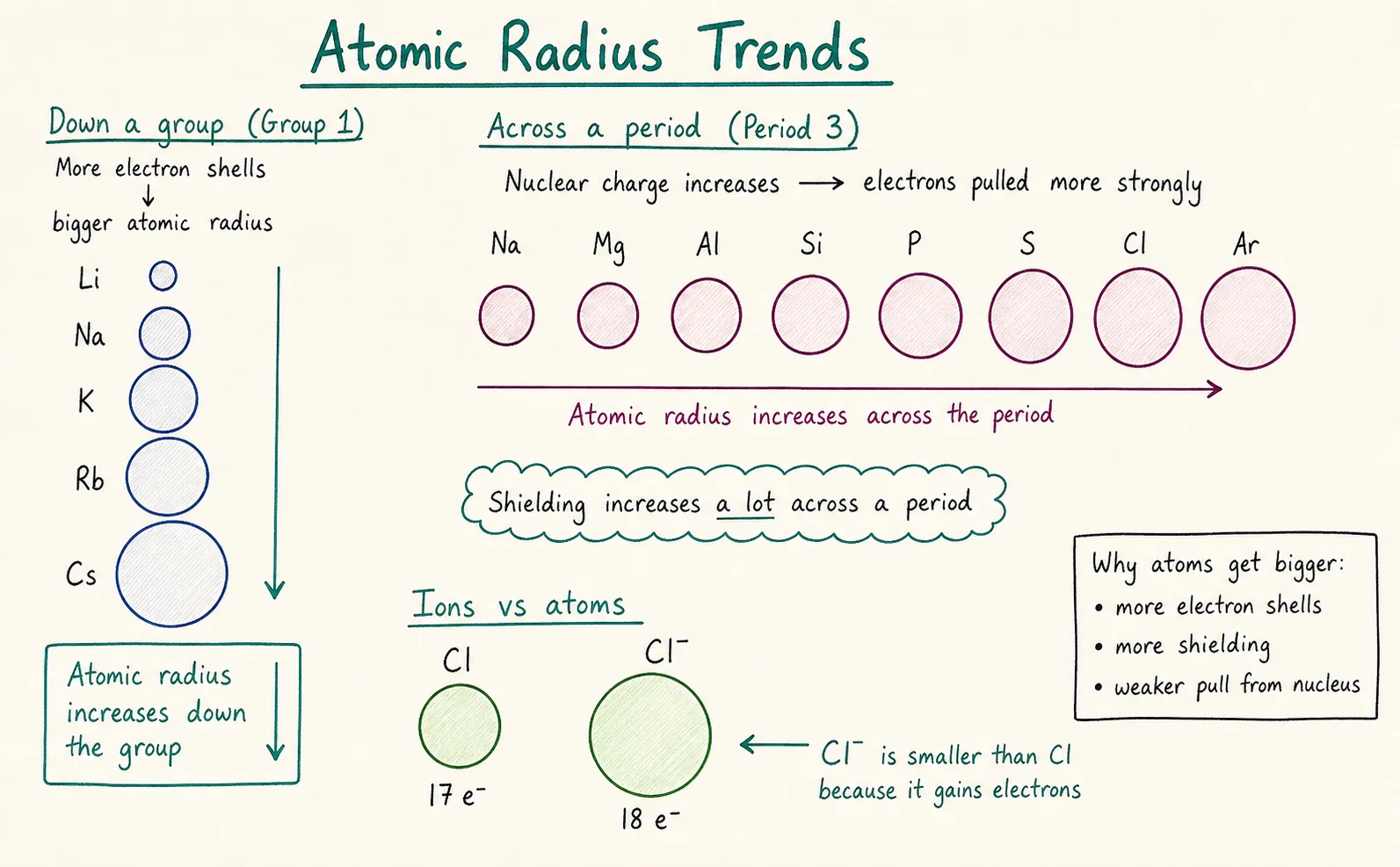
5.1 Error 1: What is wrong?
Correction:
5.2 Error 2: What is wrong?
Correction:
5.3 Error 3: What is wrong?
Correction:
Q1.1 — Table completion
Number of protons = atomic number (Na:11, Mg:12, Al:13, Si:14, P:15, S:16, Cl:17). Electron shells occupied = 3 for all Period 3 elements (1 mark each column).
Q1.2 — Trend description
Atomic radius decreases steadily from Na (186 pm) to Cl (99 pm) as atomic number increases across Period 3. The total decrease is 87 pm over 6 steps.
Q1.3 — Largest neighbouring decrease
The largest decrease between neighbouring elements is from Na (186 pm) to Mg (160 pm): a drop of 26 pm. This large drop occurs because the first step in the period adds a proton while providing no new shielding, so the effective nuclear charge jumps significantly from 11 to 12 protons, pulling the outer shell inward sharply. Accept Na→Mg or Mg→Al (160 to 143 = 17 pm) as a close second; full marks for Na→Mg with explanation referencing effective nuclear charge.
Q1.4 — Limitation of generalisation
The generalisation only holds within a single period. Moving to a new period (e.g. from Cl in Period 3 to K in Period 4) adds a new electron shell, which increases atomic radius significantly. Potassium (K, Z=19) has a much larger atomic radius (~227 pm) than chlorine (99 pm) even though K has more protons.
Q2.1 — Graph trend description
For both Group 1 and Group 17, atomic radius increases as atomic number increases (i.e. as you go down the group). Group 1 values are consistently larger than Group 17 values at each period.
Q2.2 — Li vs Na
From the graph, Li has an atomic radius of approximately 150 pm. Li has a smaller atomic radius than Na. Li is in Period 2 (2 electron shells) and Na is in Period 3 (3 electron shells). Na’s additional third shell places its outer electron farther from the nucleus and shields it more, giving Na a larger radius despite its higher nuclear charge.
Q2.3 — Group 1 vs Group 17 in the same period
Within the same period, Group 1 atoms have fewer protons than Group 17 atoms. Na (11 protons) has a much smaller nuclear charge than Cl (17 protons), yet both have electrons in the same third shell. The weaker nuclear pull in Na results in a larger electron cloud (>186 pm) compared to Cl (99 pm). The extra protons in Cl attract the outer electrons much more strongly, compressing the atom.
Q3 — Compare and contrast table
Direction of change: Period: decreases (atoms get smaller). Group: increases (atoms get larger). Electron shells: Period: same number of shells throughout. Group: one new shell added each step. Nuclear charge: Period: increases with each element. Group: increases with each element. Shielding: Period: barely changes (electrons enter same shell, poor shielding). Group: increases significantly (more inner shells). Named example: Period: Na (larger) → Cl (smaller). Group: Li (smaller) → K (larger).
Q4.1 — Si vs Ge atomic radius
Ge has the larger atomic radius. Ge is in Period 4 and Si is in Period 3; Ge therefore has an additional fourth electron shell. The outer electrons in Ge are further from the nucleus and more shielded by three inner shells. Even though Ge has more protons (Z=32 vs Z=14), the extra shell distance outweighs the increased nuclear charge, so Ge is larger.
Q4.2 — Si4− vs Ge4−
Si4− is smaller than Ge4−. Both ions result from gaining 4 electrons, which increases electron repulsion and expands the atom; but the starting atom (Ge) already has an extra electron shell compared to Si. The anion Ge4− therefore starts from a larger baseline and remains larger even after the same electron gain.
Q5 — Diagram critique
5.1 Error 1 (circles growing left to right across period): The period trend is incorrect; atom circles should decrease in size from left to right [1]. Correction: Across a period, atomic radius decreases because the increasing nuclear charge pulls the outer electrons (in the same shell) progressively closer to the nucleus [1].
5.2 Error 2 (“shielding increases a lot across a period”): This is incorrect; shielding barely changes across a period because electrons are added to the same main shell and same-shell electrons shield each other poorly [1]. Correction: Shielding remains approximately constant across a period; therefore effective nuclear charge increases with each added proton, driving the decrease in atomic radius [1].
5.3 Error 3 (Cl− described as smaller than Cl): This is incorrect; Cl− is larger than Cl, not smaller [1]. Correction: When Cl gains an electron to form Cl−, the extra electron increases electron–electron repulsion in the outer shell, expanding the electron cloud. The same 17 protons now attract 18 electrons less effectively, so Cl− is larger than the neutral atom [1].