Chemistry • Year 11 • Module 1 • Lesson 17
Periodic Trends: Atomic Radius
Lock in the vocabulary, the two main trends, and the structural reasons behind atomic size before moving to harder questions.
1. Term–definition match
The definitions below are shuffled. In the right-hand column write the matching term from this list: atomic radius, shielding, effective nuclear charge (Zeff), period trend, group trend, cation, anion, nuclear charge, electron shell, valence electrons. 10 marks (1 each)
| # | Definition | Matching term |
|---|---|---|
| 1.1 | A measure of the size of an atom; in HSC questions, the distance from the nucleus to the outermost occupied electron shell. | |
| 1.2 | The repulsion from inner-shell electrons that partially cancels the nuclear attraction felt by outer electrons. | |
| 1.3 | The net positive pull experienced by outer electrons after accounting for shielding; a higher value pulls electrons closer to the nucleus. | |
| 1.4 | Moving left to right across a period, atoms generally become smaller because proton number increases while electrons enter the same main shell. | |
| 1.5 | Moving down a group, atoms generally become larger because a new electron shell is occupied with each successive element. | |
| 1.6 | A positively charged ion formed when an atom loses one or more electrons; always smaller than the parent atom. | |
| 1.7 | A negatively charged ion formed when an atom gains one or more electrons; always larger than the parent atom. | |
| 1.8 | The total positive charge of the nucleus; equal to the atomic number (number of protons). | |
| 1.9 | A region around the nucleus that can hold a fixed number of electrons; a new one is added with each new period. | |
| 1.10 | Electrons in the outermost occupied shell; these are the electrons most affected by changes in nuclear charge and shielding. |
2. True or false — with correction
Circle T or F for each statement. If the statement is false, write the corrected version on the line below it. 12 marks (1 T/F + 1 correction each)
2.1 Atomic radius increases from left to right across a period because more electrons make the atom larger. T / F
2.2 Atomic radius increases down a group because each successive element has an additional occupied electron shell. T / F
2.3 Shielding increases significantly when electrons are added across a period, which is why effective nuclear charge stays roughly constant. T / F
2.4 Na+ is smaller than Na because it has one fewer occupied electron shell after losing its 3s electron. T / F
2.5 Cl− is smaller than Cl because it has gained an extra electron, compressing the outer shell. T / F
2.6 Among Na, Mg, and Al, sodium has the largest atomic radius because it has the fewest protons and therefore the smallest effective nuclear charge in that period. T / F
3. Fill-in-the-blank paragraph
Use the word bank to complete the passage. Each word is used once. 8 marks (1 per blank)
Word bank:
decreases · effective nuclear charge · electron shell · increases · larger · protons · shielding · smaller
Atomic radius ___________ as you move from left to right across a period. This is because the number of ___________ increases while electrons are added to the same main shell. Shielding changes only slightly, so the ___________ rises and pulls outer electrons closer to the nucleus. Moving down a group, atomic radius ___________ because each element has an additional occupied ___________, placing outer electrons further from the nucleus. The extra ___________ provided by the additional inner shells also reduces the attraction on the outermost electrons. When a cation is formed, it is ___________ than the parent atom. When an anion is formed, it is ___________ than the parent atom.
4. Function recall
Answer each question in 1–2 sentences using precise terms from the lesson. 8 marks (2 each)
4.1 What is the role of shielding in determining atomic radius?
4.2 Why does atomic radius decrease across Period 3 from Na to Cl, even though more electrons are being added?
4.3 Why is K larger than Na even though K has more protons?
4.4 Explain why Cl− is larger than a chlorine atom.
5. Build a concept map
Draw labelled arrows between the six terms below to show how they are connected. Each arrow must carry a linking phrase (e.g. “increases”, “reduces”, “determines”). Aim for at least 6 labelled arrows. 6 marks (1 per valid labelled arrow)
Supplied terms: nuclear charge · shielding · effective nuclear charge · atomic radius · electron shells · period trend.
6. Label the periodic trend diagram
The diagram below shows a simplified periodic table grid with arrows indicating two atomic radius trends. Label each arrow (A–D) with the correct description from the list: atomic radius decreases, atomic radius increases, same number of electron shells, additional electron shell added. Then complete the two explanation slots (E, F). 6 marks (1 each)
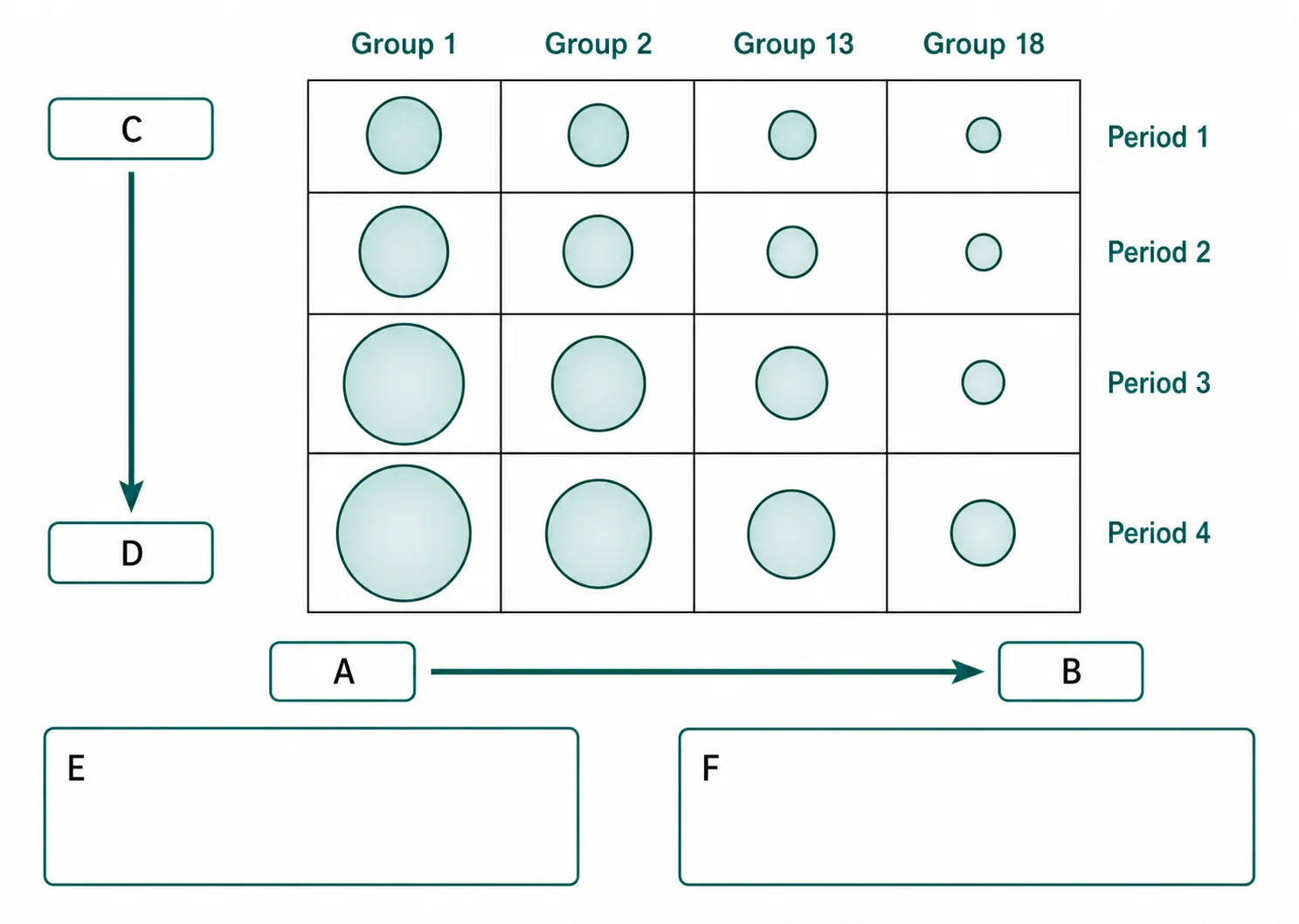
| Label | Your answer |
|---|---|
| A (horizontal left end) | |
| B (horizontal right end) | |
| C (vertical top) | |
| D (vertical bottom) | |
| E (reason for period trend) | |
| F (reason for group trend) |
Q1 — Term–definition match
1.1 atomic radius • 1.2 shielding • 1.3 effective nuclear charge (Zeff) • 1.4 period trend • 1.5 group trend • 1.6 cation • 1.7 anion • 1.8 nuclear charge • 1.9 electron shell • 1.10 valence electrons.
Q2 — True / false with correction
2.1 False. Atomic radius decreases from left to right across a period. Although more electrons are added, they enter the same main shell and do not shield each other effectively. The increasing nuclear charge therefore pulls the outer electrons closer, reducing atomic radius.
2.2 True.
2.3 False. Shielding does not increase significantly when electrons are added across a period (electrons added to the same shell shield poorly). Therefore effective nuclear charge increases across a period, pulling electrons closer.
2.4 True.
2.5 False. Cl− is larger than Cl. The extra electron increases electron–electron repulsion in the outer shell, causing the electron cloud to expand.
2.6 True.
Q3 — Cloze paragraph
In order: decreases / protons / effective nuclear charge / increases / electron shell / shielding / smaller / larger.
Q4.1 — Role of shielding
Shielding is the repulsion exerted by inner-shell electrons on outer electrons, which partially cancels the attractive force from the nucleus. Greater shielding reduces the effective nuclear charge experienced by outer electrons, allowing them to occupy a larger orbital radius.
Q4.2 — Decrease across Period 3
Across Period 3, each added electron enters the same third shell and does not effectively shield other electrons in that shell. The increasing proton number raises the effective nuclear charge, pulling all outer electrons progressively closer to the nucleus, so atomic radius decreases.
Q4.3 — K larger than Na
Potassium (Period 4) has an additional fourth electron shell compared to sodium (Period 3). The outer 4s electron is further from the nucleus and shielded by three full inner shells, so despite the higher nuclear charge, the extra shell distance dominates and K has a larger atomic radius.
Q4.4 — Cl− larger than Cl
When Cl gains an electron to form Cl−, the extra electron increases electron–electron repulsion in the outer shell. The same nuclear charge (17 protons) must now hold 18 electrons, so the electron cloud expands, making Cl− larger than the neutral atom.
Q5 — Sample concept map
Correct maps should include arrows such as:
- nuclear charge — increases effective → effective nuclear charge
- shielding — reduces → effective nuclear charge
- effective nuclear charge — higher value decreases → atomic radius
- electron shells — adding one increases → atomic radius
- atomic radius — decreases across a → period trend
- period trend — driven by increasing → nuclear charge
Award 1 mark per valid labelled arrow (minimum 6, maximum 6 marked).
Q6 — Period trend diagram labels
A (left end): larger atomic radius (e.g. Na). B (right end): smaller atomic radius (e.g. Cl) / atomic radius decreases left to right. C (top): fewer electron shells / smallest atomic radius in group. D (bottom): additional electron shells added / largest atomic radius in group / atomic radius increases down group. E (period reason): increasing nuclear charge pulls outer electrons closer; shielding barely changes as electrons enter the same shell; effective nuclear charge increases. F (group reason): each successive element has an extra occupied electron shell, placing outer electrons further from the nucleus and increasing shielding.