Chemistry • Year 11 • Module 1 • Lesson 15
The Periodic Table: Organisation
Apply your understanding of periodic trends, group behaviour, and the Mendeleev–modern comparison to experimental data, real scenarios, and element prediction tasks.
1. Interpret experimental data — Group 1 reactivity with water
A student investigated how vigorously three alkali metals react with cold water. The table records observations and measured data. 8 marks
| Element | Period | Observations | Time to consume 0.1 g (s) | Reactivity rank (most = 1) |
|---|---|---|---|---|
| Lithium (Li) | 2 | Fizzes steadily; floats; no flame | 46 | |
| Sodium (Na) | 3 | Fizzes rapidly; skates on surface; occasionally ignites | 12 | |
| Potassium (K) | 4 | Reacts violently; ignites with a lilac flame; moves rapidly | 3 |
1.1 Complete the “Reactivity rank” column and state the trend in reactivity going down Group 1. 2 marks
1.2 Using data from the table, explain the trend in reactivity with reference to atomic radius and the ease of losing a valence electron. 3 marks
1.3 Predict the reactivity of rubidium (Rb, Period 5, Group 1) relative to potassium. Justify your prediction. 3 marks
2. Interpret graph — first ionisation energy across Period 3
The graph below shows the first ionisation energy (kJ mol−1) of the Period 3 elements from sodium to argon. 8 marks
Figure 2.1. First ionisation energy of Period 3 elements. Data: NIST Atomic Spectra Database (2023).
2.1 Describe the overall trend in first ionisation energy across Period 3 from Na to Ar. 2 marks
2.2 Identify two elements in Period 3 that appear lower than expected based on the overall increasing trend. Name both elements and state one observation from the graph (e.g. which element is higher despite coming later in the period). Note: full subshell explanations for these dips are covered in Lesson 16. 2 marks (1 per correctly identified element)
2.2b Using the data in the graph, compare the first ionisation energy of Na (Z = 11) with that of Cl (Z = 17). Explain the difference using the concept of effective nuclear charge. 2 marks
2.3 Argon has the highest first ionisation energy in Period 3. Using your knowledge of electron configuration, explain why this is consistent with Ar’s position in Group 18. 2 marks
3. Compare Mendeleev’s and the modern periodic table
Complete the two-column table below. For each feature, write a concise description contrasting the two tables. 10 marks (1 per cell)
| Feature | Mendeleev’s table (1869) | Modern periodic table |
|---|---|---|
| Organising principle | ||
| Handling of Te and I anomaly | ||
| Treatment of undiscovered elements | ||
| Basis of group similarities | ||
| Number of confirmed elements |
4. Predict and justify — a mystery Australian element
Australia’s Olympic Dam mine in South Australia is the world’s largest single deposit of uranium (Z = 92). Uranium is an actinide in the f-block of Period 7. Consider also the following clue: the element directly above uranium in the same f-block is thorium (Z = 90). Using your knowledge of periodic table organisation, answer the questions below.
5 marks
4.1 Identify which row (period) and block uranium belongs to. State one physical property you would expect uranium to have, given it is a heavy metal in the f-block. 2 marks
4.2 A newly synthesised element Q has Z = 120. Predict its group, period, and block in an extended periodic table. Justify each prediction. 3 marks
5. Diagram critique — what’s wrong with this student’s periodic table notes?
A Year 11 student drew a poster summarising periodic table organisation. There are three errors in the poster. Identify each error and write the correction. 6 marks (2 per error: 1 identify, 1 correct)
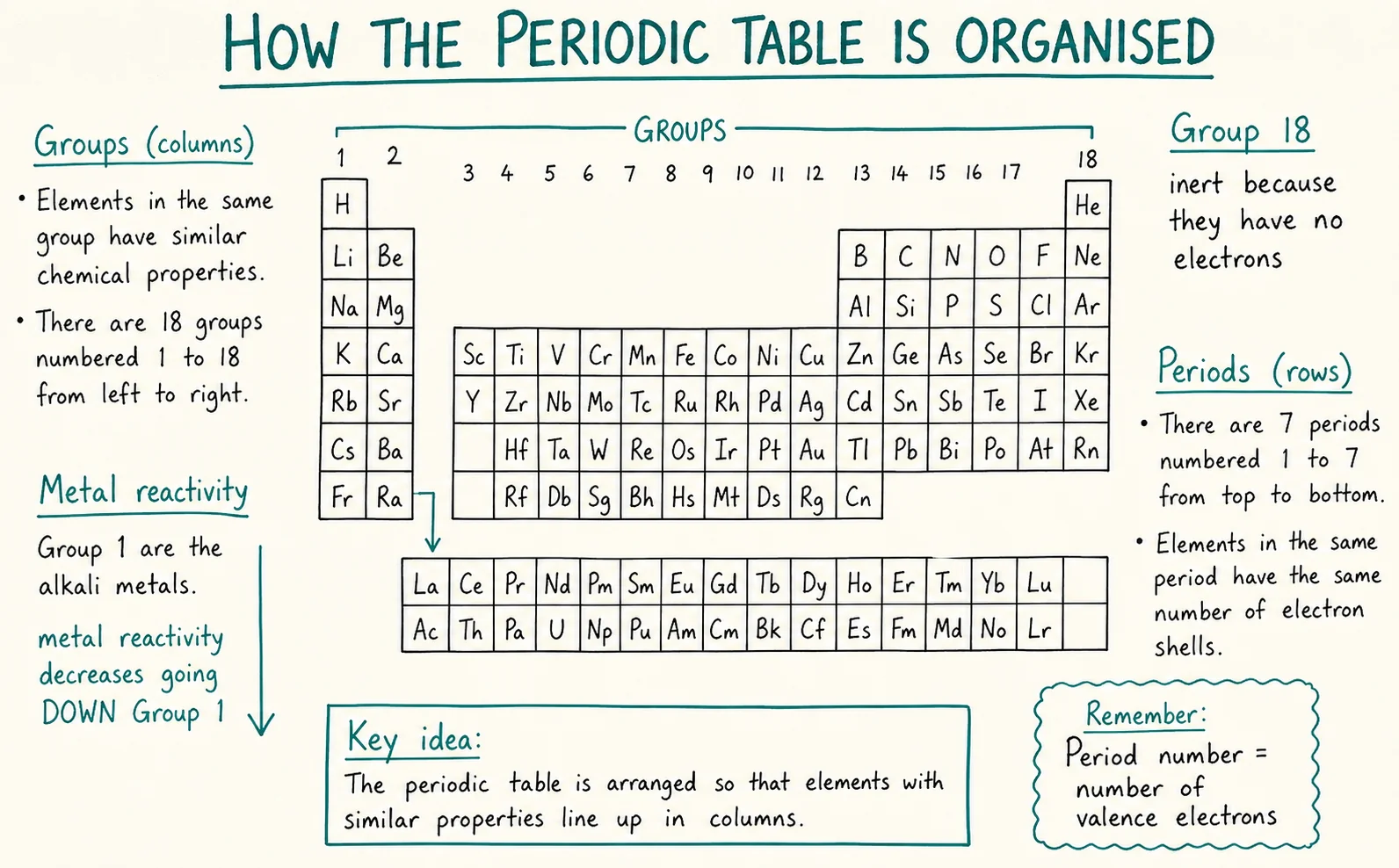
5.1 Error 1: What is wrong?
Correction:
5.2 Error 2: What is wrong?
Correction:
5.3 Error 3: What is wrong?
Correction:
Q1.1 — Reactivity ranking and trend
Reactivity rank: Li = 3, Na = 2, K = 1 (fastest time = most reactive). Trend: reactivity increases going down Group 1 (from Li to K). This is consistent with the group trend — lower-period alkali metals are more reactive.
Q1.2 — Explanation using atomic radius and valence electron loss
Going down Group 1 (Li → Na → K), atomic radius increases because each element has an additional electron shell [1]. The single valence electron is therefore further from the nucleus and shielded by more inner shells, reducing the effective nuclear attraction holding it [1]. This makes it easier to remove the valence electron in a reaction, so reactivity increases [1]. This is consistent with the time data: K consumed in 3 s vs Li in 46 s.
Q1.3 — Prediction for Rb
Prediction: Rb (Period 5) will be more reactive than K (Period 4) [1]. Justification: Rb is one period lower in Group 1, so it has an even larger atomic radius with an additional electron shell compared to K [1]. The valence electron is further from the nucleus and more heavily shielded → easier to lose → greater reactivity; time to consume 0.1 g would be less than 3 s [1].
Q2.1 — Overall ionisation energy trend across Period 3
The first ionisation energy generally increases from Na (496 kJ mol−1) to Ar (1521 kJ mol−1) across Period 3 [1]. This is because atomic number (Z) increases across the period, increasing the effective nuclear charge and pulling the valence electrons closer — requiring more energy to remove them [1].
Q2.2 — Two anomalous elements (identification only)
The two elements that break the overall increasing trend are aluminium (Al) and sulfur (S) [1 mark per element]. Observation: Al (577 kJ mol−1) has a lower first ionisation energy than magnesium (738 kJ mol−1), even though Al comes after Mg in Period 3. Similarly, S (1000 kJ mol−1) is slightly lower than P (1012 kJ mol−1). The detailed subshell-based explanation for these dips (3p vs 3s subshell energy for Al; half-filled 3p stability for S) is covered in Lesson 16.
Q2.2b — Na vs Cl first ionisation energy
Na has a first ionisation energy of 496 kJ mol−1; Cl has 1251 kJ mol−1 — more than twice as large [1]. Both are in Period 3, so their outer electrons are in the same (third) shell. Moving from Na (Z = 11) to Cl (Z = 17), the nuclear charge increases by 6 protons while shielding from inner electrons remains roughly constant. The higher effective nuclear charge in Cl pulls the outer electrons closer to the nucleus and holds them more tightly, requiring substantially more energy to remove one — hence the much higher first ionisation energy [1].
Q2.3 — Ar and Group 18 position
Argon has a complete valence shell (2, 8, 8 — full 3s and 3p subshells) [1]. Removing an electron from this stable, full configuration requires an exceptionally high amount of energy, which is why Ar has the highest first ionisation energy in Period 3. This is consistent with Group 18 elements having full valence shells and being essentially unreactive [1].
Q3 — Comparison table
Organising principle: Mendeleev: increasing relative atomic mass. Modern: increasing atomic number (Z). Te/I anomaly: Mendeleev: had to override mass ordering empirically (Te before I by properties, not mass). Modern: Z correctly places Te (52) before I (53) — no anomaly. Undiscovered elements: Mendeleev: left deliberate gaps and predicted properties of missing elements. Modern: all 118 confirmed elements included; gaps no longer exist. Basis of group similarities: Mendeleev: observed empirically (repeating properties). Modern: explained theoretically by identical valence electron configurations. Number of elements: Mendeleev: 63 known. Modern: 118 confirmed.
Q4.1 — Uranium period and block
Uranium (Z = 92) is in Period 7, f-block (actinide series) [1]. Expected physical property: very high density, high melting point, metallic — all heavy f-block elements are dense metals (uranium density ≈ 19.1 g cm−3) [1].
Q4.2 — Element Q (Z = 120)
Period: Current Period 7 ends at Z = 118 (Og). Z = 119 begins Period 8; Z = 120 is the second element in Period 8 [1]. Group: Group 2 (second column of s-block, analogous to Be, Mg, Ca, Sr, Ba, Ra) [1]. Block: s-block (filling the 8s subshell); 2 valence electrons. Q would be predicted to be a very reactive alkaline earth metal, even more reactive than Ra [1].
Q5 — Diagram critique
5.1 Error 1 (noble gases have no electrons): Noble gases are labelled “inert because they have no electrons” — this is incorrect [1]. Correction: Noble gases are unreactive because their valence shells are complete (8 electrons, or 2 for He). They have the same total electrons as any other element; it is the stable, full valence configuration that prevents them from reacting [1].
5.2 Error 2 (metal reactivity decreases down Group 1): The arrow states reactivity decreases going down Group 1 — this is the opposite of the correct trend [1]. Correction: Metal reactivity increases going down Group 1. Larger atoms have their valence electron further from the nucleus with more shielding, so it is easier to lose — making lower-period alkali metals more reactive [1].
5.3 Error 3 (period number = number of valence electrons): Period number is incorrectly described as equalling the number of valence electrons [1]. Correction: Period number = number of occupied electron shells. Valence electrons determine the group number (for main-group elements), not the period number [1].