Chemistry • Year 11 • Module 1 • Lesson 15
The Periodic Table: Organisation
Lock in the core vocabulary, group and period definitions, key group names, and the difference between Mendeleev’s and the modern periodic table before moving to harder questions.
1. Term–definition match
The definitions below are shuffled. In the right-hand column write the matching term from this list: period, group, valence electrons, periodicity, s-block, p-block, d-block, alkali metals, halogens, noble gases. 10 marks (1 each)
| # | Definition | Matching term |
|---|---|---|
| 1.1 | A horizontal row in the periodic table; all elements in the same row have the same number of occupied electron shells. | |
| 1.2 | A vertical column in the periodic table; elements in the same column have the same number of valence electrons and similar chemical properties. | |
| 1.3 | Electrons in the outermost (highest energy) shell of an atom that are involved in bonding and chemical reactions. | |
| 1.4 | The repeating pattern of elemental properties at regular intervals when elements are arranged in order of increasing atomic number. | |
| 1.5 | The region of the periodic table (Groups 1–2) where the highest-energy electrons occupy an s subshell. | |
| 1.6 | The region of the periodic table (Groups 13–18) where the highest-energy electrons occupy a p subshell. | |
| 1.7 | The region of the periodic table (Groups 3–12) where the highest-energy electrons occupy a d subshell; contains the transition metals. | |
| 1.8 | Group 1 elements; soft, low-melting-point metals that react vigorously with water to produce hydrogen gas and a metal hydroxide. | |
| 1.9 | Group 17 elements; highly reactive non-metals that exist as diatomic molecules and form −1 ions. | |
| 1.10 | Group 18 elements; extremely unreactive monatomic gases with complete valence shells. |
2. True or false — with correction
Circle T or F for each statement. If the statement is false, write the corrected version on the line below it. 12 marks (1 T/F + 1 correction each)
2.1 Elements in the same period have the same number of valence electrons. T / F
2.2 Noble gases are unreactive because they have no electrons at all. T / F
2.3 The modern periodic table arranges elements in order of increasing atomic number (Z). T / F
2.4 For metals in Group 1, reactivity decreases going down the group because the atoms become larger. T / F
2.5 Halogens (Group 17) become more reactive going down the group because their atoms get larger. T / F
2.6 Transition metals (Groups 3–12) are found in the d-block of the periodic table and can exhibit multiple oxidation states. T / F
3. Fill-in-the-blank paragraph
Use the word bank to complete the passage. Each word is used once. 8 marks (1 per blank)
Word bank:
atomic number · electron configuration · groups · mass · periods · predicted · shells · valence
Dmitri Mendeleev organised the elements in order of increasing atomic ___________, whereas the modern table uses increasing ___________ instead. The modern periodic table has horizontal rows called ___________ and vertical columns called ___________. All elements in the same period have the same number of occupied electron ___________. All elements in the same group have the same number of ___________ electrons, which is why their chemical properties are similar. Chemical properties are fundamentally determined by an element’s ___________, which is itself determined by atomic number. Mendeleev was so confident in his table’s pattern that he left gaps and ___________ the properties of undiscovered elements such as gallium before they were found.
4. Function recall
Answer each question in 1–2 sentences using precise terms from the lesson. 8 marks (2 each)
4.1 What is the relationship between an element’s group number (for Groups 1–2 and 13–18) and its number of valence electrons?
4.2 Why did Mendeleev leave gaps in his periodic table and what did those gaps represent?
4.3 What determines the period number of an element in the modern periodic table?
4.4 Why do elements in the same group have similar chemical properties?
5. Build a concept map
Draw labelled arrows between the six terms below to show how they connect. Each arrow must carry a linking phrase (e.g. “determines”, “organises”, “predicts”). Aim for at least 6 labelled arrows. 6 marks (1 per valid labelled arrow)
Supplied terms: atomic number · electron configuration · valence electrons · group · chemical properties · period.
6. Label the regions of the periodic table
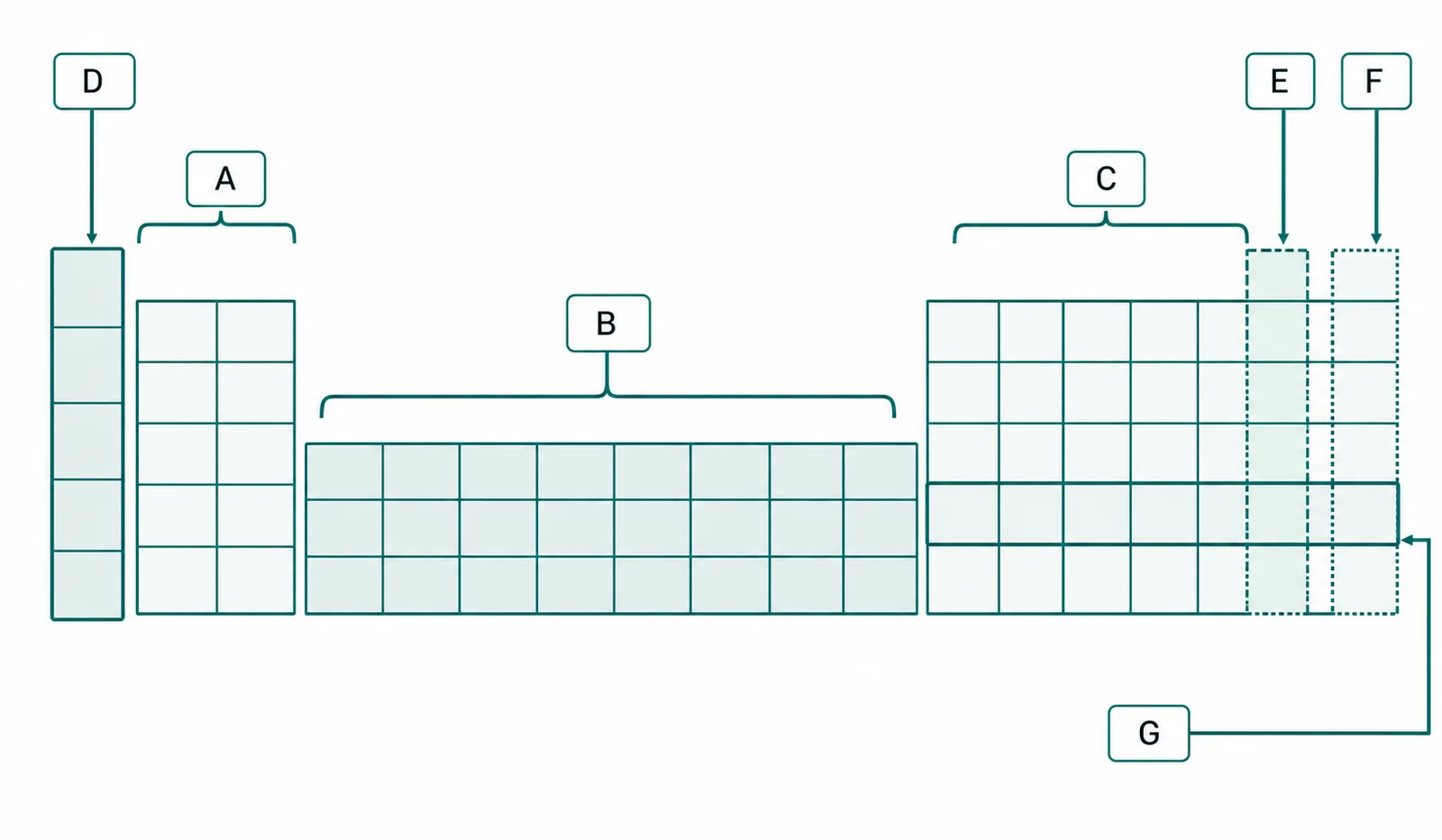
The diagram below shows a simplified outline of the periodic table with seven labelled regions. Write the correct region name and one identifying feature for each label A–G. 14 marks (1 name + 1 feature each)
| Label | Region / group name | One identifying feature |
|---|---|---|
| A | ||
| B | ||
| C | ||
| D | ||
| E | ||
| F | ||
| G |
Q1 — Term–definition match
1.1 period • 1.2 group • 1.3 valence electrons • 1.4 periodicity • 1.5 s-block • 1.6 p-block • 1.7 d-block • 1.8 alkali metals • 1.9 halogens • 1.10 noble gases.
Q2 — True / false with correction
2.1 False. Elements in the same period have the same number of occupied electron shells, not valence electrons. Elements in the same group share the same number of valence electrons.
2.2 False. Noble gases are unreactive because their valence shells are complete (8 electrons for most; 2 for helium), giving them a highly stable electron configuration. They are not inert because they lack electrons.
2.3 True.
2.4 False. For Group 1 metals, reactivity increases going down the group. As atoms grow larger, the valence electron is further from the nucleus and more shielded, making it easier to lose — hence more reactive.
2.5 False. Halogens become less reactive going down the group. As atoms get larger, their valence shell is further from the nucleus, so the nuclear attraction for an incoming electron is weaker — reducing reactivity.
2.6 True.
Q3 — Cloze paragraph
In order: mass / atomic number / periods / groups / shells / valence / electron configuration / predicted.
Q4.1 — Group number and valence electrons
For main-group elements (Groups 1–2 and 13–18), the group number equals the number of valence electrons. For example, Group 2 elements have 2 valence electrons; Group 17 elements have 7 valence electrons. (Transition metals in Groups 3–12 are a special case with 1–2 valence electrons.)
Q4.2 — Mendeleev’s gaps
Mendeleev left gaps when no known element fit the expected periodic pattern. Each gap represented a predicted undiscovered element. He was able to forecast the properties of these elements (such as atomic mass and density) from the surrounding elements in the table. Gallium (1875) and germanium (1886) were later discovered and matched his predictions closely.
Q4.3 — What determines period number
The period number equals the number of occupied electron shells (energy levels) in an atom of that element. For example, Na (Z = 11) has electrons in 3 shells, so it is in Period 3.
Q4.4 — Why same group = similar properties
Elements in the same group have the same number of valence electrons. Because chemical reactivity is determined by interactions of the valence electrons, elements with identical valence electron counts behave similarly in reactions — they form the same types of ions, have similar reactivity, and react in analogous ways with the same reagents.
Q5 — Sample concept map
Correct maps should include arrows such as:
- atomic number — determines → electron configuration
- electron configuration — includes → valence electrons
- valence electrons — are equal within each → group
- group — predicts → chemical properties
- period — gives the number of → electron shells (or: is organised by → atomic number)
- chemical properties — are explained by → valence electrons
Award 1 mark per valid labelled arrow.
Q6 — Labelled regions
A (s-block, Groups 1–2): Highest-energy electrons are in an s subshell; contains alkali metals and alkaline earth metals. B (d-block / transition metals): Groups 3–12, Period 4 and beyond; elements filling the d subshell; multiple oxidation states. C (p-block, Groups 13–18): Highest-energy electrons in a p subshell; includes non-metals, metalloids, and some metals. D (Group 1 — alkali metals): 1 valence electron; soft, very reactive metals that react with water. E (Group 17 — halogens): 7 valence electrons; reactive non-metals, diatomic molecules, form −1 ions. F (Group 18 — noble gases): Complete valence shell (8 or 2 for He); essentially zero reactivity. G (Period 3 row): Elements have 3 occupied electron shells; spans Na to Ar.