Chemistry • Year 11 • Module 1 • Lesson 13
Atomic Models – Historical Development
Lock in the core vocabulary, the four historical models, and subatomic particle relationships before tackling harder questions.
1. Term–definition match
The definitions below are shuffled. In the right-hand column write the matching term from this list: atomic model, proton, neutron, electron, atomic number, mass number, plum pudding model, nuclear model, Bohr model, cathode ray. 10 marks (1 each)
| # | Definition | Matching term |
|---|---|---|
| 1.1 | A theoretical representation of atomic structure developed to explain experimental evidence; simplified to capture key features. | |
| 1.2 | Positively charged subatomic particle found in the nucleus; relative mass ≈ 1, relative charge = +1. | |
| 1.3 | Neutral subatomic particle found in the nucleus; relative mass ≈ 1, relative charge = 0. | |
| 1.4 | Negatively charged subatomic particle outside the nucleus; negligible mass (1/1836), relative charge = −1. | |
| 1.5 | The number of protons in an atom’s nucleus; defines the element and is given the symbol Z. | |
| 1.6 | The total number of protons plus neutrons in the nucleus; given the symbol A. | |
| 1.7 | Thomson’s 1904 model in which electrons are embedded in a uniform sphere of positive charge, like fruit in a baked pudding. | |
| 1.8 | Rutherford’s 1911 model: a tiny, dense, positively charged nucleus surrounded by mostly empty space with electrons orbiting at large distances. | |
| 1.9 | The 1913 model in which electrons occupy fixed circular orbits (shells) at discrete, quantised energy levels. | |
| 1.10 | A stream of negatively charged particles deflected by electric and magnetic fields; used by Thomson to discover the electron in 1897. |
2. True or false — with correction
Circle T or F for each statement. If the statement is false, write the corrected version on the line below it. 12 marks (1 T/F + 1 correction each)
2.1 The atomic number (Z) equals the number of protons plus neutrons in the nucleus. T / F
2.2 In Rutherford’s gold foil experiment, most alpha particles passed through the foil with little or no deflection. T / F
2.3 Rutherford’s nuclear model successfully explained why electrons do not spiral into the nucleus. T / F
2.4 Bohr’s model proposed that electrons can exist at any distance from the nucleus, radiating energy continuously. T / F
2.5 For a neutral atom, the number of electrons equals the atomic number Z. T / F
2.6 Bohr’s model worked precisely for all atoms because it introduced quantised energy levels. T / F
3. Fill-in-the-blank paragraph
Use the word bank to complete the passage. Each word or phrase is used once. 8 marks (1 per blank)
Word bank:
cathode ray · dense nucleus · empty space · energy levels · electrons · gold foil · plum pudding · spectral lines
J.J. Thomson discovered ___________ in 1897 through his famous ___________ tube experiment, in which negatively charged particles were deflected by electric and magnetic fields. Thomson proposed the ___________ model: a uniform sphere of positive charge with electrons embedded within it. This model was overturned by Rutherford’s ___________ experiment (1911), which showed that the atom is mostly ___________, with a tiny, positively charged ___________ at the centre. However, Rutherford’s model could not explain the discrete ___________ observed in hydrogen’s emission spectrum. Bohr resolved this in 1913 by proposing that electrons occupy fixed, quantised ___________.
4. Function recall
Answer each question in 1–2 sentences using precise terms from the lesson. 8 marks (2 each)
4.1 What is the defining piece of evidence that forced scientists to replace Thomson’s plum pudding model with Rutherford’s nuclear model?
4.2 What is the function of the atomic number (Z) in identifying an element?
4.3 Why did Bohr propose that electrons must occupy fixed, quantised energy levels rather than any orbit?
4.4 How do you calculate the number of neutrons in a given nuclide?
5. Build a concept map — atomic model development
Draw labelled arrows between the six terms below to show how the development of atomic models connects. Each arrow must carry a linking phrase (e.g. “was overturned by”, “provided evidence for”, “added the concept of”). Aim for at least 6 labelled arrows. 6 marks (1 per valid labelled arrow)
Supplied terms: plum pudding model · nuclear model · Bohr model · gold foil experiment · quantised energy levels · hydrogen emission spectrum.
6. Label the subatomic particles
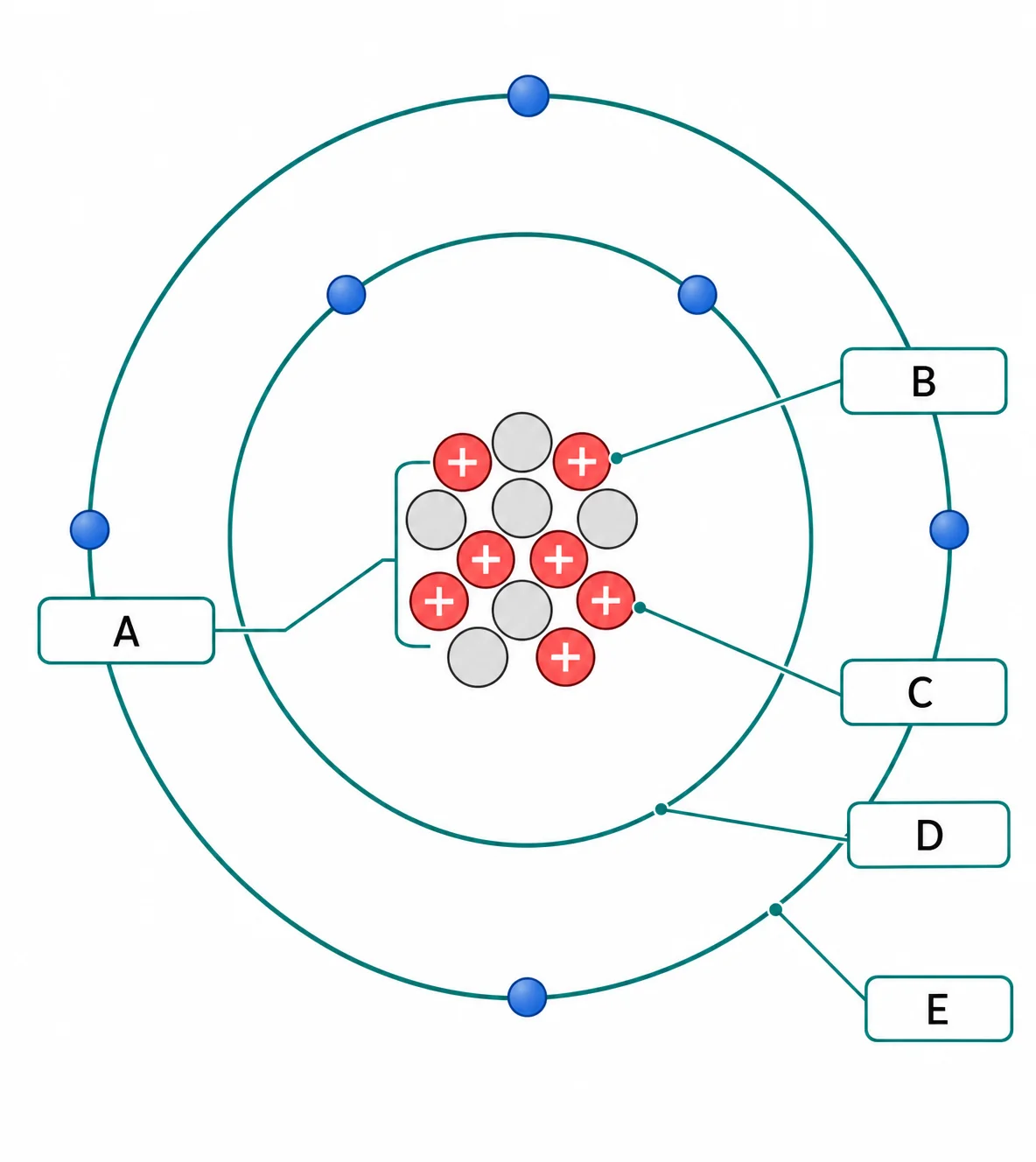
The diagram below shows a simplified atom with labels A–E. In the table, write the name of each labelled component and its relative charge. 10 marks (1 name + 1 charge each)
| Label | Name of component | Relative charge |
|---|---|---|
| A | ||
| B | ||
| C | ||
| D | ||
| E |
Q1 — Term–definition match
1.1 atomic model • 1.2 proton • 1.3 neutron • 1.4 electron • 1.5 atomic number • 1.6 mass number • 1.7 plum pudding model • 1.8 nuclear model • 1.9 Bohr model • 1.10 cathode ray.
Q2 — True / false with correction
2.1 False. The atomic number Z equals the number of protons only. The mass number A equals protons plus neutrons.
2.2 True. Most alpha particles passed through the foil undeflected, consistent with the atom being mostly empty space.
2.3 False. Rutherford’s nuclear model did not explain electron stability. Classical physics predicted orbiting electrons would radiate energy and spiral into the nucleus. Bohr’s model addressed this by introducing quantised energy levels.
2.4 False. Bohr proposed that electrons occupy fixed, discrete (quantised) energy levels and do not radiate energy while in these orbits. Electrons emit or absorb energy only when jumping between levels.
2.5 True. For a neutral atom, protons = electrons = Z.
2.6 False. Bohr’s model worked well only for hydrogen (one-electron atoms). It could not accurately describe multi-electron atoms and was superseded by the quantum mechanical model.
Q3 — Cloze paragraph
In order: electrons / cathode ray / plum pudding / gold foil / empty space / dense nucleus / spectral lines / energy levels.
Q4.1 — Evidence that overturned the plum pudding model
The large-angle deflection (and back-scatter) of alpha particles in Rutherford’s gold foil experiment forced the change. The plum pudding model predicted only small, uniform deflections from a diffuse positive sphere; instead, a small fraction of alpha particles deflected at angles greater than 90°, which was only explicable if positive charge was concentrated in a tiny, dense nucleus.
Q4.2 — Function of atomic number Z
The atomic number Z gives the number of protons in the nucleus and uniquely defines the element. Every atom of a given element has the same Z; changing Z creates a different element. Z also equals the number of electrons in a neutral atom, determining the chemical behaviour of the element.
Q4.3 — Why Bohr proposed quantised energy levels
Rutherford’s model predicted electrons would continuously radiate energy (accelerating charges lose energy in classical physics) and spiral into the nucleus within nanoseconds, making atoms unstable. Additionally, hydrogen’s emission spectrum showed only discrete coloured lines, not a continuous spectrum. Bohr proposed that electrons can only occupy specific energy levels where they do not radiate energy; this explained both the stability of atoms and why only specific photon energies (spectral lines) are emitted.
Q4.4 — Calculating neutrons
Neutrons = mass number (A) − atomic number (Z). The mass number A is the total of protons + neutrons; subtracting the number of protons (Z) gives the neutron count. For example, ¹²C has A = 12, Z = 6, so neutrons = 12 − 6 = 6.
Q5 — Sample concept map
Correct maps should include arrows such as:
- gold foil experiment — disproved → plum pudding model
- gold foil experiment — provided evidence for → nuclear model
- nuclear model — could not explain → hydrogen emission spectrum
- hydrogen emission spectrum — provided evidence for → Bohr model
- Bohr model — introduced → quantised energy levels
- quantised energy levels — explain discrete lines in → hydrogen emission spectrum
Award 1 mark per valid labelled arrow (minimum 6).
Q6 — Label the subatomic particles
A: Nucleus — overall positive charge (contains protons and neutrons). B: Proton — relative charge +1. C: Neutron — relative charge 0. D: First electron shell — contains electrons, relative charge −1 each. E: Second electron shell — contains electrons, relative charge −1 each.
Accept any valid Bohr-model labels that correctly identify nucleus, proton, neutron, and electron shells.