Chemistry • Year 11 • Module 1 • Lesson 10
Intermolecular Forces and Physical Properties
Lock in the vocabulary, the three IMF types, and the conditions required for each before tackling harder questions.
1. Term–definition match
The definitions below are shuffled. In the right-hand column write the matching term from this list: intermolecular forces, dispersion forces, dipole-dipole forces, hydrogen bonding, electronegativity, London dispersion forces, temporary dipole, permanent dipole, polarisability, homologous series. 10 marks (1 each)
| # | Definition | Matching term |
|---|---|---|
| 1.1 | Attractive forces that act between separate molecules, responsible for physical properties such as boiling point, viscosity and surface tension. | |
| 1.2 | Weak, temporary attractions present in ALL molecules, caused by instantaneous uneven distributions of electrons creating fleeting partial charges. | |
| 1.3 | Another name for dispersion forces, honouring the physicist who described them quantum mechanically in 1930. | |
| 1.4 | IMFs that arise between polar molecules because their permanent δ+ and δ− ends attract one another. | |
| 1.5 | A strong, specific IMF involving a hydrogen atom bonded to F, O, or N and a lone pair on F, O, or N of an adjacent molecule; denoted X–H···Y. | |
| 1.6 | A measure of an atom’s ability to attract shared electrons in a covalent bond; high values in F, O, and N enable hydrogen bonding. | |
| 1.7 | A short-lived charge separation that arises when the electron cloud of a non-polar molecule momentarily shifts to one side. | |
| 1.8 | A persistent charge separation in a polar molecule, arising from unequal sharing of electrons in a bond (δ+ and δ− ends). | |
| 1.9 | The ease with which the electron cloud of an atom or molecule can be distorted, determining dispersion force strength. | |
| 1.10 | A series of compounds with the same general formula and functional group where each member differs by –CH2–, giving a regular increase in boiling point. |
2. True or false — with correction
Circle T or F for each statement. If the statement is false, write the corrected version on the line below it. 12 marks (1 T/F + 1 correction each)
2.1 Non-polar molecules have no intermolecular forces because they have no partial charges. T / F
2.2 Hydrogen bonding can only occur when hydrogen is bonded to fluorine, oxygen, or nitrogen. T / F
2.3 HCl forms hydrogen bonds because it is a polar molecule with a hydrogen atom. T / F
2.4 Dispersion forces increase in strength as molecular size and electron count increase. T / F
2.5 When a substance boils, the covalent bonds within molecules are broken by the absorbed energy. T / F
2.6 A molecule with hydrogen bonding will always have a higher boiling point than any non-polar molecule, regardless of size. T / F
3. Fill-in-the-blank paragraph
Use the word bank to complete the passage. Each word is used once. 9 marks (1 per blank)
Word bank:
boiling point · dipole-dipole · dispersion · electronegativity · electron · hydrogen bonding · intermolecular · intramolecular · polar
The physical properties of molecular substances — such as ___________ and viscosity — depend on ___________ forces (IMFs), which act between molecules rather than within them. Three types of IMF exist. ___________ forces are present in all molecules; they arise when instantaneous uneven ___________ distribution creates a temporary dipole that induces a dipole in a neighbouring molecule. ___________ forces additionally act between ___________ molecules that carry permanent partial charges. The strongest IMF, ___________, requires hydrogen to be covalently bonded to an atom with high ___________ (namely F, O, or N). When a substance boils, only ___________ forces are broken — the covalent bonds inside each molecule remain intact.
4. Function recall
Answer each question in 1–2 sentences using precise terms from the lesson. 8 marks (2 each)
4.1 What two conditions must both be met for a molecule to form hydrogen bonds with its neighbours?
4.2 Why does the boiling point of straight-chain alkanes (methane, ethane, propane, …) increase regularly with chain length?
4.3 State the order of IMF strength from weakest to strongest and identify which IMF is solely responsible for the physical properties of non-polar substances.
4.4 Explain why water (H2O, MW 18) has a higher boiling point than H2S (MW 34) even though H2S is the heavier molecule.
5. Build a concept map
Draw labelled arrows between the six terms below to show how they connect. Each arrow must carry a linking phrase (e.g. “determines strength of”, “is required for”, “increases with”). Aim for at least 6 labelled arrows. 6 marks (1 per valid labelled arrow)
Supplied terms: intermolecular forces · boiling point · electronegativity · hydrogen bonding · dispersion forces · electron count.
6. Identify the IMF type
The diagram below shows four pairs of molecules, each illustrating a different intermolecular interaction. For each pair (A–D), write the name of the IMF present and the molecule(s) shown. 8 marks (1 name + 1 molecule each)
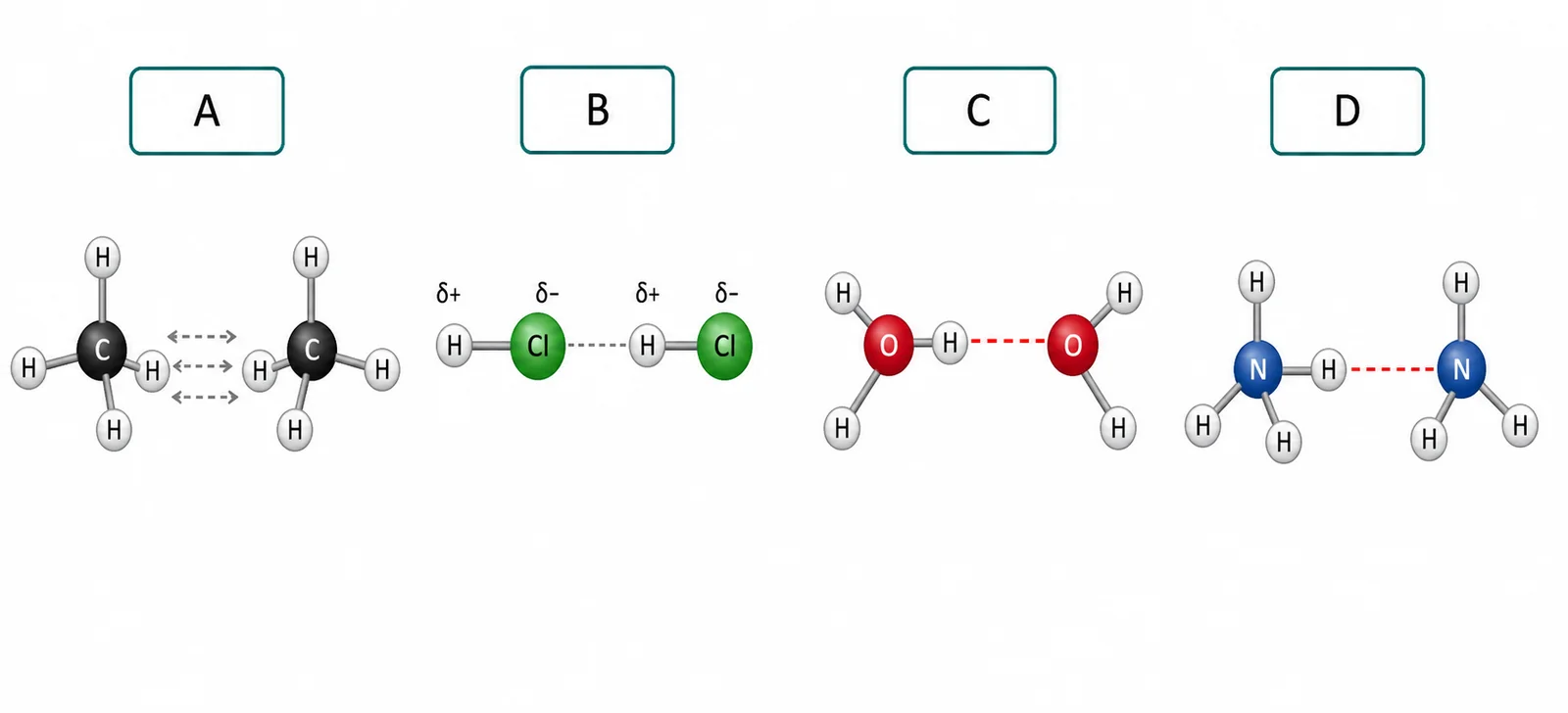
| Box | IMF type present | Molecule(s) shown |
|---|---|---|
| A | ||
| B | ||
| C | ||
| D |
Q1 — Term–definition match
1.1 intermolecular forces • 1.2 dispersion forces • 1.3 London dispersion forces • 1.4 dipole-dipole forces • 1.5 hydrogen bonding • 1.6 electronegativity • 1.7 temporary dipole • 1.8 permanent dipole • 1.9 polarisability • 1.10 homologous series.
Q2 — True / false with correction
2.1 False. Non-polar molecules still experience dispersion forces (London forces) arising from instantaneous temporary dipoles. All molecules have dispersion forces — the correct statement is that non-polar molecules have only dispersion forces.
2.2 True.
2.3 False. HCl does NOT form hydrogen bonds. Although HCl is polar and has a hydrogen atom, chlorine is not electronegative enough (Pauling scale: Cl = 3.0 vs F = 4.0, O = 3.5). For hydrogen bonding, H must be bonded to F, O, or N. HCl has only dispersion and dipole-dipole forces.
2.4 True.
2.5 False. When a substance boils, only intermolecular forces between molecules are overcome, not the covalent bonds within molecules. The molecules themselves remain intact; they simply escape from the liquid phase into the gas phase.
2.6 False. A molecule with hydrogen bonding will generally have a higher boiling point than a similarly-sized non-polar molecule, but a much larger non-polar molecule can have stronger dispersion forces that produce an even higher boiling point. Example: large alkanes like hexadecane (C16H34, BP 287 °C) boil far higher than water (BP 100 °C) despite water’s hydrogen bonding.
Q3 — Cloze paragraph
In order: boiling point / intermolecular / Dispersion / electron / Dipole-dipole / polar / hydrogen bonding / electronegativity / intramolecular.
Q4.1 — Conditions for hydrogen bonding
Two conditions must both be met: (1) a hydrogen atom must be covalently bonded to F, O, or N (giving the H a large δ+ charge); and (2) an adjacent molecule must have a lone pair on F, O, or N to act as the H-bond acceptor. Both conditions are necessary; satisfying only one is insufficient for hydrogen bonding to occur.
Q4.2 — Alkane boiling point trend
Each additional –CH2– unit adds approximately 8 electrons to the molecule (6 from C, 2 from H bonds), increasing the size and polarisability of the electron cloud. This leads to stronger temporary dipoles and therefore stronger dispersion forces between adjacent molecules. Stronger dispersion forces require more energy to overcome on boiling, giving a higher boiling point with each additional carbon.
Q4.3 — IMF strength order
Weakest to strongest: dispersion forces < dipole-dipole forces < hydrogen bonding. Dispersion forces are solely responsible for the physical properties of non-polar substances such as the alkanes, noble gases, and halogens.
Q4.4 — H2O vs H2S boiling point
Water forms strong hydrogen bonds (O–H···O) between molecules because oxygen’s high electronegativity (Pauling: 3.5) makes the O–H bond strongly polar, creating a large δ+ on H. H2S cannot form hydrogen bonds because sulfur is not electronegative enough (χ = 2.6); H2S has only dispersion and weak dipole-dipole forces. Although H2S is heavier, the much stronger hydrogen bonding in water requires far more energy to overcome, giving water a dramatically higher boiling point (100 °C vs −60 °C).
Q5 — Sample concept map
Correct maps should include arrows such as:
- intermolecular forces — determine → boiling point
- hydrogen bonding — is the strongest type of → intermolecular forces
- dispersion forces — are the weakest type of → intermolecular forces
- electronegativity — is required for → hydrogen bonding
- electron count — determines strength of → dispersion forces
- dispersion forces — increase with → electron count
Award 1 mark per valid labelled arrow (minimum 6, maximum 6 marked).
Q6 — IMF identification
A: Dispersion forces (London dispersion forces) — CH4 (methane). B: Dipole-dipole forces (and dispersion forces) — HCl. C: Hydrogen bonding (O–H···O) — H2O (water). D: Hydrogen bonding (N–H···N) — NH3 (ammonia).