Chemistry • Year 11 • Module 1 • Lesson 9
Covalent Compounds: Molecular and Network
Apply your understanding of molecular vs network structures, IMF trends, and property classification to real data, real scenarios, and a diagram critique.
1. Interpret property data — classify six covalent substances
The table below gives property data for six substances, all of which are covalent. 10 marks
| Substance | Melting point (°C) | Hardness | Electrical conductivity | Solubility in water | Covalent type (molecular / network) |
|---|---|---|---|---|---|
| Substance P | −85 | Gas at RT, no hardness | None | Slightly soluble | |
| Substance Q | 3550 | Hardest natural substance | None | Insoluble | |
| Substance R | 100 | Liquid at RT, no hardness | None (pure state) | Fully miscible | |
| Substance S | 1713 | Very hard | None | Insoluble | |
| Substance T | ≈3650 | Very soft (Mohs 1–2) | Yes (within layers) | Insoluble | |
| Substance U | 184 | Shiny solid at RT | None | Slightly soluble |
1.1 Complete the “Covalent type” column for all six substances. 6 marks (1 per row)
1.2 Identify a likely real substance for each of P, Q, R, S, T, and U based on the data. 2 marks (1 mark per two correct)
1.3 Substance T is a network solid with a very high melting point, yet it is soft and conducts electricity within its layers. Explain this apparent contradiction using its structure. 2 marks
2. Interpret graph — boiling points of the Group 16 hydrides
The graph below shows the boiling points of the Group 16 hydrides (H2O, H2S, H2Se, H2Te) plotted against molecular mass. 8 marks
Figure 2.1. Boiling points of Group 16 hydrides vs molecular mass. Dashed line shows trend extrapolated from H2S, H2Se, H2Te. Illustrative data based on standard values.
2.1 Describe the trend in boiling point from H2S to H2Te and explain it in terms of intermolecular forces. 2 marks
2.2 H2O is shown as a red outlier, far above the extrapolated trend line. Using the dashed line, estimate what the boiling point of H2O would be if it behaved like the rest of the group. State the anomaly in °C. 2 marks
2.3 Explain the anomalously high boiling point of H2O in terms of the type of intermolecular forces it forms. Why can H2O form these forces but H2S cannot? 4 marks
3. Compare covalent molecular and covalent network substances
Complete the two-column table below. For each feature, write a concise description that contrasts the two types. 10 marks (1 per cell)
| Feature | Covalent molecular | Covalent network solid |
|---|---|---|
| Structure | ||
| What breaks on melting? | ||
| Typical melting point range | ||
| Hardness | ||
| Named Australian or global example |
4. Predict and justify — a silica mining scenario
The Olympic Dam mine in South Australia processes iron oxide ore and also extracts silicon dioxide (SiO2, silica) as a by-product. Pure silica is used to manufacture optical fibres. A chemical engineer proposes dissolving the silica in water to purify it.
5 marks
4.1 Predict whether the engineer’s proposal would work. Justify your prediction using the structural model of SiO2. 3 marks
4.2 Carbon dioxide (CO2) is also produced at the mine during ore processing and dissolves slightly in water to form carbonic acid. Explain why CO2 can dissolve in water but SiO2 cannot, using the concept of structural type. 2 marks
5. Diagram critique — three errors in a student’s covalent bonding poster
A Year 11 student drew a summary poster of covalent substances. There are three scientific errors in the poster. Identify each error and write the correction. 6 marks (2 per error: 1 identify, 1 correct)
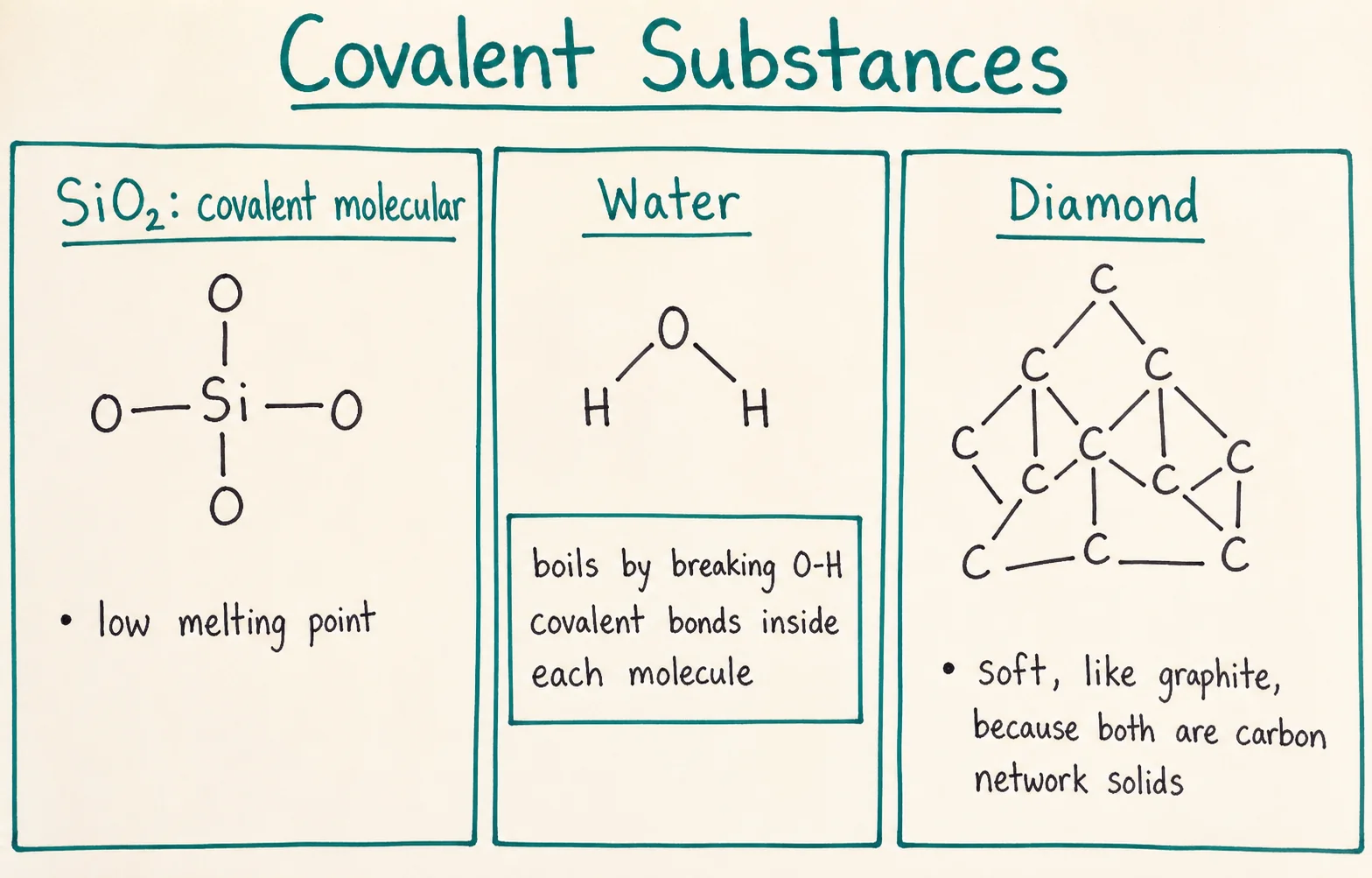
5.1 Error 1: What is wrong?
Correction:
5.2 Error 2: What is wrong?
Correction:
5.3 Error 3: What is wrong?
Correction:
Q1.1 — Classification of six substances (6 marks)
P (−85°C, gas, no conduct, slightly soluble): Covalent molecular. Q (3550°C, hardest, no conduct, insoluble): Covalent network (diamond). R (100°C, liquid, no conduct, miscible): Covalent molecular (water). S (1713°C, very hard, no conduct, insoluble): Covalent network (SiO2). T (≈3650°C, very soft, conducts in layers, insoluble): Covalent network (graphite). U (184°C, shiny solid, no conduct, slightly soluble): Covalent molecular (iodine, I2).
Q1.2 — Identifying substances (2 marks)
P = HCl (BP −85°C); Q = diamond; R = water (H2O); S = quartz/silicon dioxide (SiO2); T = graphite; U = iodine (I2, BP 184°C). Award 1 mark per two correctly identified substances.
Q1.3 — Graphite explanation (2 marks)
Graphite is a covalent network solid where each carbon forms three covalent bonds within flat layers, with one delocalised electron per carbon atom free to move within each layer [1]. The layers are held together by only weak dispersion forces, allowing them to slide past each other easily (hence softness and use as a lubricant). The delocalised electrons within each layer carry charge, explaining electrical conductivity within the layers [1]. Diamond, by contrast, has each carbon bonded to four others in a rigid 3D network with no delocalised electrons — it is hard and non-conducting.
Q2.1 — BP trend H2S to H2Te (2 marks)
Boiling point increases from H2S (−60°C) to H2Se (−41°C) to H2Te (−2°C) as molecular mass increases [1]. Larger molecules have more electrons → stronger dispersion forces between molecules → more energy required to separate them on boiling → higher boiling point [1].
Q2.2 — H2O anomaly estimate (2 marks)
Using the dashed extrapolated trend line at MW = 18, the predicted boiling point of H2O based on dispersion forces alone is approximately −90°C to −95°C [1]. The actual boiling point is +100°C, so the anomaly is approximately 190–195°C above the expected value [1]. Accept any estimate that reads the extrapolated line correctly to within ±10°C.
Q2.3 — Why H2O has an anomalously high BP (4 marks)
H2O has a much higher boiling point than expected from dispersion forces alone because it forms strong intermolecular hydrogen bonds (O–H···O) between adjacent molecules [1]. Hydrogen bonding is possible because oxygen is highly electronegative (electronegativity 3.5), making the O–H bond strongly polar and creating a large partial positive charge on hydrogen and a lone pair on oxygen that can attract adjacent H atoms [1]. H2S cannot form hydrogen bonds because sulfur is much less electronegative (electronegativity 2.6) — the S–H bond is only weakly polar and sulfur cannot act as a hydrogen-bond acceptor under normal conditions [1]. Therefore only weak dispersion forces and dipole-dipole forces act between H2S molecules, requiring far less energy to overcome on boiling [1].
Q3 — Compare and contrast table
Structure: Molecular — discrete separate molecules with IMFs between them. Network — continuous covalent bonds extending throughout the entire crystal; no discrete molecules. What breaks on melting? Molecular — intermolecular forces (IMFs) only; covalent bonds within molecules are NOT broken. Network — covalent bonds throughout the lattice. Melting point range: Molecular — low to moderate (<300°C typical). Network — very high (>1000°C). Hardness: Molecular — soft; solid forms easily deformed. Network — extremely hard (all bonds are strong covalent, except graphite layers). Named example: Molecular — H2O, CO2, I2, C6H12O6. Network — diamond (cut glass, South African mines), SiO2 (quartz, Broken Hill), graphite (lubricants, pencil lead). Award 1 mark per correctly completed cell.
Q4.1 — SiO2 dissolution prediction (3 marks)
The proposal would NOT work [1]. SiO2 is a covalent network solid in which every silicon atom is covalently bonded to four oxygen atoms, and every oxygen bridges two silicon atoms, forming a giant 3D covalent lattice [1]. To dissolve SiO2, enormous numbers of strong Si–O covalent bonds throughout the entire network would need to be broken. Water molecules cannot supply the energy needed to disrupt this network, so SiO2 is insoluble in water [1]. (Note: SiO2 dissolves only in concentrated HF or hot concentrated NaOH.)
Q4.2 — CO2 vs SiO2 solubility (2 marks)
CO2 is a covalent molecular substance — it exists as discrete O=C=O molecules held together by weak dispersion forces [1]. Water molecules can interact with these polar molecules and the weak forces between CO2 molecules are easily disrupted, allowing dissolution. SiO2 is a covalent network solid with no discrete molecules; water cannot break the extensive Si–O covalent bond network, making it insoluble [1].
Q5 — Diagram critique (6 marks)
5.1 Error 1 (SiO2 labelled as molecular with low MP): SiO2 is a covalent network solid, not a covalent molecular substance [1]. Correction: SiO2 has a melting point of 1713°C because it forms a continuous Si–O covalent bond network — every Si is bonded to 4 oxygen atoms and every O bridges two Si atoms. Melting it requires breaking enormous numbers of strong Si–O covalent bonds [1].
5.2 Error 2 (water boils by breaking O–H covalent bonds): This is incorrect and one of the most common errors in covalent chemistry [1]. Correction: When water boils, the intermolecular hydrogen bonds (O–H···O) between adjacent water molecules are broken. The O–H covalent bonds within each water molecule remain intact — the gas phase still consists of H2O molecules [1].
5.3 Error 3 (diamond described as soft like graphite): Diamond is the hardest natural substance (Mohs 10), not soft [1]. Correction: Both diamond and graphite are covalent network solids of carbon, but their structures differ completely. Diamond has every carbon bonded to four others in a rigid 3D tetrahedral network — making it extremely hard. Graphite has carbon bonded to only three others in flat layers held by weak dispersion forces — the layers slide easily, making graphite soft and a useful lubricant [1].