Chemistry • Year 11 • Module 1 • Lesson 8
Metallic Bonding and Properties
Lock in the electron sea model vocabulary, the property-by-property explanations, and the mechanism of alloy hardening before tackling harder questions.
1. Term–definition match
The definitions below are shuffled. In the right-hand column write the matching term from this list: metallic bonding, delocalised electrons, malleability, ductility, alloy, thermal conductivity, electron sea, non-directional bonding, cation lattice, metallic lustre. 10 marks (1 each)
| # | Definition | Matching term |
|---|---|---|
| 1.1 | Electrostatic attraction between a regular array of positive metal cations and a sea of mobile, delocalised valence electrons. | |
| 1.2 | Electrons that are not associated with any single atom but move freely throughout the entire metallic structure. | |
| 1.3 | The ability to be hammered or pressed into sheets without fracturing; possible because ion layers slide while bonding is maintained. | |
| 1.4 | The ability to be drawn into wire; arises from the same mechanism as malleability. | |
| 1.5 | A mixture of a metal with one or more other elements designed to improve properties such as hardness or corrosion resistance. | |
| 1.6 | The ability to transfer heat energy rapidly through a substance via the kinetic energy carried by mobile electrons. | |
| 1.7 | The informal name for the mobile cloud of delocalised valence electrons that surround the cation lattice in a metal. | |
| 1.8 | Type of bonding in metals where there is no preferred bond direction, allowing layers of ions to slide relative to each other. | |
| 1.9 | The regular arrangement of positive metal ions that forms when metal atoms release their valence electrons into the electron sea. | |
| 1.10 | The shiny, reflective surface appearance of metals, caused by delocalised electrons absorbing and re-emitting light of all visible wavelengths. |
2. True or false — with correction
Circle T or F for each statement. If the statement is false, write the corrected version on the line below it. 12 marks (1 T/F + 1 correction each)
2.1 In a metal, valence electrons remain localised on their parent atoms, forming individual electron-pair bonds between adjacent metal ions. T / F
2.2 Metals are malleable because the electrostatic attraction between ions and the electron sea is non-directional, so ion layers can slide without breaking the overall bonding. T / F
2.3 Alloys are harder than pure metals because they contain more atoms per unit volume. T / F
2.4 A Group 2 metal (two valence electrons per atom) generally has stronger metallic bonding than a Group 1 metal of similar size, and therefore a higher melting point. T / F
2.5 Metals conduct electricity because they contain mobile ions that move through the structure when a voltage is applied. T / F
2.6 Tungsten (W) has a higher melting point than sodium (Na) because tungsten contributes more valence electrons to the electron sea and has a higher ionic charge, producing stronger metallic bonding. T / F
3. Fill-in-the-blank paragraph
Use the word bank to complete the passage. Each word is used once. 8 marks (1 per blank)
Word bank:
cations · delocalised · distortions · ductile · electron sea · electrostatic · higher · sliding
Metallic bonding involves an ___________ attraction between a lattice of positive metal ___________ and a sea of ___________ valence electrons. This mobile ___________ is responsible for the characteristic properties of metals. Because the bonding is non-directional, ion layers can slide past one another without breaking the bonding, which is why metals are malleable and ___________. When a different-sized atom is introduced to make an alloy, it creates ___________ in the regular lattice that prevent smooth layer ___________, making the alloy harder and stronger. A transition metal like iron has a ___________ melting point than a Group 1 metal like sodium because it contributes more valence electrons to the electron sea, producing stronger bonding.
4. Function recall
Answer each question in 1–2 sentences using precise terms from the lesson. 8 marks (2 each)
4.1 What is the function of the delocalised electron sea in explaining the electrical conductivity of metals?
4.2 Why does non-directional metallic bonding allow malleability, while directional covalent bonding in diamond does not?
4.3 What is the role of a foreign (different-sized) atom in an alloy in determining the alloy’s hardness?
4.4 How does the number of valence electrons contributed per atom affect the strength of metallic bonding and hence the melting point?
5. Build a concept map
Draw labelled arrows between the six terms below to show how they connect. Each arrow must carry a linking phrase (e.g. “causes”, “produces”, “depends on”). Aim for at least 6 labelled arrows. 6 marks (1 per valid labelled arrow)
Supplied terms: metallic bonding · delocalised electrons · malleability · electrical conductivity · melting point · alloy hardness.
6. Label the metallic bonding diagram
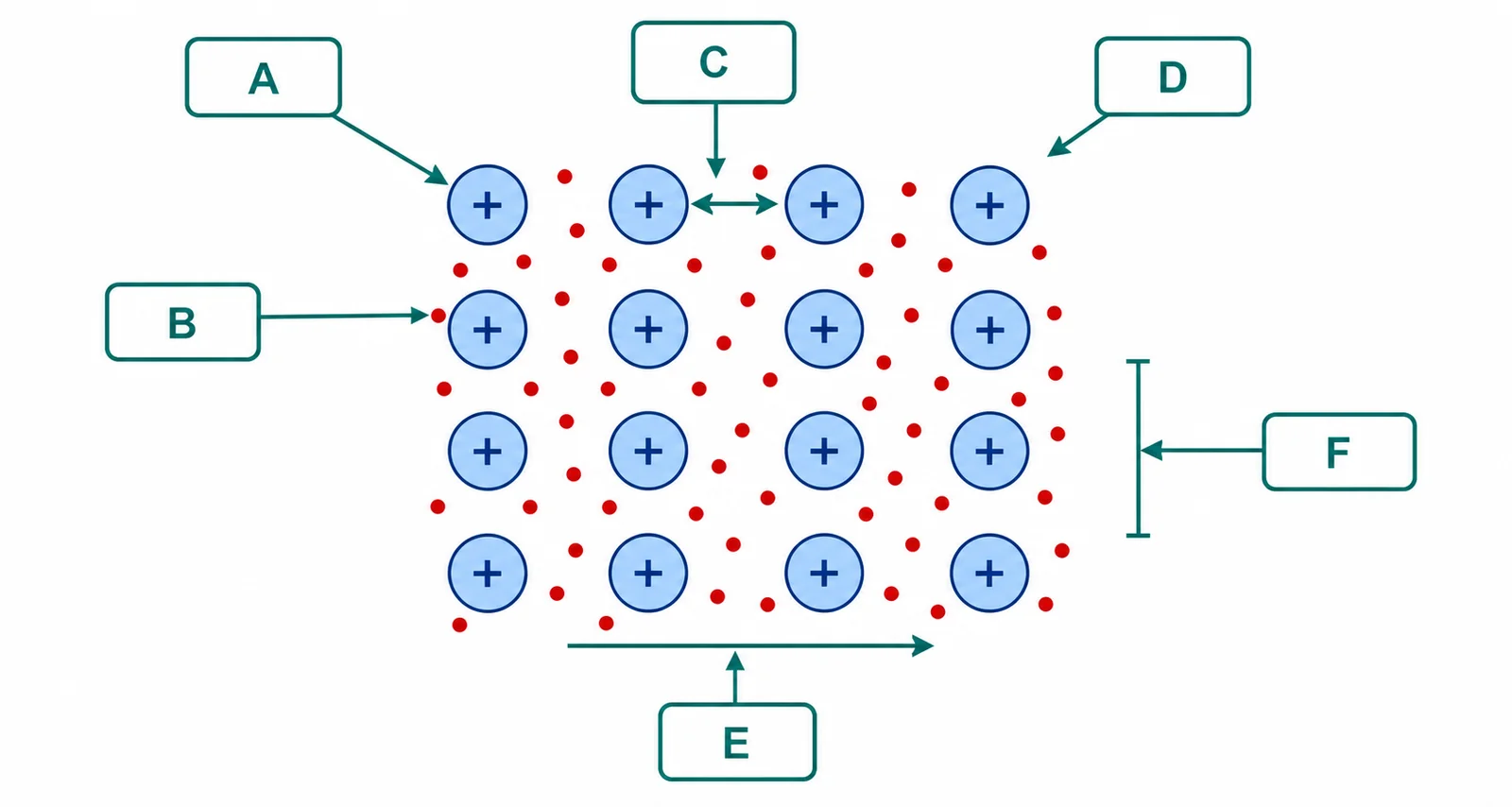
The diagram below shows a cross-section of a metallic lattice and its electron sea. Write the correct label for each position A–F using terms from the lesson. 6 marks (1 each)
| Label | Your answer |
|---|---|
| A | |
| B | |
| C | |
| D | |
| E | |
| F |
Q1 — Term–definition match
1.1 metallic bonding • 1.2 delocalised electrons • 1.3 malleability • 1.4 ductility • 1.5 alloy • 1.6 thermal conductivity • 1.7 electron sea • 1.8 non-directional bonding • 1.9 cation lattice • 1.10 metallic lustre.
Q2 — True / false with correction
2.1 False. In a metal, valence electrons are delocalised — they leave their parent atoms and are shared freely across the entire metallic structure (the electron sea). They are not localised in individual bonds between adjacent atoms.
2.2 True. Non-directional metallic bonding means there is no preferred bond direction; when an external force causes ion layers to slide, the electron sea simply redistributes, maintaining the overall electrostatic attraction and preventing fracture.
2.3 False. Alloys are harder because foreign atoms of different size disrupt the regular lattice, creating distortions that prevent smooth layer sliding. The quantity of atoms is not the cause; it is the size irregularity that impedes deformation.
2.4 True. Group 2 metals contribute 2 delocalised electrons per atom and have a cation charge of +2, both of which strengthen the electrostatic attraction between the cation lattice and the electron sea. This gives a higher lattice energy and higher melting point than a comparable Group 1 metal.
2.5 False. Metals conduct electricity because they contain mobile delocalised electrons, not mobile ions. When a voltage is applied, these free electrons flow as a directed electric current. Metal ions remain in fixed lattice positions (in the solid state).
2.6 True. Tungsten is a Group 6 transition metal contributing ~6 valence electrons per atom with a high ionic charge, producing an extremely dense and strongly attracted electron sea. Sodium (Group 1) contributes only 1 delocalised electron per atom with a +1 cation, giving much weaker bonding and a far lower melting point (98°C vs 3422°C).
Q3 — Cloze paragraph
In order: electrostatic / cations / delocalised / electron sea / ductile / distortions / sliding / higher.
Q4.1 — Electrical conductivity
Delocalised electrons in the electron sea are free to move throughout the metallic lattice at all times. When a potential difference (voltage) is applied, these electrons flow in a directed manner from the negative terminal to the positive terminal, constituting an electric current. Their continuous mobility means metals conduct electricity in both solid and liquid states.
Q4.2 — Malleability vs diamond brittleness
In metals, the bonding is non-directional: the electrostatic attraction between cations and the electron sea operates in all directions equally. When a force causes a layer of metal ions to shift sideways, the electron sea moves with them, maintaining the overall attraction — no bonds are broken and the metal deforms without fracturing. In diamond, each carbon is bonded to four others in a rigid 3D network with strong, directional covalent bonds at fixed angles. Applying a shear force breaks these directional bonds and shatters the crystal because they cannot accommodate sliding.
Q4.3 — Role of foreign atoms in alloy hardness
A foreign atom of different size (larger or smaller than the host metal atoms) creates a local distortion in the regular cation lattice where it sits. When an external force is applied, the layer of ions cannot slide smoothly past the site of distortion — the size mismatch acts as a physical obstacle, blocking the movement of dislocations. Greater force is therefore needed to deform the alloy, making it harder and stronger than the pure metal.
Q4.4 — Valence electrons and melting point
Each additional valence electron contributed by a metal atom adds one more delocalised electron to the electron sea, increasing the density of the electron sea and thus the overall electrostatic attraction between the cation lattice and the sea. A higher cation charge also strengthens this attraction. Together, these factors increase the lattice energy, meaning more thermal energy (higher temperature) is required to overcome the metallic bonding and allow atoms to move freely — hence a higher melting point.
Q5 — Sample concept map
Correct maps should include arrows such as:
- metallic bonding — arises from → delocalised electrons
- delocalised electrons — enable → electrical conductivity
- metallic bonding — non-directional, allows → malleability
- stronger metallic bonding — raises → melting point
- alloy hardness — caused by lattice distortions that reduce → malleability
- delocalised electrons — strength of sea determines → melting point
Award 1 mark per valid labelled arrow (minimum 6, maximum 6 marked).
Q6 — Metallic bonding diagram labels
A: Positive metal cation (metal ion with positive charge). B: Delocalised electrons (electron sea). C: Electrostatic attraction (between cation and electron sea). D: Metallic bonding (the overall structure). E: Non-directional bond / layer sliding under applied force (malleability). F: Non-directional bonding allows layer displacement without bond breaking.