Chemistry • Year 11 • Module 1 • Lesson 6
Chemical Bonding Overview
Apply the property-classification framework to real data, real materials, and a cause-and-effect analysis of structure-property relationships.
1. Classify from property data — Australian materials
The table below lists measured properties of five substances relevant to Australian industry or everyday life. Use only the data given to classify each substance and answer the sub-questions below. 10 marks
| Substance | MP (°C) | Conducts (solid) | Conducts (molten / aq) | Hardness / texture |
|---|---|---|---|---|
| P — used in electrical wiring | 1085 | Yes | Yes | Malleable, ductile |
| Q — table salt | 801 | No | Yes (dissolved) | Hard, brittle |
| R — dry ice (solid CO2) | −78 | No | No | Soft, crumbly |
| S — abrasive grit in sandpaper | 2730 | No | No | Extremely hard |
| T — pencil lead component | 3652 | Yes | Yes | Soft, slippery layers |
1.1 Complete the table: classify each substance as ionic compound, covalent molecular, covalent network, or metallic element, and write the name of a likely substance for P, Q, R, and S. 5 marks (1 per substance)
| Substance | Structural type | Likely identity (if known) |
|---|---|---|
| P | ||
| Q | ||
| R | ||
| S | ||
| T |
1.2 Substance T breaks the general rules for its structural type in two ways. Identify both exceptions and explain the structural feature responsible for each. 3 marks
1.3 Why does substance Q not conduct electricity as a solid, even though it contains charged particles (ions)? 2 marks
2. Cause-and-effect chain — why ionic solids shatter
The boxes on the left describe the cause at each step. Write the effect in the right-hand box, and complete the overall outcome. 5 marks
Overall outcome (so…): Contrast this with what happens when a metal is struck. Why does the metal deform instead of shattering?
3. Compare ionic and metallic bonding across five features
Complete the two-column table. For each feature, write a concise description that contrasts the two bonding types. 10 marks (1 per cell)
| Feature | Ionic compound | Metallic element |
|---|---|---|
| Particle arrangement | ||
| Type of bonding force | ||
| Electrical conductivity (solid) | ||
| Electrical conductivity (molten) | ||
| Mechanical behaviour under force |
4. Diagram critique — spot the errors in a student’s classification poster
A Year 11 student drew the classification poster below. There are three errors. Identify each error and write the correction. 6 marks (2 per error: 1 identify + 1 correct)
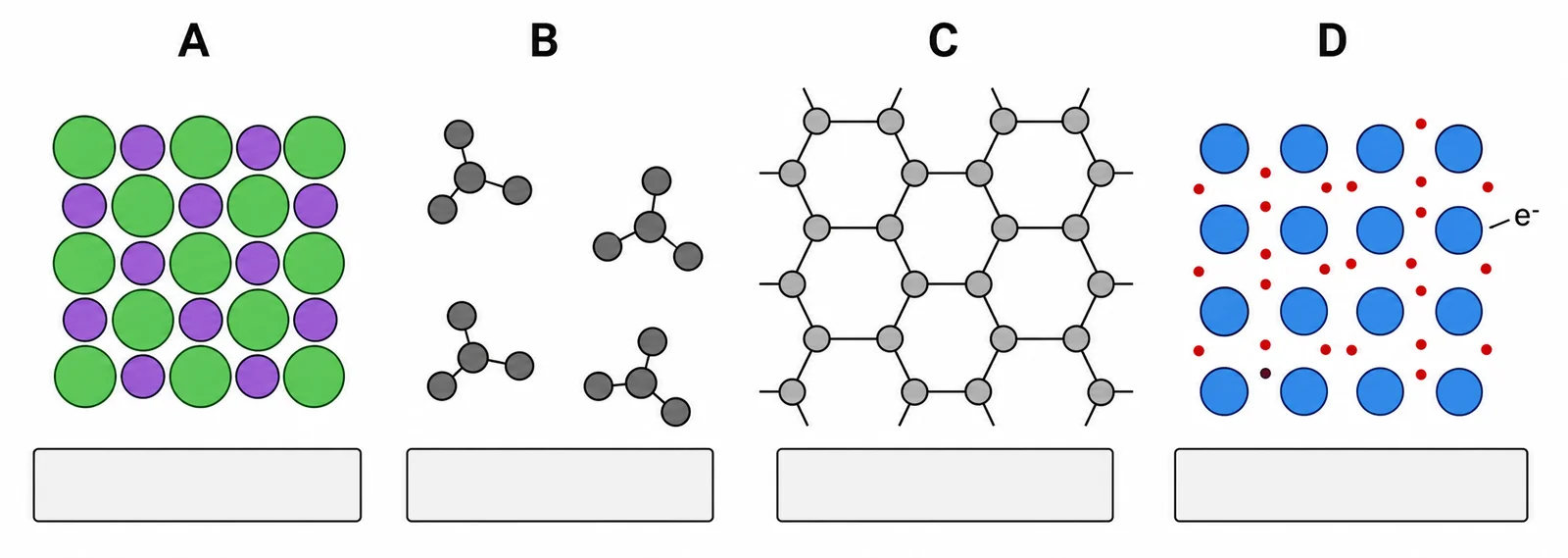
4.1 Error 1: What is wrong?
Correction:
4.2 Error 2: What is wrong?
Correction:
4.3 Error 3: What is wrong?
Correction:
Q1.1 — Classification table
P (1085°C, conducts solid + molten, malleable): Metallic element — copper (Cu).
Q (801°C, no solid conductivity, conducts dissolved, hard + brittle): Ionic compound — sodium chloride (NaCl).
R (−78°C, no conductivity, soft): Covalent molecular — dry ice / carbon dioxide (CO2).
S (2730°C, no conductivity, extremely hard): Covalent network — silicon carbide (SiC) or similar network solid.
T (3652°C, conducts solid + molten, soft/slippery layers): Covalent network — graphite (C). [Graphite is the exception to both general covalent-network rules.]
Q1.2 — Graphite exceptions (3 marks)
Exception 1 — conducts electricity: Within each hexagonal carbon layer, each carbon atom forms only three covalent bonds, leaving one electron per atom delocalised and free to move within the layer. These mobile electrons carry charge, enabling conductivity (1 mark + structural explanation, 1 mark).
Exception 2 — soft and slippery: Between layers, only weak dispersion (van der Waals) forces act rather than covalent bonds. These interlayer forces are easily overcome, allowing layers to slide over each other, making graphite soft (1 mark).
Q1.3 — Why Q does not conduct as solid (2 marks)
In solid NaCl, the Na+ and Cl− ions are fixed in a rigid, ordered lattice held by strong electrostatic attractions (1 mark). Although the ions are charged, they cannot move through the lattice, so they cannot carry electric current (1 mark). Conduction requires mobile charge carriers, which solid ionic compounds lack.
Q2 — Cause-and-effect chain (5 marks)
Effect 1: The crystal planes shift slightly relative to each other under the applied force. (1 mark)
Effect 2: Like-charged ions (e.g. Na+ directly adjacent to Na+, Cl− adjacent to Cl−) come into alignment across the shifted planes. (1 mark)
Effect 3: Strong electrostatic repulsion between the like-charged ions causes the lattice to fracture catastrophically along the cleavage plane, shattering the crystal. (1 mark)
Overall outcome (2 marks): Ionic solids shatter because their rigid, directional bonding means any layer shift causes repulsive alignment. In contrast, when a metal is struck, the layers of metal cations slide past each other while the delocalised electron sea re-distributes and maintains bonding throughout the deformation — the metal bends or flattens rather than shattering, making it malleable. (1 mark for contrast + 1 mark for electron-sea explanation)
Q3 — Compare ionic and metallic bonding
Particle arrangement — Ionic: Alternating positive and negative ions in a regular 3D lattice. Metallic: Positive metal cations surrounded by a delocalised “sea” of mobile electrons.
Type of bonding force — Ionic: Strong electrostatic attraction between oppositely charged ions. Metallic: Electrostatic attraction between the positive cations and the negative electron sea (metallic bonding).
Conductivity (solid) — Ionic: Does not conduct; ions are fixed. Metallic: Conducts; delocalised electrons are free to move.
Conductivity (molten) — Ionic: Conducts; ions are mobile. Metallic: Conducts; electrons still mobile in the melt.
Mechanical behaviour — Ionic: Hard but brittle; layers shift causing like-ion repulsion and fracture. Metallic: Malleable and ductile; layers slide with electron sea maintaining cohesion.
Q4 — Diagram critique (6 marks)
4.1 Error 1 (Ionic box: “conducts in all states”): Ionic compounds do NOT conduct in all states — they only conduct when molten or dissolved in water. As solids, the ions are fixed in the lattice and cannot move to carry charge [1 mark identify]. Correction: The ionic box should read: “Does not conduct as a solid; conducts when molten or dissolved in water (mobile ions)” [1 mark correct].
4.2 Error 2 (Covalent Network box: “never conducts”): The statement is incorrect for graphite, which is a covalent network solid that DOES conduct electricity due to delocalised electrons within its layers [1 mark identify]. Correction: The box should read: “Generally does not conduct, except graphite, which has delocalised electrons within each carbon layer and conducts electricity” [1 mark correct].
4.3 Error 3 (Metallic box: “hard and brittle like ionic solids”): Metals are NOT hard and brittle — they are malleable and ductile [1 mark identify]. Correction: The box should read: “Malleable and ductile — metal cation layers can slide past each other while the electron sea maintains bonding, allowing deformation without fracture” [1 mark correct].