Chemistry • Year 11 • Module 1 • Lesson 6
Chemical Bonding Overview
Lock in the key vocabulary, the four structural types, and the five classification properties before tackling harder questions.
1. Term–definition match
The definitions below are shuffled. In the right-hand column write the matching term from this list: ionic compound, covalent molecular, covalent network, metallic bonding, delocalised electrons, malleability, ductility, electrical conductivity, melting point, hardness. 10 marks (1 each)
| # | Definition | Matching term |
|---|---|---|
| 1.1 | A substance formed when electrons are transferred from a metal atom to a non-metal atom, producing oppositely charged ions held in a rigid 3D lattice by electrostatic forces. | |
| 1.2 | A substance consisting of discrete molecules where atoms share electrons; held together by weak intermolecular forces rather than a continuous lattice. | |
| 1.3 | A solid where covalent bonds extend continuously throughout the entire structure in a 3D network, with no discrete molecules — e.g. diamond and SiO2. | |
| 1.4 | The type of bonding in a pure metal element where cations sit in a “sea” of mobile electrons; the electrostatic attraction between cations and the electron cloud holds the metal together. | |
| 1.5 | Electrons that are not localised between two specific atoms but are free to move throughout a structure — the reason metals and graphite conduct electricity. | |
| 1.6 | The ability of a material to be hammered or rolled into sheets without fracturing; a property unique to metals because their bonding is non-directional. | |
| 1.7 | The ability of a material to be drawn into a wire; closely related to malleability and also exclusive to metallic substances. | |
| 1.8 | The ability of a substance to allow electric current to flow; requires mobile charge carriers (free electrons or free ions). | |
| 1.9 | The temperature at which a substance changes from solid to liquid; reflects the strength of the forces holding particles together — higher value means stronger forces. | |
| 1.10 | Resistance to scratching or indentation; extremely high in covalent network solids because every bond throughout the crystal must be broken to deform the structure. |
2. True or false — with correction
Circle T or F for each statement. If the statement is false, write the corrected version on the line below it. 12 marks (1 T/F + 1 correction each)
2.1 Ionic compounds do not conduct electricity in any state because they have no free electrons. T / F
2.2 Covalent molecular compounds have low melting points because the covalent bonds within their molecules are weak. T / F
2.3 Metallic substances are malleable because metal atom layers can slide past each other while the electron sea maintains cohesion. T / F
2.4 Graphite is a covalent network solid that is soft and conducts electricity — both properties are exceptions to the general rules for covalent network solids. T / F
2.5 Ionic solids shatter when struck because the applied force causes like-charged ions to align and repel each other, breaking the lattice. T / F
2.6 A substance that conducts electricity only when molten or dissolved in water — but not as a solid — must be a metallic element. T / F
3. Fill-in-the-blank paragraph
Use the word bank to complete the passage. Each word is used once. 9 marks (1 per blank)
Word bank:
brittle · covalent molecular · covalent network · delocalised electrons · ionic · malleable · melting point · mobile ions · very high
There are four main structural types of substances. An ___________ compound is formed by electron transfer, producing a lattice of oppositely charged particles held by strong electrostatic forces; this gives a high ___________ and makes the solid hard but ___________. A ___________ substance consists of discrete molecules with weak intermolecular forces, so it melts at a low temperature. A ___________ solid has covalent bonds extending throughout the entire structure, giving a ___________ melting point and extreme hardness. Metals conduct electricity because they contain ___________ that are always free to move. When force is applied to a metal, it deforms rather than shatters because non-directional bonding allows ion layers to slide — metals are therefore ___________. Ionic compounds can only conduct electricity when melted or dissolved because only then do they have ___________.
4. Function recall
Answer each question in 1–2 sentences using precise terms from the lesson. 8 marks (2 each)
4.1 Why does a metallic substance conduct electricity both as a solid and as a liquid, whereas an ionic compound only conducts when liquid or dissolved?
4.2 What property distinguishes a covalent network solid from a covalent molecular substance in terms of structure?
4.3 Why is the melting point of a covalent molecular compound typically much lower than that of an ionic compound?
4.4 What three properties form the “diagnostic trio” when classifying an unknown substance, and why is each one needed?
5. Build a concept map
Draw labelled arrows between the six terms below to show how they connect. Each arrow must carry a linking phrase (e.g. “causes”, “is an example of”, “results in”). Aim for at least 6 labelled arrows. 6 marks (1 per valid labelled arrow)
Supplied terms: metallic bonding · delocalised electrons · electrical conductivity · ionic lattice · mobile ions · malleability.
6. Label the four structural types
The diagram shows four particle models — one for each structural type. Write the correct structural type name and one example substance into boxes A–D. 8 marks (1 label + 1 example each)
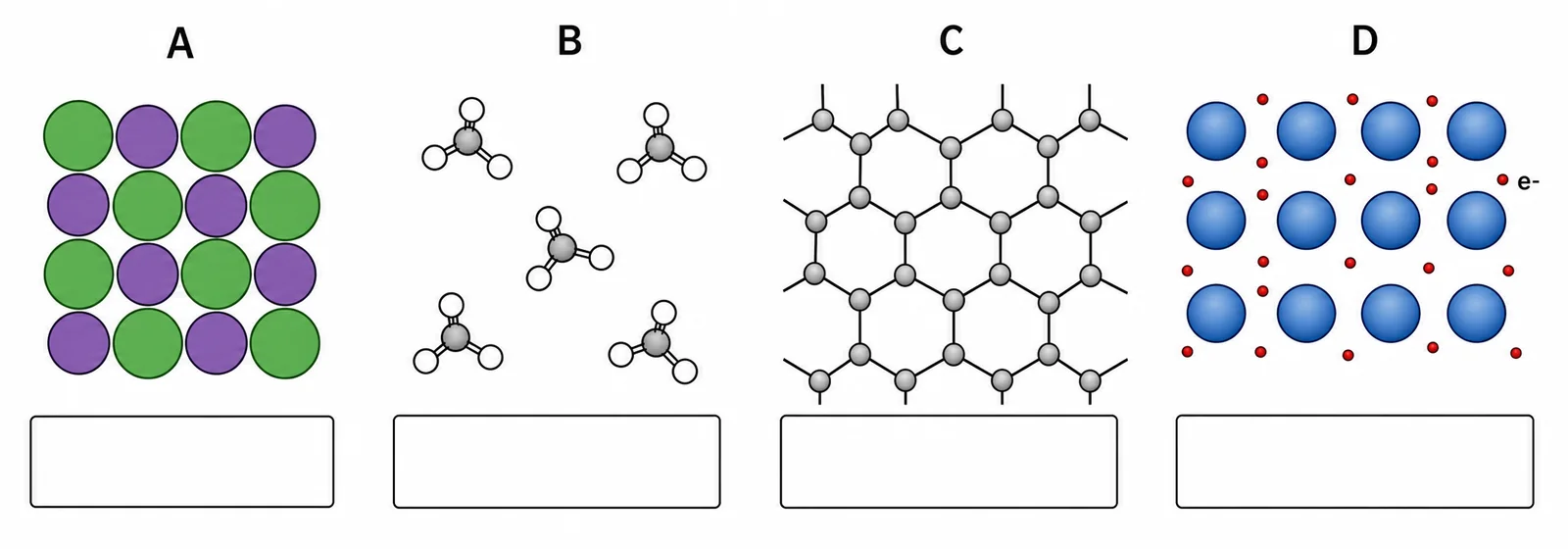
| Box | Structural type name | One example substance |
|---|---|---|
| A | ||
| B | ||
| C | ||
| D |
Q1 — Term–definition match
1.1 ionic compound • 1.2 covalent molecular • 1.3 covalent network • 1.4 metallic bonding • 1.5 delocalised electrons • 1.6 malleability • 1.7 ductility • 1.8 electrical conductivity • 1.9 melting point • 1.10 hardness.
Q2 — True / false with correction
2.1 False. Ionic compounds do not conduct as solids (ions are fixed in the lattice), but they DO conduct electricity when molten or dissolved in water because the ions become mobile. The reason for non-conduction as a solid is immobile ions, not the absence of free electrons.
2.2 False. Covalent molecular compounds have low melting points because the intermolecular forces between molecules are weak, not because the covalent bonds within the molecules are weak. The intramolecular covalent bonds are actually strong; it is the intermolecular forces (dispersion, dipole-dipole, H-bonding) that are overcome on melting.
2.3 True.
2.4 True.
2.5 True.
2.6 False. A substance that conducts only when molten or dissolved is an ionic compound, not a metallic element. Metals always conduct as solids because their delocalised electrons are always free to move. Ionic compounds only conduct when ions become mobile (liquid or dissolved).
Q3 — Cloze paragraph
In order: ionic / melting point / brittle / covalent molecular / covalent network / very high / delocalised electrons / malleable / mobile ions.
Q4.1 — Metal vs ionic conductivity
Metals contain delocalised electrons that are always free to move throughout the structure in any state, so they always conduct. Ionic compounds have ions fixed in a rigid lattice when solid, so they cannot carry charge. When melted or dissolved, the lattice breaks down and ions become mobile, allowing conduction.
Q4.2 — Network vs molecular structure
In a covalent network solid, covalent bonds extend continuously throughout the entire 3D structure with no discrete molecules. In a covalent molecular substance, covalent bonds only link atoms within individual molecules; separate molecules are held to each other by much weaker intermolecular forces.
Q4.3 — Why covalent molecular has lower MP
Covalent molecular compounds consist of discrete molecules held together by weak intermolecular forces (e.g. dispersion forces). These forces require little energy to overcome, so the substance melts at a low temperature. Ionic compounds have strong electrostatic attractions throughout the entire lattice, requiring much more energy to break down.
Q4.4 — The diagnostic trio
The three properties are: (1) melting point — distinguishes low-MP covalent molecular from high-MP ionic from very-high-MP covalent network; (2) electrical conductivity — determines whether charge carriers exist and in what state; (3) hardness/malleability — distinguishes hard-brittle ionic from malleable metallic from extremely hard covalent network. Each one is needed because no single property uniquely identifies all four types; the combination resolves ambiguous cases.
Q5 — Sample concept map
Correct maps should include arrows such as:
- metallic bonding — contains → delocalised electrons
- delocalised electrons — enable → electrical conductivity
- metallic bonding — allows → malleability
- ionic lattice — releases when molten → mobile ions
- mobile ions — enable → electrical conductivity
- delocalised electrons — absent in → ionic lattice
Award 1 mark per valid labelled arrow (minimum 6).
Q6 — Four structural types
A: Ionic compound — example: sodium chloride (NaCl) or magnesium oxide (MgO).
B: Covalent molecular — example: water (H2O) or carbon dioxide (CO2).
C: Covalent network — example: diamond (C) or silicon dioxide (SiO2).
D: Metallic — example: copper (Cu) or iron (Fe) or sodium (Na).
Accept any correct examples in each category.