Chemistry • Year 11 • Module 1 • Lesson 3
Separation Techniques — Physical Methods
Apply your understanding of filtration and crystallisation to real data, novel scenarios, and structured comparisons to build exam-level reasoning.
1. Interpret graph — solubility of potassium nitrate
The graph below shows the solubility of potassium nitrate (KNO3) in water at different temperatures. Use it to answer the questions below. 8 marks
Figure 1. Solubility of KNO3 in water at temperatures 0–80 °C. Illustrative data based on standard reference tables.
1.1 Describe the trend in solubility of KNO3 as temperature increases from 0 °C to 80 °C. 2 marks
1.2 A solution is prepared at 80 °C by dissolving 169 g of KNO3 in 100 g of water. Using the graph, estimate the mass of KNO3 crystals that would form if this solution were cooled to 20 °C. Show your reasoning. 3 marks
1.3 Explain why a student using this solubility data would choose slow cooling rather than rapid cooling when trying to obtain pure KNO3 crystals from a hot saturated solution. 3 marks
2. Compare filtration and crystallisation across five features
Complete the two-column table. For each feature, write a concise description that contrasts the two separation techniques. 10 marks (1 per cell)
| Feature | Filtration | Crystallisation |
|---|---|---|
| Separation basis | ||
| Mixture type | ||
| Key equipment | ||
| What is collected | ||
| Purification ability |
3. Interpret experimental data — choose a technique
A student has five mixtures to separate. For each mixture, identify the best physical separation technique (filtration or crystallisation), state the separation basis, and identify what would be collected as the final product. 10 marks
| Mixture | Best technique | Separation basis | Product collected |
|---|---|---|---|
| Sand and water | |||
| Copper(II) sulfate dissolved in water | |||
| Chalk powder (CaCO3, insoluble) in water | |||
| KNO3 dissolved in water | |||
| NaCl dissolved in water (plus some undissolved grit) |
3.1 For the last mixture (NaCl + grit), describe the two-step procedure you would use to obtain both clean NaCl crystals and dry grit separately. 3 marks
4. Predict and justify — a failed separation attempt
A student wants to obtain pure copper(II) sulfate (CuSO4) from a solution of CuSO4 in water. The student pours the solution through filter paper and then collects the material on the filter paper as their “pure copper sulfate product”. 5 marks
4.1 Predict what the student will find on the filter paper and explain why. 2 marks
4.2 Explain the error in the student’s method and describe the correct technique they should use to obtain dry CuSO4 crystals. Include at least three steps in your corrected procedure. 3 marks
5. Diagram critique — spot three errors in a student’s crystallisation poster
A Year 11 student drew a poster describing the crystallisation process. There are three errors in the poster. Identify each error and write the correction. 6 marks (2 per error: 1 identify, 1 correct)
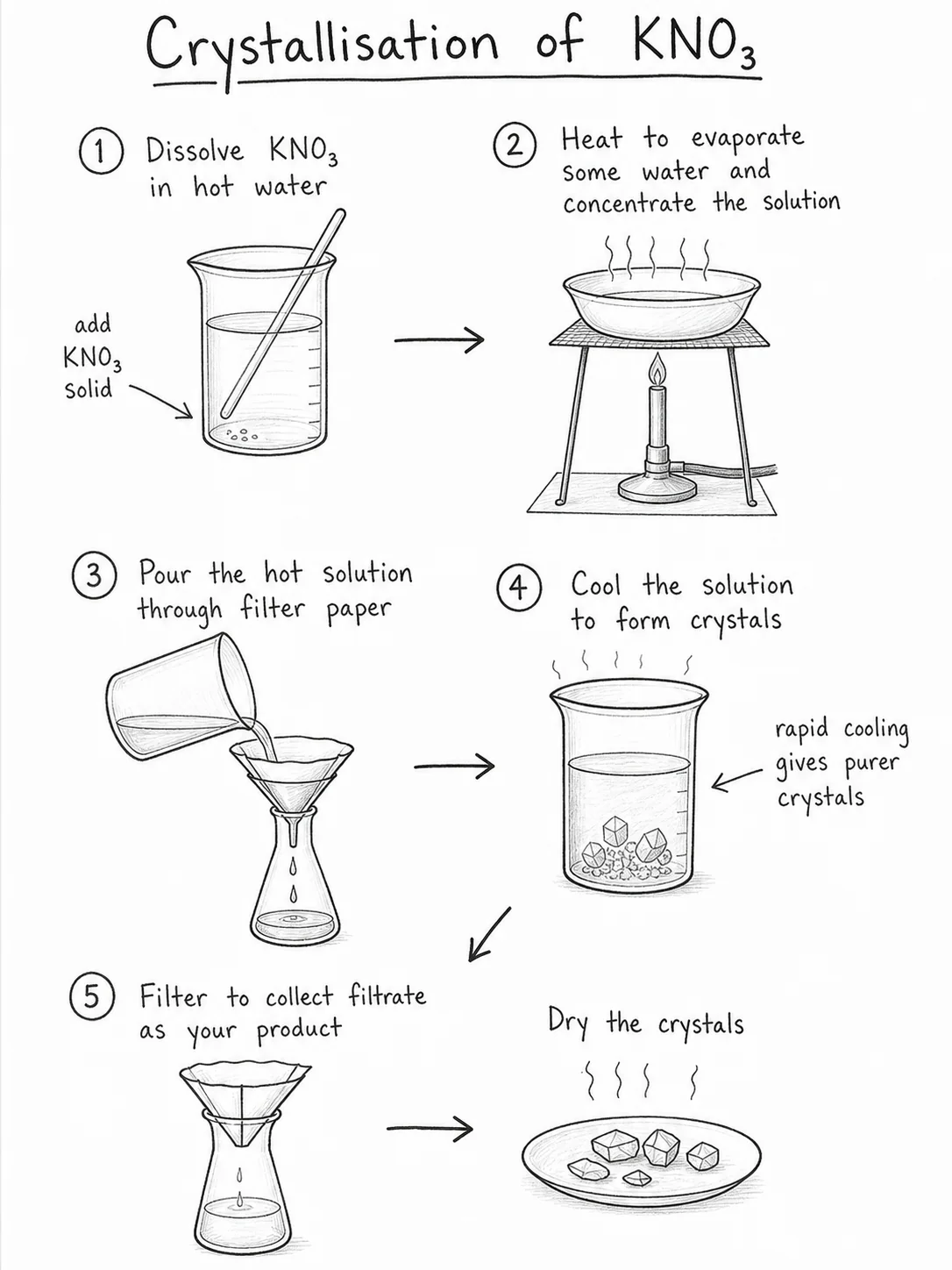
5.1 Error 1: What is wrong?
Correction:
5.2 Error 2: What is wrong?
Correction:
5.3 Error 3: What is wrong?
Correction:
Q1.1 — Solubility trend (2 marks)
The solubility of KNO3 increases steeply and non-linearly as temperature rises from 0 °C to 80 °C [1 mark for “increases”]. The increase is particularly steep above 40 °C, rising from about 64 g/100 g water at 40 °C to 169 g/100 g water at 80 °C [1 mark for describing the steep/non-linear nature or referencing specific data points].
Q1.2 — Mass of crystals formed (3 marks)
At 80 °C: solubility = 169 g / 100 g water [1 mark for reading 80 °C value]. At 20 °C: solubility = 31 g / 100 g water [1 mark for reading 20 °C value]. Mass of crystals formed = 169 − 31 = 138 g of KNO3 crystallises out of solution [1 mark for correct subtraction and answer].
Q1.3 — Why slow cooling is preferred (3 marks)
Slow cooling allows KNO3 ions time to arrange themselves into an ordered crystal lattice [1 mark]. Impurity particles have different sizes and shapes and are excluded from the ordered lattice during slow crystal growth, remaining in solution [1 mark]. Rapid cooling does not allow time for this ordered arrangement; impurities become trapped within the crystal structure and the crystals are small and impure [1 mark].
Q2 — Compare and contrast table
Separation basis: Filtration: particle size (solid too large to pass through filter paper). Crystallisation: change in solubility with temperature (dissolved solute comes out of solution on cooling). Mixture type: Filtration: insoluble solid in liquid. Crystallisation: dissolved solid in solution (solute in solvent). Key equipment: Filtration: filter paper, glass funnel, conical flask, glass rod. Crystallisation: evaporating basin, heat source (Bunsen burner), tripod, wire gauze, funnel for final filtration. What is collected: Filtration: residue (solid on filter paper) and filtrate (liquid). Crystallisation: dry crystals (after filtering and drying) and mother liquor. Purification ability: Filtration: limited — removes insoluble impurities only. Crystallisation: yes — each cycle progressively improves purity as impurities remain in solution.
Q3 — Choose-a-technique table
Sand and water: Filtration / particle size / dry sand as residue. CuSO4 dissolved in water: Crystallisation / solubility change with temperature / CuSO4 crystals. Chalk powder in water: Filtration / particle size / dry chalk as residue. KNO3 dissolved in water: Crystallisation / solubility change with temperature / KNO3 crystals. NaCl + grit: Both techniques needed (filtration first, then crystallisation).
Q3.1 — Two-step procedure for NaCl + grit (3 marks)
Step 1 — Filtration: pour the NaCl + grit + water mixture through filter paper in a funnel. The grit (insoluble) is trapped as residue on the filter paper; the NaCl solution (filtrate) passes through into a flask below [1 mark]. Step 2 — Crystallisation: heat the filtrate (NaCl solution) in an evaporating basin until saturated, allow to cool slowly so NaCl crystallises out, then filter off the crystals and dry them [1 mark]. Both products are obtained separately — dry grit from step 1, dry NaCl crystals from step 2 [1 mark for linking both steps and identifying both products].
Q4.1 — Prediction about filter paper (2 marks)
The student will find nothing (or only dust) on the filter paper [1 mark]. CuSO4 is fully dissolved in solution; its ions are at the molecular level and pass straight through the pores of the filter paper with the water [1 mark].
Q4.2 — Error and correct procedure (3 marks)
Error: filtration cannot separate a dissolved solid from solution because the dissolved particles pass through the filter paper [1 mark]. Correct technique is crystallisation. Procedure: (1) Heat the CuSO4 solution in an evaporating basin until it is concentrated/saturated [1 mark]; (2) Cool slowly to allow CuSO4 crystals to form; (3) Filter off the blue crystals and dry them at low temperature [1 mark].
Q5 — Diagram critique (6 marks)
5.1 Error 1 (collecting filtrate as product): After crystallisation filtering, the product crystals are collected as the residue on the filter paper, not the filtrate [1]. Correction: the filtrate (mother liquor) contains remaining dissolved impurities and is discarded or kept for further crystallisation; the crystals (residue) on the filter paper are the desired product [1].
5.2 Error 2 (rapid cooling gives purer crystals): This statement is incorrect; rapid cooling produces small, impure crystals [1]. Correction: slow cooling allows an ordered crystal lattice to form, excluding impurities and producing larger, purer crystals [1].
5.3 Error 3 (no heating/evaporation step shown): The procedure cannot start with filtration; a solution must be heated in an evaporating basin first to concentrate/saturate it before cooling will cause crystallisation [1]. Correction: Step 1 must be to heat the solution in an evaporating basin to evaporate solvent and concentrate the solution to near saturation, then allow it to cool slowly [1].