Chemistry • Year 11 • Module 1 • Lesson 3
Separation Techniques — Physical Methods
Build your core vocabulary and recall the principles, equipment, and terminology for filtration and crystallisation before tackling harder questions.
1. Term–definition match
The definitions below are shuffled. Write the matching term from this list in the right-hand column: filtration, crystallisation, residue, filtrate, saturated solution, solubility curve, filter paper, evaporating basin, mother liquor, recrystallisation. 10 marks (1 each)
| # | Definition | Matching term |
|---|---|---|
| 1.1 | Separation of an insoluble solid from a liquid using a porous barrier; separates by particle size. | |
| 1.2 | Separation of a dissolved solid from solution by evaporating solvent until the solute precipitates as pure crystals. | |
| 1.3 | The solid material retained on the filter paper during filtration. | |
| 1.4 | The liquid that passes through the filter paper during filtration. | |
| 1.5 | A solution containing the maximum possible amount of dissolved solute at a given temperature. | |
| 1.6 | A graph showing how the maximum solubility of a solute changes with temperature. | |
| 1.7 | A porous cellulose sheet placed in a funnel to trap insoluble solids while allowing liquid through. | |
| 1.8 | A shallow, wide ceramic dish used to heat a solution to evaporate solvent during crystallisation. | |
| 1.9 | The solution remaining after crystals have been filtered off; contains impurities and remaining solute. | |
| 1.10 | A purification process in which crystals are redissolved in hot solvent and allowed to crystallise again to improve purity. |
2. True or false — with correction
Circle T or F for each statement. If the statement is false, write the corrected version on the line below it. 12 marks (1 T/F + 1 correction each)
2.1 Filtration can be used to separate dissolved sodium chloride from a salt solution. T / F
2.2 The solid trapped on filter paper during filtration is called the filtrate. T / F
2.3 Crystallisation is used to separate a dissolved solid from solution by exploiting changes in solubility with temperature. T / F
2.4 Rapid cooling during crystallisation produces larger, purer crystals than slow cooling. T / F
2.5 A saturated solution contains the maximum amount of dissolved solute at a given temperature. T / F
2.6 Filtration can be used to separate two dissolved substances from each other. T / F
3. Fill-in-the-blank paragraph
Use the word bank to complete the passage. Each word is used once. 8 marks (1 per blank)
Word bank:
crystallisation · dissolved · filtrate · filtration · insoluble · particle size · residue · solubility
___________ is a physical separation technique that separates an ___________ solid from a liquid. It works because of differences in ___________: the solid particles are too large to pass through the pores of the filter paper and are collected as the ___________, while the liquid and any ___________ substances pass through as the ___________. To separate a dissolved solid from solution, ___________ must be used instead, because it exploits the decrease in ___________ that occurs when a hot solution is cooled.
4. Function recall
Answer each question in 1–2 sentences using precise terms from the lesson. 8 marks (2 each)
4.1 What property of a mixture determines whether filtration can be used as a separation technique?
4.2 Why does slow cooling produce larger and purer crystals during crystallisation?
4.3 What is the function of the glass rod in the filtration setup?
4.4 Why can crystallisation be described as a purification technique as well as a separation technique?
5. Label the filtration setup
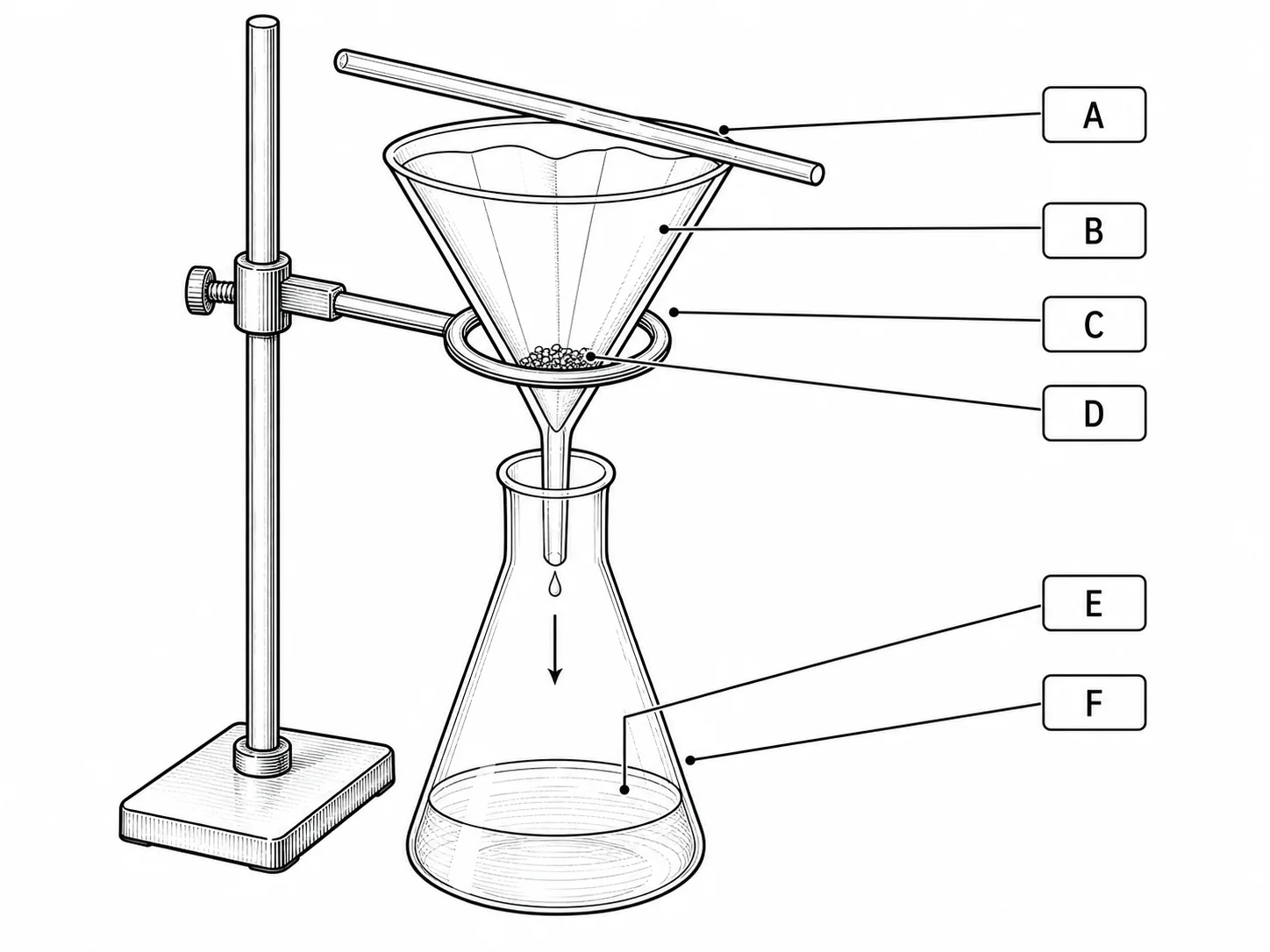
The diagram below shows a standard laboratory filtration setup. Write the correct label for each pointer A–F in the table below the diagram. 6 marks (1 each)
| Pointer | Label |
|---|---|
| A | |
| B | |
| C | |
| D | |
| E | |
| F |
6. Build a concept map
Draw labelled arrows between the six terms below to show how they connect. Each arrow must carry a linking phrase (e.g. “separates”, “produces”, “requires”, “cannot separate”). Aim for at least 6 labelled arrows. 6 marks (1 per valid labelled arrow)
Supplied terms: filtration · crystallisation · insoluble solid · dissolved solid · saturated solution · residue.
Q1 — Term–definition match
1.1 filtration • 1.2 crystallisation • 1.3 residue • 1.4 filtrate • 1.5 saturated solution • 1.6 solubility curve • 1.7 filter paper • 1.8 evaporating basin • 1.9 mother liquor • 1.10 recrystallisation.
Q2 — True / false with correction
2.1 False. Filtration cannot separate dissolved NaCl from solution because the Na+ and Cl− ions are at the molecular level and pass straight through the filter paper with the water. Crystallisation is required instead.
2.2 False. The solid trapped on the filter paper is called the residue. The filtrate is the liquid that passes through.
2.3 True.
2.4 False. Slow cooling produces larger and purer crystals. Rapid cooling traps impurities inside the crystal lattice and yields small, impure crystals.
2.5 True.
2.6 False. Filtration cannot separate two dissolved substances from each other. Both dissolved substances pass through the filter paper with the liquid. Chromatography or other techniques are required.
Q3 — Cloze paragraph
In order: Filtration / insoluble / particle size / residue / dissolved / filtrate / crystallisation / solubility.
Q4.1 — Property that determines filtration suitability
The solid must be insoluble in the liquid. If the solid is dissolved, its particles are at the molecular/ionic level and pass straight through the filter paper with the liquid; filtration cannot collect them.
Q4.2 — Why slow cooling produces better crystals
Slow cooling allows solute particles time to arrange themselves into an ordered crystal lattice. Impurities have different shapes and are excluded from the lattice. Rapid cooling traps impurities inside and produces small, impure crystals.
Q4.3 — Function of the glass rod
The glass rod guides the liquid stream gently down into the funnel so the mixture flows smoothly onto the filter paper without splashing or puncturing it.
Q4.4 — Why crystallisation is also a purification technique
Each crystallisation cycle preferentially incorporates the pure substance into the ordered crystal lattice while impurities remain in the mother liquor. Repeating crystallisation (recrystallisation) progressively reduces impurity levels, making it a purification as well as a separation process.
Q5 — Filtration setup labels
A: Glass rod • B: Filter paper (cone) • C: Funnel • D: Residue (solid retained on filter paper) • E: Filtrate (liquid collected in flask) • F: Conical flask.
Q6 — Sample concept map
Valid arrows include:
- filtration — separates → insoluble solid
- filtration — produces → residue
- filtration — cannot separate → dissolved solid
- crystallisation — separates → dissolved solid
- crystallisation — requires → saturated solution
- saturated solution — forms when → dissolved solid can no longer dissolve
Award 1 mark per valid labelled arrow (maximum 6 marked).