Chemistry • Year 11 • Module 1 • Lesson 2
Properties of Elements, Compounds and Mixtures
Lock in the vocabulary of physical properties, the sharp vs gradual melting point distinction, and the conductivity rules before moving to harder questions.
1. Term–definition match
The definitions below are shuffled. In the right-hand column write the matching term from this list: melting point, boiling point, electrical conductivity, solubility, density, pure substance, mixture, physical property, sharp melting point, melting range. 10 marks (1 each)
| # | Definition | Matching term |
|---|---|---|
| 1.1 | A property that can be measured or observed without changing the chemical identity of the substance. | |
| 1.2 | The temperature at which a solid converts to a liquid; fixed and precise for pure substances. | |
| 1.3 | The temperature at which a liquid converts to a gas; fixed and precise for pure substances. | |
| 1.4 | The ability of a substance to allow electric current to flow through it; requires mobile charged particles. | |
| 1.5 | The maximum mass of solute that dissolves in a given volume of solvent at a specified temperature. | |
| 1.6 | Mass per unit volume, expressed in g cm−³ or g mL−¹; a characteristic value useful for identification. | |
| 1.7 | A substance with a fixed, uniform composition and consistent physical properties throughout. | |
| 1.8 | Two or more substances physically combined; properties depend on the proportions of the components. | |
| 1.9 | A single, precise transition temperature at which an entire sample changes from solid to liquid simultaneously — characteristic of pure substances. | |
| 1.10 | The span of temperatures over which a sample softens and gradually becomes liquid; indicates the presence of a mixture. |
2. True or false — with correction
Circle T or F for each statement. If the statement is false, write the corrected version on the line below it. 12 marks (1 T/F + 1 correction each)
2.1 Pure substances have sharp, fixed melting points because all particles in the sample are identical and require the same amount of energy to change state. T / F
2.2 A substance that melts over the range 45–65°C is most likely a pure element, because the 20°C range is within normal thermometer error. T / F
2.3 Sodium chloride (NaCl) does not conduct electricity as a solid because its ions are locked in a rigid lattice and cannot move. T / F
2.4 The properties of a compound are an average of the properties of its component elements. T / F
2.5 To confirm that an unknown solid is a pure substance, the most reliable single physical test is to measure its melting point and check that it is sharp and fixed. T / F
2.6 Sodium (Na) is a soft, reactive metal; chlorine (Cl&sub2;) is a toxic yellow-green gas; therefore sodium chloride (NaCl) should be reactive and toxic too. T / F
3. Fill-in-the-blank paragraph
Use the word bank to complete the passage. Each word is used once. 8 marks (1 per blank)
Word bank:
characteristic · composition · conductivity · fixed · identical · ions · mixture · range
Physical properties are useful for identifying substances because each pure substance has a set of ___________ values that do not vary from sample to sample. The most reliable test of purity is melting point: a pure substance melts at a single ___________ temperature, because all particles are ___________ and require the same amount of energy to break free from the lattice. A ___________, by contrast, melts over a ___________ of temperatures because its different components interact with each other and require different energies to melt. The exact boiling point of a mixture depends on its ___________ — salt water boils higher than pure water, and the more salt it contains, the higher the boiling point. Metals and ionic solutions conduct electricity because they contain mobile electrons or ___________; the ability to measure electrical ___________ can therefore help classify an unknown substance.
4. Function recall
Answer each question in 1–2 sentences using precise terms from the lesson. 8 marks (2 each)
4.1 Why do chemists require at least two independent physical properties before concluding that an unknown sample is a specific substance?
4.2 What does a flat plateau on a heating curve indicate about the substance being heated?
4.3 Under what conditions does solid NaCl conduct electricity, and why?
4.4 Why can a compound’s properties not be predicted from the properties of its constituent elements?
5. Build a concept map
Draw labelled arrows between the six terms below to show how they connect. Each arrow must carry a linking phrase (e.g. “indicates purity”, “is variable for”, “can be used to identify”). Aim for at least 6 labelled arrows. 6 marks (1 per valid labelled arrow)
Supplied terms: pure substance · mixture · sharp melting point · melting range · physical property · compound.
6. Label the heating curve features
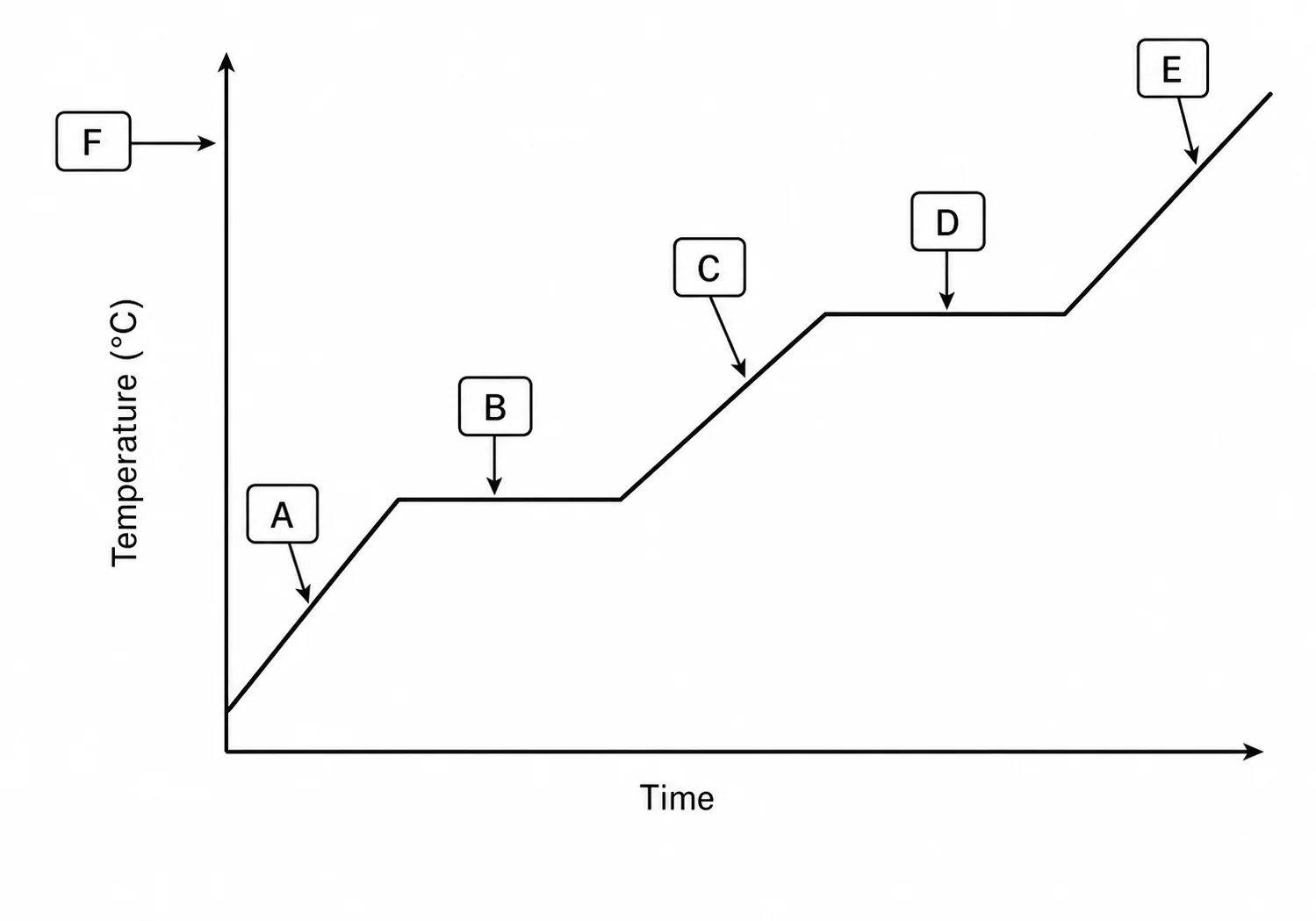
The diagram below shows a heating curve for a pure substance being heated from solid to gas. Label each indicated region or point (A–F) using the terms in the box. 6 marks (1 each)
Terms to use: solid phase · liquid phase · gas phase · melting plateau (fixed MP) · boiling plateau (fixed BP) · temperature axis
| Label | Feature name |
|---|---|
| A | |
| B | |
| C | |
| D | |
| E | |
| F |
Q1 — Term–definition match
1.1 physical property • 1.2 melting point • 1.3 boiling point • 1.4 electrical conductivity • 1.5 solubility • 1.6 density • 1.7 pure substance • 1.8 mixture • 1.9 sharp melting point • 1.10 melting range.
Q2 — True / false with correction
2.1 True. Pure substances melt sharply because every particle is chemically identical; they all gain enough energy to break free of the lattice at precisely the same temperature.
2.2 False. A 20°C melting range is chemical evidence of a mixture, not thermometer error. Thermometer inaccuracy causes a deviation of at most ±1–2°C. A 20°C span means different components in the mixture begin melting at different temperatures.
2.3 True. NaCl ions are fixed in a rigid 3D lattice as a solid. Only when melted (molten NaCl) or dissolved in water do the ions become mobile and able to carry charge.
2.4 False. A compound’s properties are completely different from those of its elements — they are not averages. When Na and Cl&sub2; react, new ionic bonds form between Na&sup+ and Cl&sup− ions in a new lattice structure, producing a substance with entirely new properties.
2.5 True. A sharp, fixed melting point is the single most reliable physical indicator of purity. However, the lesson also recommends confirming with at least two independent properties to be confident.
2.6 False. Compounds do not retain the properties of their elements. NaCl is not reactive or toxic; when Na and Cl&sub2; react, new ionic bonds create a completely new substance with properties that cannot be predicted from the elements.
Q3 — Cloze paragraph
In order: characteristic / fixed / identical / mixture / range / composition / ions / conductivity.
Q4.1 — Two independent properties
No single physical property is conclusive alone — two different substances could coincidentally share the same melting point or the same density. Confirming that at least two independent measured properties (e.g. melting point AND density) match a known substance greatly reduces the chance of a false identification.
Q4.2 — Flat plateau on heating curve
A flat plateau indicates a phase transition (melting or boiling) for a pure substance. At this point, energy input goes into breaking intermolecular forces rather than raising temperature, so the temperature stays constant until the phase change is complete. The existence of a plateau confirms a sharp, fixed transition point — evidence of a pure substance.
Q4.3 — When NaCl conducts
Solid NaCl does not conduct because Na&sup+ and Cl&sup− ions are immobilised in the rigid lattice. NaCl conducts when molten (ions can move in the liquid) or when dissolved in water (ions are free to move through the solution). In both cases, mobile ions carry charge and allow current to flow.
Q4.4 — Compound properties vs element properties
When elements react to form a compound, the chemical reaction creates entirely new bonds between atoms, producing a new internal structure. This new structure determines the compound’s properties. Because the bonding environment in the compound is completely different from that in the individual elements, the compound’s properties are entirely new — not inherited from or predictable from the elements.
Q5 — Sample concept map
Correct maps should include arrows such as:
- pure substance — has a → sharp melting point
- mixture — melts over a → melting range
- compound — is a type of → pure substance
- physical property — is used to identify → pure substance
- sharp melting point — is a → physical property
- mixture — has variable → physical property
Award 1 mark per valid labelled arrow (minimum 6, maximum 6 marked).
Q6 — Heating curve labels
A: solid phase • B: melting plateau (fixed MP) • C: liquid phase • D: boiling plateau (fixed BP) • E: gas phase • F: temperature axis.