Chemistry • Year 11 • Module 1 • Lesson 1
Properties and Classification of Matter
Lock in the six core vocabulary terms, the classification tree, the key distinctions between pure substances and mixtures, and why alloys are not compounds.
1. Term–definition match
The definitions below are shuffled. In the right-hand column write the matching term from this list: pure substance, element, compound, mixture, homogeneous mixture, heterogeneous mixture. 6 marks (1 each)
| # | Definition | Matching term |
|---|---|---|
| 1.1 | Matter with a uniform, definite composition throughout; only one kind of particle present; cannot be separated by physical means. | |
| 1.2 | A pure substance that contains only one type of atom and cannot be broken down into simpler substances by chemical means. | |
| 1.3 | A pure substance formed from two or more elements chemically bonded together in a fixed, definite ratio. | |
| 1.4 | Two or more substances physically combined (not chemically bonded), with variable composition, separable by physical means. | |
| 1.5 | A mixture with uniform composition throughout; only one visible phase; looks the same in all regions of the sample. | |
| 1.6 | A mixture with non-uniform composition; different regions of the sample have visibly different composition or appearance. |
2. True or false — with correction
Circle T or F for each statement. If the statement is false, write the corrected version on the line below it. 12 marks (1 T/F + 1 correction each)
2.1 A homogeneous mixture and a pure substance are the same thing because both look uniform throughout. T / F
2.2 An element contains only one type of atom, so a diatomic molecule such as O2 is still classified as an element. T / F
2.3 Brass (copper + zinc alloy) is a compound because the two metals are chemically bonded in a fixed ratio. T / F
2.4 The defining test for a pure substance is that it has a fixed, definite composition that does not vary from sample to sample. T / F
2.5 Granite (a rock containing visible crystals of quartz, feldspar and mica) is a homogeneous mixture because all rocks look similar. T / F
2.6 A compound always has different properties from the elements it is made of. T / F
3. Fill-in-the-blank paragraph
Use the word bank to complete the passage. Each word is used once. 8 marks (1 per blank)
Word bank:
compound · element · fixed · heterogeneous · homogeneous · mixture · physical · pure substance
All matter is classified as either a ___________, which has a definite and ___________ composition, or a ___________, in which two or more substances are combined without chemical bonds and can be separated by ___________ means. A pure substance that cannot be broken down chemically is called an ___________. If the pure substance contains two or more elements bonded in a fixed ratio, it is a ___________. A mixture that looks the same throughout is called a ___________ mixture, while one with visible distinct regions is called a ___________ mixture.
4. Short recall questions
Answer each question in 1–2 sentences using precise terms from the lesson. 8 marks (2 each)
4.1 What is the key question to ask first when classifying any substance as either a pure substance or a mixture?
4.2 Why are steel and bronze classified as mixtures rather than compounds?
4.3 State one property that a pure substance has but a homogeneous mixture does not, and explain why.
4.4 If a substance has the formula H2SO4, what type of matter is it? Justify using the formula alone.
5. Label the matter classification tree
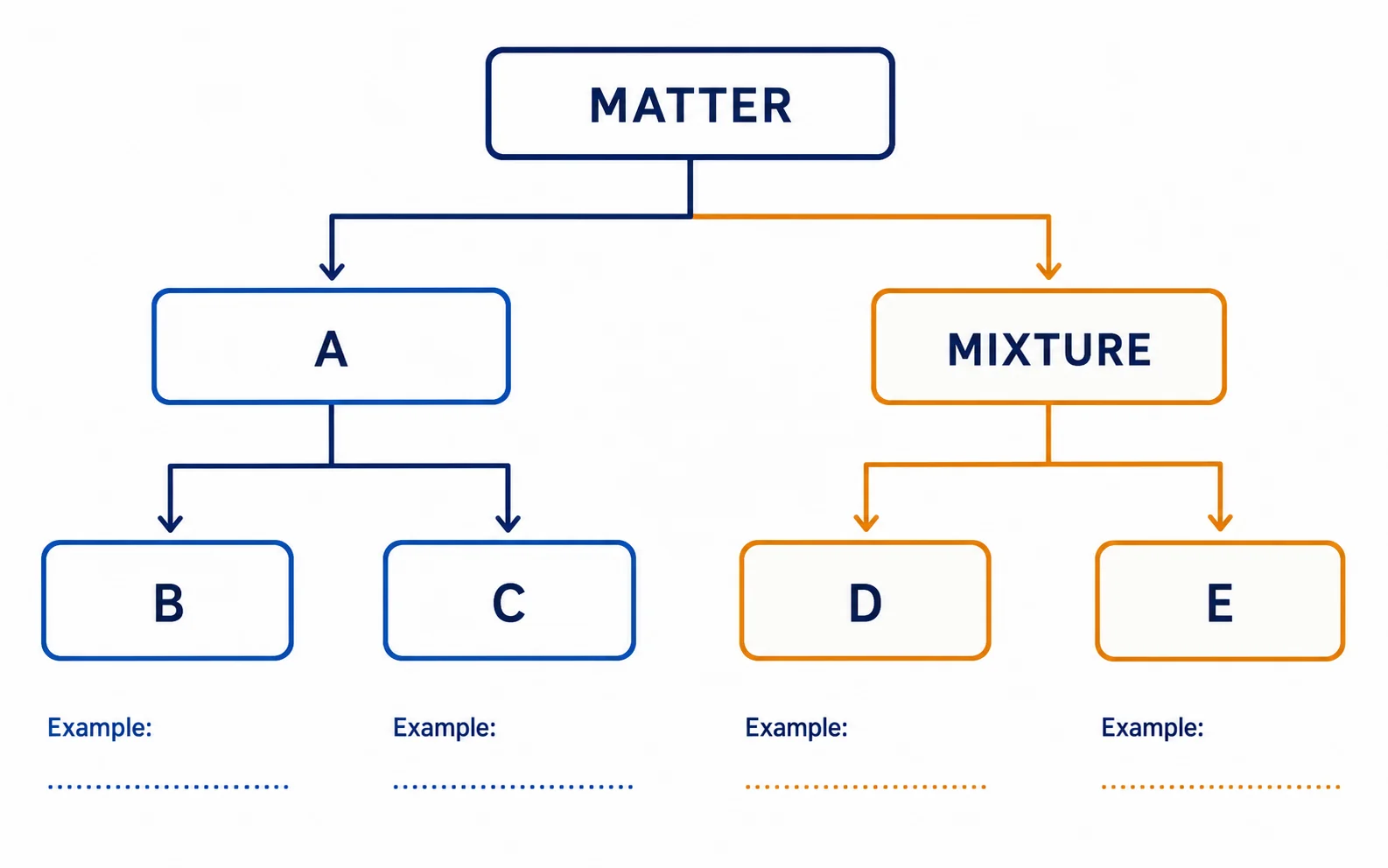
The diagram below shows a classification tree for matter with five empty label boxes A–E. Write the correct classification label in each box, and for boxes B, D and E write one named example. 10 marks (1 label + 1 example where required)
| Box | Classification label | Named example (where required) |
|---|---|---|
| A | n/a — label only | |
| B | ||
| C | ||
| D | ||
| E |
6. Build a concept map
Draw labelled arrows between the six terms below to show how they connect. Each arrow must carry a linking phrase (e.g. “is a type of”, “differs from by”, “can be separated by”). Aim for at least 6 labelled arrows. 6 marks (1 per valid labelled arrow)
Supplied terms: pure substance · element · compound · mixture · homogeneous · heterogeneous.
Q1 — Term–definition match
1.1 pure substance • 1.2 element • 1.3 compound • 1.4 mixture • 1.5 homogeneous mixture • 1.6 heterogeneous mixture.
Q2 — True / false with correction
2.1 False. Although both look uniform, a pure substance has only one type of particle and a fixed composition; a homogeneous mixture contains two or more substances physically combined with variable composition. The key distinction is at the particle level, not the visual appearance.
2.2 True. O2 contains only one type of atom (oxygen); two oxygen atoms bonded together is still an element, not a compound.
2.3 False. Brass is a homogeneous mixture (alloy). The copper and zinc are physically blended with no chemical bonds in a fixed ratio between them. The composition of brass can vary (different grades of brass have different Cu:Zn ratios), confirming it is not a compound.
2.4 True.
2.5 False. Granite is a heterogeneous mixture. Different coloured mineral crystals (quartz, feldspar, mica) are visible as distinct regions throughout the rock, making it non-uniform.
2.6 True. Classic example: sodium (reactive metal) + chlorine (toxic gas) combine to form NaCl (table salt, safe and unreactive), which has completely different properties from either element.
Q3 — Cloze paragraph
In order: pure substance / fixed / mixture / physical / element / compound / homogeneous / heterogeneous.
Q4.1 — First question for classifying
The key question is: “Can this substance be separated by physical means without breaking any chemical bonds?” If yes — it is a mixture. If no — it is a pure substance.
Q4.2 — Why alloys are mixtures not compounds
Steel and bronze are homogeneous mixtures because the component metals are physically blended together — there are no chemical bonds between the different metal atoms in a fixed ratio. The composition of the alloy can vary (e.g. different grades of steel have different carbon percentages), which is a defining feature of mixtures, not compounds.
Q4.3 — Property of pure substance vs homogeneous mixture
A pure substance has sharp, fixed physical constants such as a precise melting point and boiling point. A homogeneous mixture does not; its melting and boiling points vary depending on the concentration of dissolved substances. This is because the composition of a pure substance is always the same, while a mixture’s composition can vary.
Q4.4 — Classifying H2SO4
H2SO4 is a compound. The formula contains three different element symbols (H, S, O) in a fixed ratio (2:1:4), indicating that two or more elements are chemically bonded together in a definite proportion. It is a pure substance because its composition is always the same.
Q5 — Classification tree labels
A: Pure Substance (label only). B: Element — example: any of Fe, Cu, O2, N2, C (diamond/graphite), S8. C: Compound — example: any of H2O, NaCl, CO2, H2SO4. D: Homogeneous mixture — example: salt water, air, brass, vinegar. E: Heterogeneous mixture — example: sand + water, granite, oil + water. Award 1 mark per correct label; 1 mark per valid example for B, D, E.
Q6 — Sample concept map
Valid arrows include:
- pure substance — includes → element
- pure substance — includes → compound
- mixture — can be → homogeneous
- mixture — can be → heterogeneous
- element — differs from compound: has only one atom type → compound
- homogeneous — has uniform composition, unlike → heterogeneous
Award 1 mark per valid labelled arrow with a correct linking phrase. Maximum 6 marks.