Biology • Year 12 • Module 8 • Lesson 20
Kidney Disorders, Dialysis and Transplantation
Lock in the core vocabulary, nephron regions, causes of kidney failure, and the mechanism of dialysis.
1. Label the nephron diagram
The diagram below shows the five regions of a nephron and their sequence. Write the missing labels into boxes A–H. Each label is drawn from the lesson's Key Terms and Card 1. 8 marks
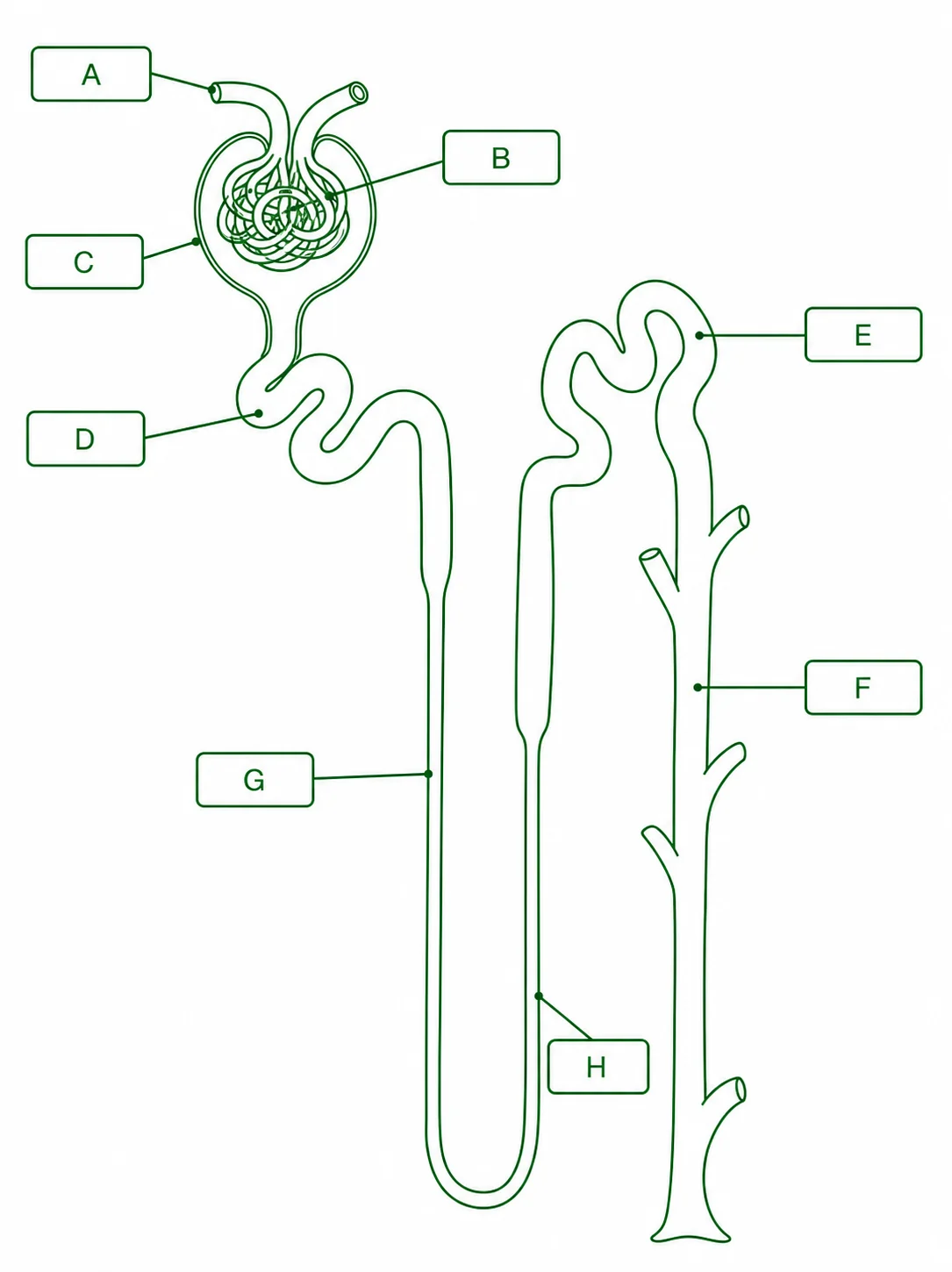
| Box | Your label |
|---|---|
| A | |
| B | |
| C | |
| D | |
| E | |
| F | |
| G | |
| H |
2. Term–definition match
The ten definitions below are shuffled. In the right-hand column write the matching term from this list: nephron, glomerulus, GFR, haemodialysis, peritoneal dialysis, immunosuppressants, PKD, ESRD, dialysate, HLA matching. 10 marks
| # | Definition (shuffled) | Matching term |
|---|---|---|
| 2.1 | The functional unit of the kidney; each human kidney contains approximately one million of these. | |
| 2.2 | A capillary knot inside Bowman's capsule where blood is filtered under hydrostatic pressure. | |
| 2.3 | A measure of how well the kidneys filter blood; expressed in mL/min; used to stage chronic kidney disease. | |
| 2.4 | Filtration of blood through an external machine containing a semi-permeable membrane, typically three times per week. | |
| 2.5 | Dialysis that uses the abdominal lining as the semi-permeable membrane; can be performed at home. | |
| 2.6 | Drugs that reduce immune activity to prevent rejection of a transplanted organ. | |
| 2.7 | An autosomal dominant genetic condition causing fluid-filled cysts that progressively destroy nephron tissue. | |
| 2.8 | The clinical term for kidney failure; GFR falls below 15 mL/min; triggers need for dialysis or transplant. | |
| 2.9 | The fluid used in dialysis, prepared with normal plasma electrolyte levels to establish concentration gradients. | |
| 2.10 | Tissue-typing process that compares human leukocyte antigens between donor and recipient to minimise rejection risk. |
3. True or false, with correction
For each statement, circle T or F. If the statement is false, write the corrected version on the line. 8 marks (1 for T/F, 1 for the correction where needed)
3.1 Diabetes is the leading cause of end-stage renal disease in Australia, accounting for approximately 37% of cases. T / F
3.2 Dialysis cures chronic kidney disease by restoring all kidney functions, including hormone production. T / F
3.3 In haemodialysis, the dialysate flows in the same direction as blood to remove waste solutes. T / F
3.4 During a kidney transplant, the recipient's failed kidneys are usually removed before the donor kidney is implanted. T / F
4. Function recall
Answer each in 1–2 sentences using precise terms from the lesson. 10 marks (2 each)
4.1 What is the function of the glomerulus in nephron filtration?
4.2 What is the role of the semi-permeable membrane in haemodialysis?
4.3 What is the function of immunosuppressant drugs after a kidney transplant?
4.4 What is the function of the proximal convoluted tubule (PCT) in the nephron?
4.5 What is the function of the collecting duct and which hormone regulates it?
5. Fill-in-the-blank paragraph
Complete the passage using words from the word bank. Each word is used once. 8 marks
Word bank: diffusion, concentration gradient, semi-permeable, counter-current, urea, proteins, dialysate, peritoneum
Both haemodialysis and peritoneal dialysis use the principle of ______________ across a ______________ membrane to clean the blood. In haemodialysis, waste solutes such as ______________ move from the blood into the ______________ because the dialysate is kept at low waste-solute concentration, maintaining a ______________. Plasma ______________ and red blood cells are too large to cross the membrane. The dialysate flows in the opposite direction to blood, a ______________ arrangement, so the gradient is maintained along the entire dialyser length. In peritoneal dialysis, the ______________ (abdominal lining) acts as the natural membrane.
Q1, Nephron diagram labels
A: Bowman's capsule. B: Glomerulus (capillary knot where pressure filtration occurs). C: Proximal convoluted tubule (PCT). D: Bulk reabsorption (~65% water, all glucose, most ions reabsorbed). E: Loop of Henle (counter-current multiplier). F: Descending limb (permeable to water, water leaves by osmosis). G: Distal convoluted tubule (DCT), fine-tuning under ADH and aldosterone. H: Collecting duct, final ADH-regulated water reabsorption; concentrated urine produced.
Q2, Term–definition matches
2.1 nephron • 2.2 glomerulus • 2.3 GFR • 2.4 haemodialysis • 2.5 peritoneal dialysis • 2.6 immunosuppressants • 2.7 PKD • 2.8 ESRD • 2.9 dialysate • 2.10 HLA matching.
Q3, True / false with correction
3.1 True. Diabetic nephropathy (damage to glomerular capillaries from chronic hyperglycaemia) is the leading cause of ESRD in Australia at ~37% of cases.
3.2 False. Correction: Dialysis replaces the filtration function of the kidneys but cannot replicate hormone production (erythropoietin, activated Vitamin D) or provide as precise acid-base balance as healthy kidneys. Dialysis manages ESRD but does not cure it.
3.3 False. Correction: The dialysate flows counter-current to blood (in the opposite direction). This maintains the concentration gradient along the entire length of the dialyser, maximising urea removal.
3.4 False. Correction: The recipient's failed kidneys are usually left in place. The donor kidney is implanted in the pelvis (iliac fossa) where surgical connection to the iliac artery and vein is easier.
Q4.1, Function of the glomerulus
The glomerulus is a knot of capillaries inside Bowman's capsule where blood filtration occurs under hydrostatic pressure. Small molecules (water, glucose, urea, ions) are forced from the blood into the Bowman's capsule to form the filtrate; large molecules (plasma proteins) and blood cells remain in the blood.
Q4.2, Role of the semi-permeable membrane in haemodialysis
The semi-permeable membrane allows small waste solutes (urea, excess K&sup+;, creatinine) to diffuse from the blood into the dialysate down their concentration gradients, while retaining larger plasma proteins and blood cells that cannot pass through the pores. It acts as a selective barrier that replicates the filtration function of the glomerulus.
Q4.3, Function of immunosuppressants after transplant
Immunosuppressant drugs (e.g. tacrolimus, mycophenolate, prednisolone) reduce the recipient's immune response to prevent T-cell mediated rejection of the donor kidney. Without them, the immune system recognises the donor organ's foreign HLA antigens and attacks it.
Q4.4, Function of the PCT
The PCT performs bulk reabsorption: approximately 65% of filtered water, all filtered glucose (via Na&sup+;/glucose co-transporters), and most ions are actively reabsorbed back into the surrounding capillaries. This ensures essential nutrients and most water are not lost in urine.
Q4.5, Function of the collecting duct and its hormone
The collecting duct carries the filtrate from the DCT to the renal pelvis and performs final, regulated water reabsorption. Antidiuretic hormone (ADH), released from the posterior pituitary in response to rising blood osmolarity, increases the water permeability of the collecting duct, allowing more water to be reabsorbed and producing concentrated urine.
Q5, Cloze paragraph
1. diffusion • 2. semi-permeable • 3. urea • 4. dialysate • 5. concentration gradient • 6. proteins • 7. counter-current • 8. peritoneum.