Biology • Year 12 • Module 8 • Lesson 19
Visual Disorders, Glasses, Contact Lenses and Eye Surgery
Lock in the key vocabulary, the anatomical causes of refractive errors, and the optical logic of each corrective technology.
1. Label the visual pathway diagram
The diagram below shows a simplified cross-section of the human eye, with labels A–H to be filled in. Each label is drawn from the lesson’s Key Terms and Card 1 content. Write the correct term for each label. 8 marks
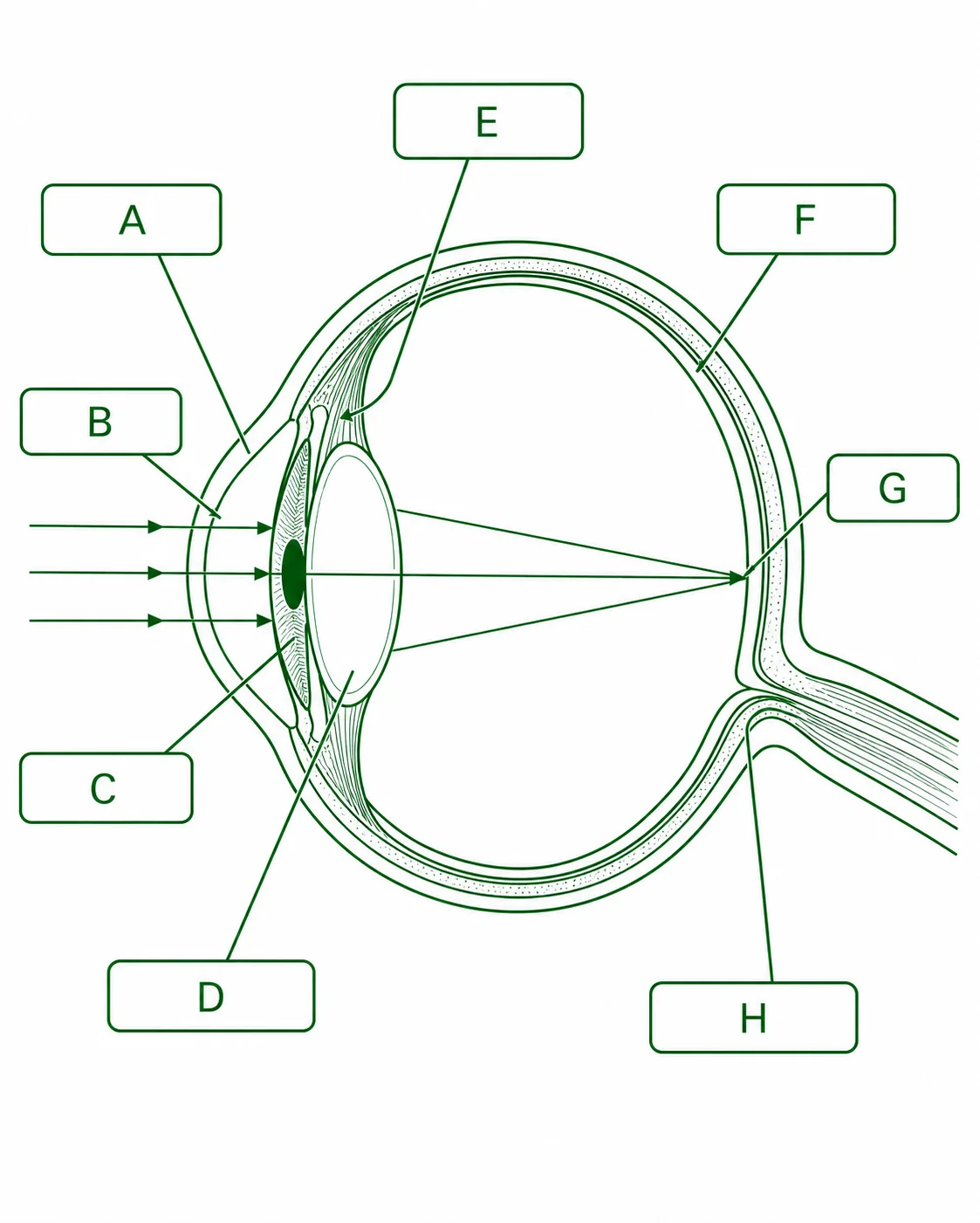
- A, transparent curved front surface; provides ~70% of refractive power _______________________
- B, opening that controls the amount of light entering _______________________
- C, flexible structure that fine-tunes focus; changes shape during accommodation _______________________
- D, clear gel filling the large chamber behind the lens _______________________
- E, light-sensitive layer at the back; contains rods and cones _______________________
- F, region of highest cone density; sharpest central colour vision _______________________
- G, bundle of nerve fibres carrying visual signals to the brain _______________________
- H, ring of muscle that contracts/relaxes to change lens shape (accommodation) _______________________
2. Term–definition match
The ten definitions below are shuffled. In the right-hand column write the matching term from this list: myopia, hyperopia, astigmatism, accommodation, presbyopia, LASIK, concave lens, convex lens, cylindrical lens, fovea. 10 marks
| # | Definition (shuffled) | Matching term |
|---|---|---|
| 2.1 | Short-sightedness; parallel light from distant objects focuses in front of the retina because the eyeball is too long or the cornea too steeply curved. | |
| 2.2 | Long-sightedness; light would focus behind the retina because the eyeball is too short or the cornea too flat. | |
| 2.3 | Irregular corneal curvature that creates multiple focal points across different meridians, causing blurred or distorted vision at all distances. | |
| 2.4 | The ability of the crystalline lens to change shape via ciliary muscle contraction, adjusting focus for objects at different distances. | |
| 2.5 | Age-related hardening of the crystalline lens that reduces its ability to accommodate for near vision; typically begins in the mid-40s. | |
| 2.6 | Laser surgery that creates a corneal flap and uses an excimer laser to permanently reshape the corneal stroma, correcting refractive error. | |
| 2.7 | A diverging lens (negative power) used to correct myopia by spreading light rays, moving the focal point backwards onto the retina. | |
| 2.8 | A converging lens (positive power) used to correct hyperopia or presbyopia by bringing light rays together, moving the focal point forward onto the retina. | |
| 2.9 | A toric lens with different refractive powers in different meridians, used to correct astigmatism. | |
| 2.10 | The small central pit of the retina containing the highest density of cone photoreceptors, responsible for sharp, detailed central vision. |
3. True or false, with correction
Circle T or F. If false, write the corrected statement on the line. 8 marks (1 for T/F, 1 for correction where needed)
3.1 Myopia is caused by the eyeball being too short, so light from distant objects focuses behind the retina. T / F
3.2 A concave (diverging) lens corrects myopia by spreading incoming parallel light rays, moving the focal point backwards onto the retina. T / F
3.3 Presbyopia is caused by the eyeball shortening with age, in the same way as hyperopia. T / F
3.4 LASIK surgery permanently corrects myopia by flattening the central cornea, but it does not prevent presbyopia from developing with age. T / F
4. Function recall
Answer each in 1–2 sentences using precise terms from the lesson. 8 marks (2 each)
4.1 What is the function of the cornea in focusing light, and why does it provide more refractive power than the crystalline lens?
4.2 What is the function of accommodation, and which two structures are directly involved in the process?
4.3 What is the function of a cylindrical (toric) lens that a standard concave or convex lens cannot perform?
4.4 What is the function of the excimer laser in LASIK surgery, and how does removing central corneal tissue correct myopia?
5. Fill the blank, refractive errors and corrections
Fill each blank using a word from the word bank. Each word is used once only. 10 marks (1 each)
Word bank: concave · convex · cylindrical · fovea · presbyopia · myopia · hyperopia · astigmatism · accommodation · axial
5.1 In __________________ (short-sightedness), the eyeball is too long __________________ ly, so parallel light from distant objects converges before reaching the retina.
5.2 The corrective lens for myopia is a __________________ lens, which diverges incoming light to shift the focal point backwards.
5.3 In __________________ (long-sightedness), the focus point for near objects falls behind the retina; a __________________ lens is required to bring it forward.
5.4 Uneven corneal curvature causes __________________, and is corrected by a __________________ lens that provides different refracting power in different meridians.
5.5 Age-related loss of lens elasticity causing difficulty with near focus is called __________________. It is distinct from hyperopia because it results from loss of __________________, not from a change in eyeball length.
5.6 For clear vision, all corrective technologies aim to focus light precisely onto the __________________, the central high-density region of cone photoreceptors.
6. Build a concept map
Draw labelled arrows between the six terms below to show how they are connected. Each arrow must carry a linking phrase. Aim for at least 6 labelled arrows. 6 marks
Supplied terms: myopia · too-long eyeball · focus in front of retina · concave lens · LASIK (flatten centre) · clear distance vision
Q1, Visual pathway labels
A: Cornea. B: Pupil (iris controls size). C: Crystalline lens. D: Vitreous humour. E: Retina. F: Fovea. G: Optic nerve. H: Ciliary muscles.
Q2, Term–definition matches
2.1 myopia • 2.2 hyperopia • 2.3 astigmatism • 2.4 accommodation • 2.5 presbyopia • 2.6 LASIK • 2.7 concave lens • 2.8 convex lens • 2.9 cylindrical lens • 2.10 fovea.
Q3, True / false with correction
3.1 False. Myopia is caused by the eyeball being too long (not too short), so light from distant objects focuses in front of the retina (not behind it).
3.2 True.
3.3 False. Presbyopia is caused by age-related hardening and loss of elasticity of the crystalline lens, not by shortening of the eyeball. The eyeball length is normal in presbyopia; the problem is that the lens can no longer change shape to accommodate for near objects. Hyperopia involves a structurally short eyeball.
3.4 True.
Q4.1, Function of the cornea
The cornea is the transparent curved front surface of the eye; it refracts (bends) incoming light rays and provides approximately 70% of the eye’s total refractive power. It provides more power than the lens because it has a fixed, steeply curved surface in contact with air, the large difference in refractive indices between air and the cornea creates the strongest bending. The crystalline lens, sitting in aqueous and vitreous humour (both of similar refractive index to the lens), can only fine-tune focus.
Q4.2, Function of accommodation
Accommodation is the process by which the eye adjusts its focal length to focus on objects at different distances. When viewing a near object, the ciliary muscles contract, releasing tension on the suspensory ligaments, allowing the elastic crystalline lens to become more convex (curved) and increase its refractive power.
Q4.3, Function of a cylindrical (toric) lens
A cylindrical lens provides different refracting power in different meridians (axes). This corrects astigmatism, where the cornea is more curved in one meridian than another, creating multiple focal points. A standard concave or convex lens applies equal correction in all meridians and therefore cannot compensate for this axis-specific mismatch.
Q4.4, LASIK and myopia correction
An excimer laser (193 nm UV) ablates (vaporises) precise amounts of corneal stroma. For myopia, the laser removes more tissue from the central cornea than the periphery, which flattens the central corneal curvature. A flatter cornea has lower refractive power, it bends incoming parallel light less steeply, moving the focal point of distant light backwards from in front of the retina onto the retina.
Q5, Cloze answers
5.1 myopia; axial. 5.2 concave. 5.3 hyperopia; convex. 5.4 astigmatism; cylindrical. 5.5 presbyopia; accommodation. 5.6 fovea.
Q6, Sample concept map
A correct map should include arrows such as:
- too-long eyeballcauses → myopia
- myopiaresults in → focus in front of retina
- concave lenscorrects myopia by shifting focal point back to → clear distance vision
- LASIK (flatten centre)reduces corneal curvature to restore → clear distance vision
- concave lensdiverges light to move focal point from in front of retina to → focus in front of retina (corrects)
- LASIK (flatten centre)is a permanent surgical correction for → myopia
Award 1 mark per correctly labelled, causally correct arrow. Maximum 6 marks.