Biology • Year 12 • Module 8 • Lesson 17
Prevention, Genetic Engineering, Screening and Emerging Technologies
Lock in the key vocabulary, classification of genetic disorders, inheritance patterns and diagnostic methods covered in this lesson.
1. Label the inheritance-pattern diagram
The diagram below shows a simplified summary of the four main inheritance patterns for single-gene disorders. Write the missing labels A–H into the spaces provided. Each label comes from the lesson's Key Terms or from the inheritance-pattern grid in Card 3. 8 marks
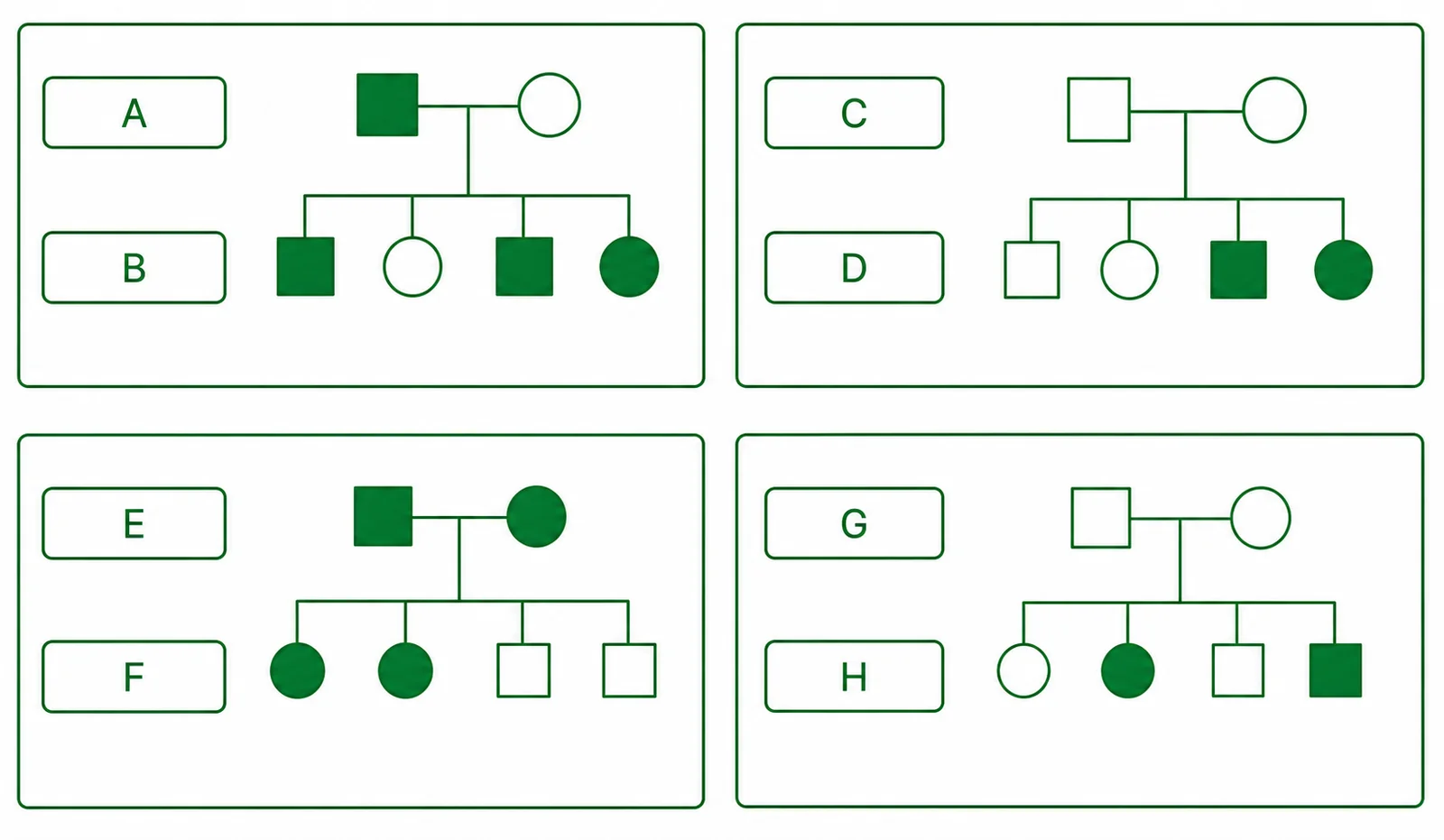
- A, Name of pattern (top-left quadrant): _______________________
- B, Probability an AR couple (both carriers) has an affected child: _______________________
- C, Name of pattern (top-right quadrant): _______________________
- D, Probability an AD parent (heterozygous) passes condition to offspring: _______________________
- E, Name of pattern (bottom-left quadrant): _______________________
- F, Which sex is primarily affected in X-linked recessive disorders and why (one word): _______________________
- G, Name of pattern (bottom-right quadrant): _______________________
- H, Which parent transmits mitochondrial mutations to ALL children: _______________________
2. Term–definition match
Write the correct term next to each definition. Choose from: genetic disorder, chromosomal abnormality, non-disjunction, single-gene disorder, penetrance, carrier, karyotype, NIPT, gene therapy, de novo mutation. 10 marks
| # | Definition | Matching term |
|---|---|---|
| 2.1 | A disease caused by an abnormality in an individual's DNA, either in chromosome number/structure or in a single gene sequence. | |
| 2.2 | Failure of homologous chromosomes or sister chromatids to separate during meiosis, producing aneuploid gametes. | |
| 2.3 | A display of an individual's chromosomes arranged by size and banding pattern, used to detect aneuploidy and structural rearrangements. | |
| 2.4 | An individual carrying one copy of a recessive disease allele who does not show symptoms of the condition. | |
| 2.5 | Non-invasive prenatal testing, analyses cell-free fetal DNA in maternal blood from 10 weeks gestation. A screening, not diagnostic, test. | |
| 2.6 | The proportion of individuals with a given genotype who actually show the associated phenotype. | |
| 2.7 | A disease caused by a mutation in one specific gene that follows a Mendelian inheritance pattern. | |
| 2.8 | A disorder arising from the wrong number or structural rearrangement of chromosomes (e.g. trisomy, monosomy, translocation). | |
| 2.9 | Experimental treatment that introduces, alters or replaces a gene within a patient's cells to treat or prevent disease. | |
| 2.10 | A mutation arising spontaneously during gamete formation or early embryogenesis, not inherited from either parent. |
3. True or false, with correction
Circle T or F. If the statement is false, write the corrected version on the line provided. 10 marks (1 T/F + 1 correction where needed)
3.1 Down syndrome (trisomy 21) is most commonly caused by a dominant mutation in a gene on chromosome 21. T / F
3.2 NIPT is a diagnostic test that definitively confirms whether a fetus has a chromosomal abnormality. T / F
3.3 Carriers of autosomal recessive conditions such as cystic fibrosis are phenotypically normal because their one functional allele produces enough protein to compensate. T / F
3.4 Somatic gene therapy editing corrects mutations in the patient's gametes, so the change is passed to the patient's children. T / F
3.5 Huntington's disease shows anticipation, the CAG repeat tends to expand in successive generations, causing earlier onset and greater severity in offspring. T / F
4. Function recall
Answer each in 1–2 sentences using precise lesson terms. 8 marks (2 each)
4.1 What is the function of amniocentesis in prenatal genetic testing, and how does it differ from NIPT?
4.2 What is the function of the Guthrie card (newborn screening program) and which conditions does it screen for in Australia?
4.3 What is the role of viral vectors in gene therapy, and name one approved gene therapy that uses them?
4.4 What is the function of CRISPR-Cas9 in treating genetic disease, and for which conditions was it first approved in 2023?
5. Fill in the blanks, cystic fibrosis mechanism
Complete the passage using words from the word bank below. Each word is used once. 8 marks
Word bank: CFTR, chloride, delta-F508, misfold, osmosis, mucus, autosomal recessive, chromosome 7
Cystic fibrosis (CF) is a(n) __________________ disorder caused by mutations in the CFTR gene located on __________________. The most common mutation is __________________, which causes the CFTR protein to __________________ and be destroyed before it reaches the cell surface. CFTR normally functions as a __________________ ion channel in epithelial cell membranes. Without functional CFTR, chloride ions cannot exit the cell; water follows by __________________, resulting in abnormally thick __________________ in the lungs, pancreatic ducts and reproductive tract. This ultimately leads to chronic lung infections and pancreatic enzyme deficiency.
6. Build a concept map, genetic disorder classification
Draw labelled arrows between the six terms below to show how they connect. Each arrow must carry a linking phrase. Aim for at least 6 labelled arrows. 6 marks
Supplied terms: non-disjunction · chromosomal abnormality · trisomy 21 · CFTR mutation · single-gene disorder · cystic fibrosis
Q1, Inheritance-pattern labels
A: Autosomal Recessive (AR). B: 25% (1 in 4). C: Autosomal Dominant (AD). D: 50% (1 in 2). E: X-linked Recessive (XLR). F: Males (they have only one X chromosome, so a single recessive allele is sufficient to cause the condition; females need two copies). G: Mitochondrial. H: Mother (mitochondria are inherited via the egg, not sperm).
Q2, Term–definition matches
2.1 genetic disorder • 2.2 non-disjunction • 2.3 karyotype • 2.4 carrier • 2.5 NIPT • 2.6 penetrance • 2.7 single-gene disorder • 2.8 chromosomal abnormality • 2.9 gene therapy • 2.10 de novo mutation.
Q3, True / false with correction
3.1 False. Correction: Down syndrome (trisomy 21) is most commonly caused by non-disjunction during meiosis producing a gamete with an extra chromosome 21; it is a chromosomal abnormality, not a single-gene dominant mutation.
3.2 False. Correction: NIPT is a screening test, it identifies individuals at higher risk but cannot definitively confirm the condition. A positive NIPT result requires follow-up with a diagnostic test such as amniocentesis or CVS.
3.3 True.
3.4 False. Correction: Somatic gene therapy edits non-reproductive body cells only; it does not affect the patient's gametes and therefore the change is not passed to children. Only germline editing (currently banned in most countries) would be heritable.
3.5 True.
Q4.1, Function of amniocentesis vs NIPT
Amniocentesis is a diagnostic test: a needle is inserted into the amniotic fluid (at 15–20 weeks) to obtain fetal cells, which are then karyotyped or analysed by PCR/DNA sequencing to confirm or rule out a specific genetic condition. NIPT is a screening test, it analyses cell-free fetal DNA in maternal blood (from 10 weeks) to identify pregnancies at higher risk of chromosomal abnormalities, but cannot provide a definitive diagnosis and carries no procedural miscarriage risk.
Q4.2, Function of the Guthrie card
The Guthrie card is used in Australia's universal newborn screening program, a dried blood spot is collected from the baby's heel at 48–72 hours after birth and screened for metabolic and endocrine disorders including phenylketonuria (PKU), cystic fibrosis, congenital hypothyroidism and galactosaemia. Early detection allows treatment (e.g. phenylalanine-restricted diet for PKU) before symptoms develop.
Q4.3, Role of viral vectors in gene therapy
Viral vectors (modified adeno-associated viruses [AAV] or lentiviruses) are used to deliver a functional copy of a defective gene into a patient's cells. The virus is stripped of its disease-causing genes but retains its ability to enter cells and integrate or express DNA. Approved examples include Luxturna (AAV carrying the RPE65 gene for a form of inherited blindness) and Zolgensma (AAV carrying SMN1 for spinal muscular atrophy).
Q4.4, Function of CRISPR-Cas9 and first approved conditions
CRISPR-Cas9 acts as molecular scissors guided by a short RNA sequence to cut DNA at a precise genomic location, allowing a gene to be disrupted or corrected. In 2023, Casgevy (exa-cel), the first CRISPR therapy approved globally, was approved for sickle-cell disease and beta-thalassaemia. It works by reactivating fetal haemoglobin production in the patient's own blood stem cells.
Q5, Cloze passage answers (in order)
autosomal recessive → chromosome 7 → delta-F508 → misfold → chloride → osmosis → mucus
(Note: the blank for CFTR in the opening sentence is already provided; the remaining 7 blanks use the seven remaining words.)
Q6, Sample concept map
Acceptable arrows include:
- non-disjunctionproduces → chromosomal abnormality
- chromosomal abnormalityexample is → trisomy 21
- non-disjunctioncan result in → trisomy 21
- CFTR mutationcauses → single-gene disorder
- CFTR mutationspecifically causes → cystic fibrosis
- single-gene disorderexample is → cystic fibrosis
Award 1 mark per biologically correct labelled arrow with causal direction maintained. A maximum of 6 marks.